
Traditional search engine volume is projected to drop 25% by 2026, according to Gartner. As ChatGPT, Google AI Overviews, Perplexity, and other answer engines reshape how buyers discover brands, showing up in AI-generated responses is no longer optional. Generative Engine Optimization (GEO) is the practice of optimizing content so it gets cited by AI models instead of merely ranking in blue links. This guide covers the most effective tool categories, key features to evaluate, and actionable steps you can take today to improve your AI visibility.
Why AI Ranking Matters More Than Ever
AI-referred sessions jumped 527% year-over-year in the first half of 2025, according to Previsible's AI Traffic Report. Meanwhile, 89% of B2B buyers now consider AI search a top source throughout the buying process. These numbers make one thing clear: if your brand is not cited inside AI answers, a growing share of your audience will never see you.
AI visibility is the degree to which a brand appears and is referenced in responses generated by large language models and AI-powered search engines. Unlike traditional SEO, where you optimize for ranked link lists, AI ranking demands structured, fact-dense content that models can extract and cite confidently. Learn more about the difference in our complete guide to AI visibility.
Five Tool Categories That Move the Needle
1. AI Visibility Trackers
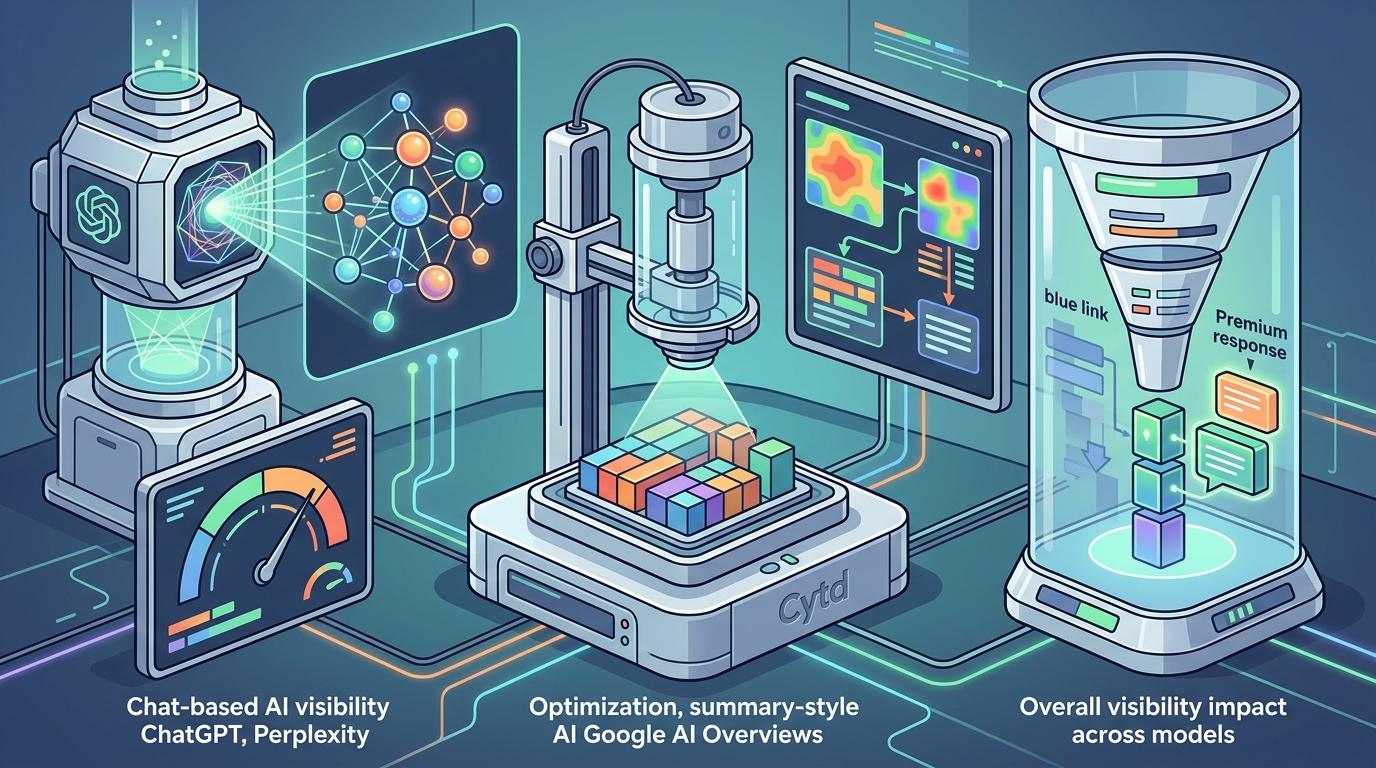
AI visibility trackers are platforms that monitor when and where your brand appears across AI engines like ChatGPT, Gemini, Perplexity, and Google AI Overviews. They provide prompt-level reporting, citation URL mapping, and share-of-voice metrics. Cytd falls squarely in this category, helping brands measure and improve citation visibility across multiple answer engines.
2. Structured Data and Schema Tools
Adding FAQ, Article, Product, and Organization schema helps AI engines interpret your content and improve snippet readiness. Schema markup optimization ensures content is visible not just to Google Search but also to AI-powered discovery layers. Tools like Google's Rich Results Test and Schema.org validators are essential here.
3. Content Optimization Platforms
GEO-focused content tools analyze what AI models currently cite for your target queries, then recommend entity coverage, statistic density, and structural changes. The goal is to make your content the most extractable, authoritative answer. Explore Cytd's content optimization resources for actionable frameworks.
4. Traditional SEO Suites With AI Add-ons
Established SEO platforms have begun adding AI visibility modules. SE Ranking, for example, launched an AI Search Add-on that monitors brand mentions across six AI platforms. These hybrid solutions work well for teams that want AI and traditional SEO reporting in one dashboard.
5. Citation and Entity Monitoring Tools
A citation monitoring tool is software that tracks which specific pages AI engines pull from when they reference your brand. Understanding LLM citation patterns helps you reverse-engineer what makes content citable.
Feature Comparison Table
| Feature | AI Visibility Trackers | Schema Tools | Content Optimization | SEO Suites + AI | Citation Monitors |
|---|---|---|---|---|---|
| Multi-model coverage (ChatGPT, Gemini, Perplexity) | Yes | No | Partial | Partial | Yes |
| Prompt-level reporting | Yes | No | Yes | Limited | Yes |
| Schema validation | No | Yes | Partial | Yes | No |
| Content gap analysis | Partial | No | Yes | Yes | No |
| Traditional rank tracking | No | No | No | Yes | No |
| Citation URL mapping | Yes | No | Partial | Limited | Yes |
Measuring AI Visibility Effectively
You cannot improve what you do not measure. AI visibility measurement starts with tracking how often your brand is mentioned across answer engines, which URLs are cited, and how your share compares to competitors. Cytd provides exactly this kind of intelligence, helping brands understand their AI visibility score and prioritize improvements.
Key metrics to watch include citation frequency, share of recommendations within AI answers, prompt-level win/loss rates, and the freshness of cited content. Research from Seer Interactive found that recently updated content appears 4.3 times more often in AI answers, making content recency a measurable ranking factor.
Content Optimization for Citation
Research published at KDD 2024 by Princeton, Georgia Tech, and IIT Delhi found that GEO techniques can boost visibility in generative engines by up to 40%. The three strongest optimization methods were adding statistics, citing authoritative sources, and including direct quotations.
Structure for Extraction
Place direct answers in the first 40 to 60 words of each section. Maintain fact density with a statistic or data point every 150 to 200 words. Use H2 and H3 question headers, because optimizing these increases the chance an AI will extract that text as an answer.
Build Authority Signals
Content with specific statistics, expert quotes, and clear sources gets cited more frequently. Backlinks still matter in AI citation, but the overlap between top Google-ranked pages and AI-cited sources has dropped from 70% to below 20%, according to Brandlight research. Learn how backlinks influence AI citations in our dedicated analysis.
Keep Content Fresh
85% of AI Overview citations were published within the last two years. A regular content refresh cycle is not optional if you want to remain visible. Review the state of AI search to benchmark your current position.
Key Takeaways
- AI-referred traffic grew 527% YoY in early 2025, making AI visibility a revenue-critical channel.
- GEO techniques (statistics, citations, quotations) can boost AI visibility by up to 40%.
- Only 6.82% of ChatGPT results appear in Google's top 10, proving AI ranking is a separate discipline.
- AI visibility trackers like Cytd let you measure citation share across ChatGPT, Google AI, Grok, and more.
- Structured data and schema markup remain foundational for AI snippet readiness.
- Recently updated content appears 4.3x more often in AI answers than older material.
- The GEO services market is projected to reach $17 billion by 2034, growing at 45.5% CAGR.
Frequently Asked Questions
What is an AI ranking tool?
An AI ranking tool is software that tracks and helps improve how your brand appears in AI-generated answers from platforms like ChatGPT, Google AI Overviews, and Perplexity. Unlike traditional rank trackers that monitor blue-link positions, these tools focus on citation visibility within conversational responses.
How is GEO different from SEO?
Generative Engine Optimization focuses on getting cited by AI systems, while traditional SEO focuses on ranking in link-based search results. GEO prioritizes content depth, structured data, original statistics, and third-party brand mentions over conventional authority metrics like domain rating.
What types of content get cited most by AI?
Comparison articles lead all content types with 32.5% of AI citations, followed by opinion pieces at 10%. Best-of content, product pages, and guides also drive significant AI referral traffic.
Do backlinks still matter for AI visibility?
Backlinks remain a signal, but their importance has shifted. The overlap between top-ranked Google pages and AI-cited sources has dropped below 20%, meaning AI models weigh content quality, freshness, and entity relevance more heavily than link profiles.
How do I measure my AI visibility?
Use a dedicated AI visibility platform like Cytd to track citation frequency, share of recommendations, and prompt-level performance across multiple AI engines. These metrics give you a clear picture of where you stand.
How often should I update content for AI ranking?
At minimum, refresh key pages every three to six months. Research shows 85% of AI Overview citations come from content published within the last two years, and recently updated pages appear 4.3 times more often in AI answers.
Is AI visibility only relevant for B2B companies?
No. While B2B SaaS sites have seen rapid AI traffic growth, any brand that depends on search discovery benefits from AI visibility. ChatGPT alone had over 900 million weekly active users by early 2026.
What is the fastest way to start improving AI ranking?
Start by auditing your current AI visibility with a tool like Cytd, then focus on adding structured data, increasing fact density in your top pages, and refreshing outdated content. Visit our getting started guide for a step-by-step walkthrough.
Get Started With AI Visibility
The shift to AI-powered discovery is accelerating. Every week you wait, competitors are capturing the citation share your brand could own. Book a setup call with Cytd to measure your current AI visibility, identify gaps, and build a plan that puts your brand in front of the audiences that matter most.