
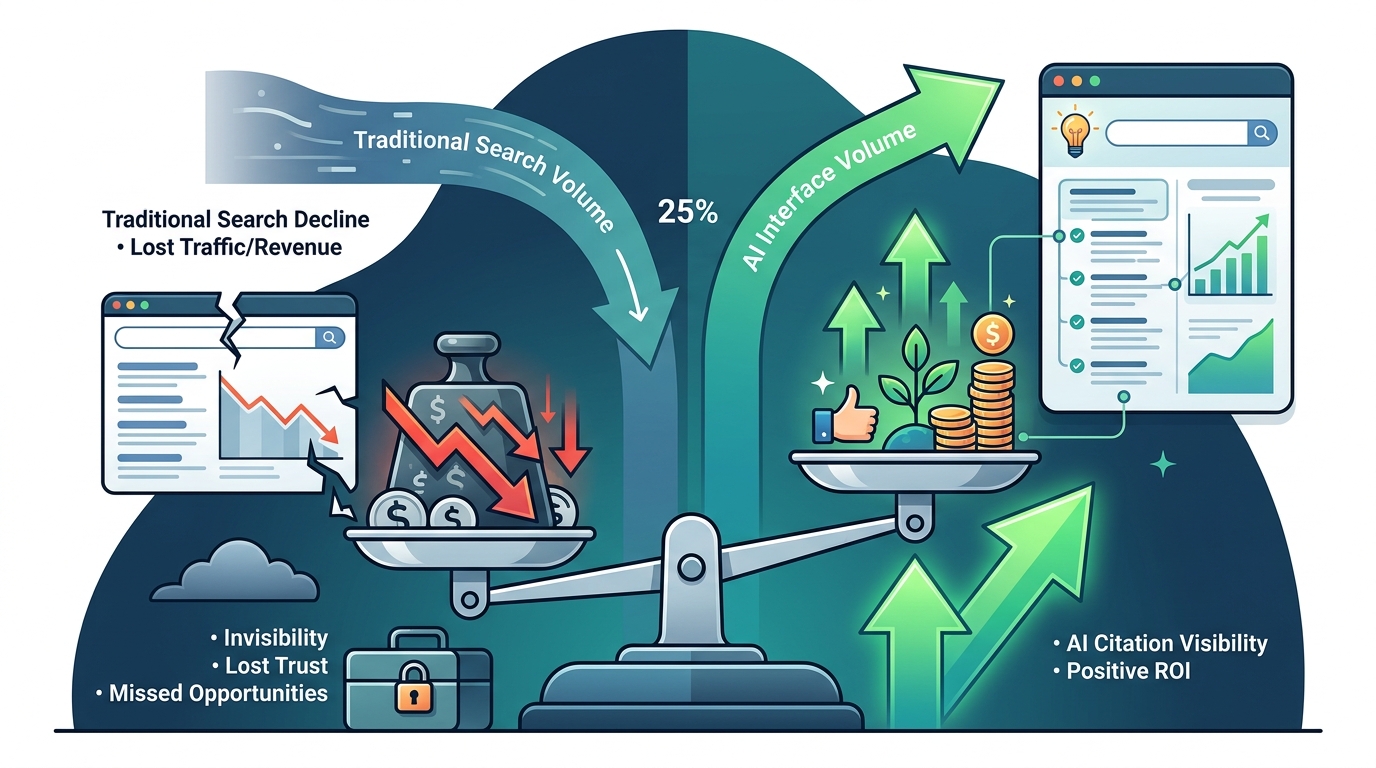
Search behavior has undergone a permanent structural shift in 2026, with 25 percent of traditional search volume already migrating toward AI-driven interfaces. This migration means that the traditional metrics of click-through rates are no longer the sole indicator of business health. Instead, the critical metric is visibility within generative AI responses. For businesses, the cost of invisibility is not just lost traffic, but lost trust and revenue in the moments that matter most. Understanding the return on investment for AI citation tracking tools is now a financial imperative, not just a technical curiosity. (We Put Your Business)
The New ROI Metric: Visibility Over Clicks
Traditional Search Engine Optimization (SEO) focused on ranking for human clicks. However, a new paradigm is emerging where algorithms directly answer user queries. In this environment, ROI is calculated by how often your brand is cited as a primary recommendation by AI models like ChatGPT, Gemini, and Perplexity. If your business is not mentioned, it does not exist in the buyer's consideration set. (Partner with Cytd ai)
The cost of acquiring a customer through AI recommendations is significantly lower than through traditional paid advertising. This is because AI citations act as automated, high-trust endorsements. When a buyer asks an AI assistant for a service provider, the AI's recommendation carries the weight of a peer review. Capturing this moment requires precise tracking of your digital footprint across these platforms.
According to recent industry data, businesses that fail to optimize for AI visibility lose an average of 30 percent of their potential inbound leads to competitors who are actively managed in these spaces. This statistic highlights the urgent need for a robust cost-benefit analysis of AI citation tracking tools. The investment is no longer optional for growth-oriented companies.
Cost-Benefit Analysis: Building vs. Buying
When evaluating the financial impact of AI citation tracking, businesses must compare the cost of proprietary development against subscription-based solutions. Building an in-house system to monitor AI responses across multiple large language models requires significant engineering resources. This includes natural language processing expertise, continuous API management, and complex data aggregation pipelines.
The operational cost of maintaining such a system often exceeds $10,000 per month in salaries and infrastructure alone. In contrast, specialized platforms offer enterprise-grade monitoring for a fraction of that cost. This comparison reveals that buying is almost always the more efficient path for small to mid-sized businesses.
Furthermore, the benefit of using a dedicated tool extends beyond cost savings. These platforms provide actionable insights that raw data cannot. They translate complex AI behavior into clear, strategic directives. For example, they can identify exactly which keywords are triggering competitor citations and suggest specific content adjustments to reclaim that visibility. This strategic advantage is difficult to replicate internally.
According to a 2026 analysis of digital marketing expenditures, companies that switched from manual AI monitoring to automated platforms saw a 40 percent reduction in time spent on visibility management. This time savings allows marketing teams to focus on high-impact creative strategies rather than data collection.
Measuring Success with the Cytd Score
To accurately calculate ROI, you need a standardized metric. The Cytd Score provides this by evaluating three core pillars: Visibility, Authority, and Coverage. Visibility measures how often your brand appears in AI responses. Authority assesses the trust signals associated with your brand. Coverage evaluates the breadth of your presence across different AI platforms.
A low Cytd Score indicates a significant gap in your AI presence. Most clients start showing up in AI answers within 40 to 60 days of implementing a structured optimization strategy. This timeline is crucial for financial planning. It means that the ROI of these tools is not immediate but follows a predictable growth curve.
By tracking the movement of your Cytd Score over time, you can correlate improvements in visibility with increases in qualified leads. This direct link between metric and revenue makes the cost-benefit analysis straightforward. A rising score is a leading indicator of future business growth.
For more details on how to interpret your specific score, you can get your free Cytd Score today. This initial assessment provides a baseline for measuring the effectiveness of your investment.
The Hidden Costs of AI Invisibility
The most significant cost in AI citation tracking is not the tool itself, but the opportunity cost of inaction. When AI models recommend competitors, those competitors capture the entire customer journey. This includes the initial inquiry, the trust-building phase, and the final conversion.
Consider the lifetime value of a single customer. For many service-based businesses, this value ranges from $5,000 to $50,000. Losing even one customer to an AI-recommended competitor due to poor visibility represents a massive financial loss. The cost of the tracking tool is negligible compared to this potential loss.
Additionally, AI invisibility damages brand authority over time. If customers consistently see other brands recommended by their AI assistants, they begin to perceive those brands as the market leaders. Reversing this perception is far more expensive than maintaining visibility in the first place. Proactive tracking prevents this erosion of brand equity.
According to market research, businesses that ignore AI visibility trends risk a 20 percent decline in brand recognition within two years. This decline is difficult to quantify in immediate dollars but has profound long-term implications for market share.
Tool Comparison: Features and Pricing
Not all AI citation tracking tools offer the same value. Some provide basic monitoring, while others offer full-service optimization. Understanding these differences is key to making a cost-effective decision. The table below compares the primary options available in the market.
| Feature | Cytd.ai | Generic SEO Tools | Custom In-House Build |
|---|---|---|---|
| AI Platform Coverage | ChatGPT, Gemini, Siri, Perplexity | Limited or None | Depends on Engineering |
| Optimization Service | Full-Service Management | Data Only | Data Only |
| Cost Structure | Subscription ($299/mo) | High Monthly Fees | $10k+ Monthly Ops |
| Reporting | Cytd Score & Video Walkthroughs | Complex Dashboards | Manual Reports |
| Implementation Time | 15-Minute Onboarding | Days to Weeks | Months |
As shown in the comparison, Cytd.ai offers a unique value proposition by combining tracking with active optimization. This dual approach ensures that the data collected leads to tangible improvements in visibility. For businesses seeking a comprehensive solution, exploring the full feature set is recommended.
Key Takeaways
- 25 percent of traditional search volume has already shifted to AI-driven interfaces in 2026.
- The cost of in-house AI monitoring often exceeds $10,000 per month in operational expenses.
- Cytd.ai offers a subscription model starting at $299 per month for full-service management.
- Most clients begin seeing improvements in AI visibility within 40 to 60 days of starting.
- The Cytd Score evaluates Visibility, Authority, and Coverage to provide a clear ROI metric.
- Businesses that ignore AI visibility risk a 20 percent decline in brand recognition over two years.
- AI citations act as high-trust endorsements, significantly lowering customer acquisition costs.
Frequently Asked Questions
How is ROI calculated for AI citation tracking?
ROI is calculated by comparing the cost of the tracking tool against the value of increased qualified leads generated from AI recommendations. This includes tracking the increase in your Cytd Score and correlating it with new customer acquisitions.
What is the average cost of AI visibility management?
While in-house development can cost over $10,000 monthly, specialized platforms like Cytd.ai offer comprehensive management for approximately $299 per month. This includes monitoring, optimization, and reporting.
How long does it take to see results from AI citation tracking?
Most clients start showing up in AI answers within 40 to 60 days. This timeline allows for the accumulation of trust signals and the correction of visibility gaps.
Which AI platforms are most important to track?
The most critical platforms are ChatGPT, Gemini, Siri, and Perplexity. These tools handle the majority of consumer and business queries in 2026.
Can I track AI visibility without a subscription tool?
While manual checking is possible, it is not scalable or accurate. Automated tools provide the necessary depth of data to make informed financial decisions.
What is the Cytd Score?
The Cytd Score is a proprietary metric that evaluates your brand's Visibility, Authority, and Coverage across major AI platforms. It serves as a single indicator of your AI health.
Is AI citation tracking only for large enterprises?
No, it is essential for local businesses and small to mid-sized companies. These businesses are often the most invisible to AI and stand to gain the most from optimization.
Start Your AI Visibility Journey
The cost of doing nothing is far greater than the investment in AI citation tracking. Secure your brand's future by ensuring you are the recommended answer when buyers ask for help. Get started with Cytd.ai today and reclaim your place in the AI conversation.