
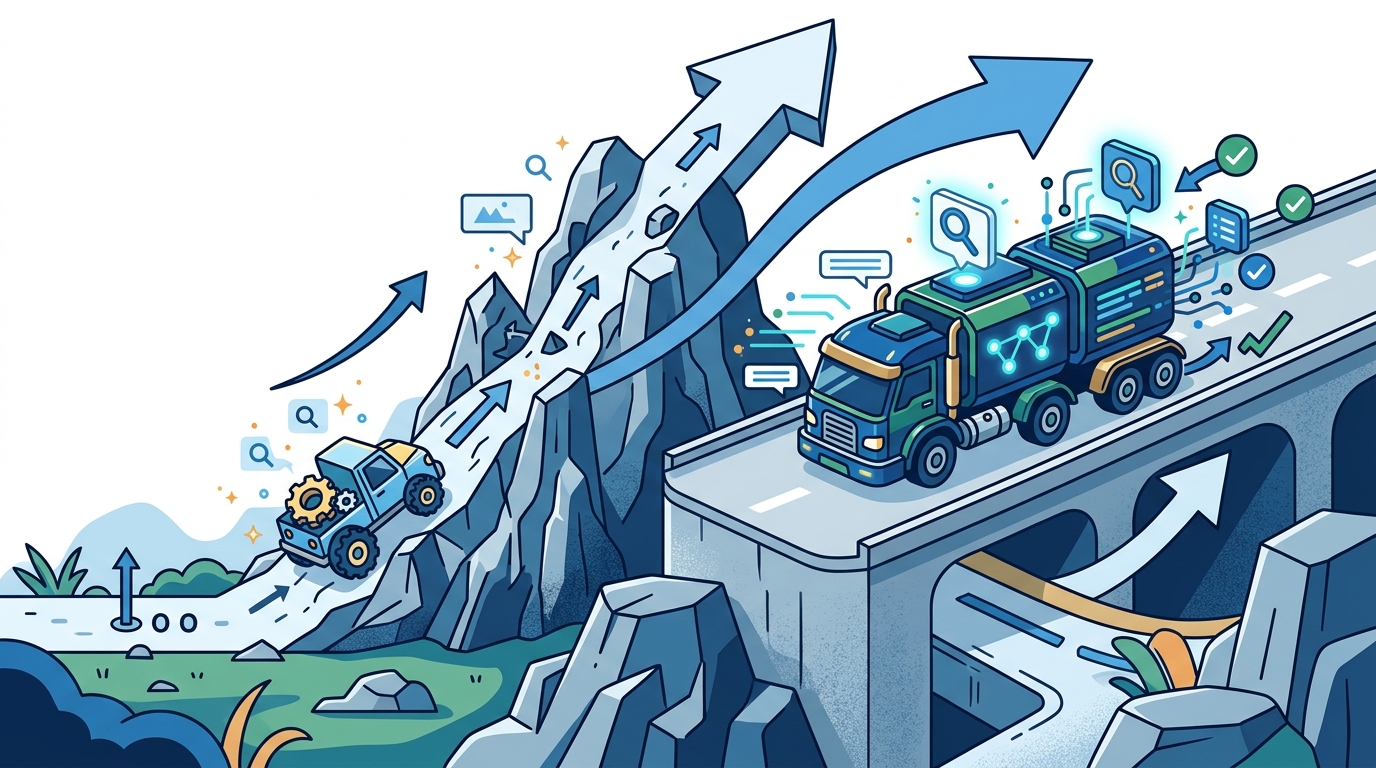
AI search traffic shifts differently for small businesses and enterprise companies because of distinct visibility baselines. Small businesses often start with near-zero AI citations, while enterprises already hold significant digital authority. This gap means small businesses face a steeper initial climb to appear in AI answers, whereas enterprises focus on maintaining their existing dominance across multiple AI platforms.
The Visibility Baseline Gap
Enterprise companies typically possess extensive digital footprints, including thousands of backlinks and high domain authority. This existing authority often translates into immediate recognition by large language models. In contrast, small businesses frequently lack the historical data signals that AI engines use to validate credibility. The result is a significant starting disparity in how AI systems perceive and recommend these two business types.
Question Intent and Local Relevance
Small businesses benefit from highly specific, local question intents that enterprise competitors cannot easily replicate. For example, a local gym in Denver can own the query for small-group coaching in that specific city. Enterprise brands, however, must compete on broader, category-level questions. This difference in question granularity creates distinct traffic patterns, with local businesses capturing high-intent, low-volume searches that drive immediate conversions.
Content Strategy Divergence
Enterprise content strategies often prioritize broad topical authority and brand awareness. They produce high-volume content that covers many aspects of their industry. Small businesses, however, must focus on deep, niche expertise to earn citations. By answering specific questions with precision, small businesses can outperform larger competitors in narrow AI answer spaces. This targeted approach allows them to build a defensible position in the AI answer layer.
Measurement and Tracking Challenges
Tracking AI search traffic presents unique challenges for both business types, but the scale differs. Enterprises have the resources to implement complex attribution models and custom tracking scripts. Small businesses often rely on simpler metrics, such as direct brand searches and referral traffic from AI platforms. Understanding these differences is crucial for setting realistic expectations and measuring the true impact of AI visibility efforts.
Key Takeaways
- Small businesses start with lower AI visibility but can achieve rapid gains in niche areas.
- Enterprise companies leverage existing digital authority to maintain broad AI presence.
- Local, specific questions offer a strategic advantage for small businesses.
- Content depth and precision matter more than volume for small business AI citations.
- Tracking AI traffic requires different approaches for small versus large organizations.
- Both business types must adapt their strategies to the unique mechanics of AI search.
Frequently Asked Questions
Do small businesses have a disadvantage in AI search?
Small businesses start with a lower visibility baseline, but they can overcome this by focusing on niche, local questions where they can provide precise, authoritative answers.
How do enterprises maintain their AI search presence?
Enterprises maintain their presence through extensive digital footprints, high domain authority, and broad content strategies that cover multiple aspects of their industry.
What is the biggest advantage for small businesses in AI search?
The biggest advantage is the ability to own specific, local, or niche questions that larger competitors cannot easily address with the same level of precision and relevance.
How should small businesses track AI search traffic?
Small businesses should track direct brand searches, referral traffic from AI platforms, and specific question performance to measure the impact of their AI visibility efforts.
Can small businesses outperform enterprises in AI search?
Yes, small businesses can outperform enterprises in specific, niche areas by providing more precise and relevant answers to targeted questions. Learn more: Cytd We make AI.