
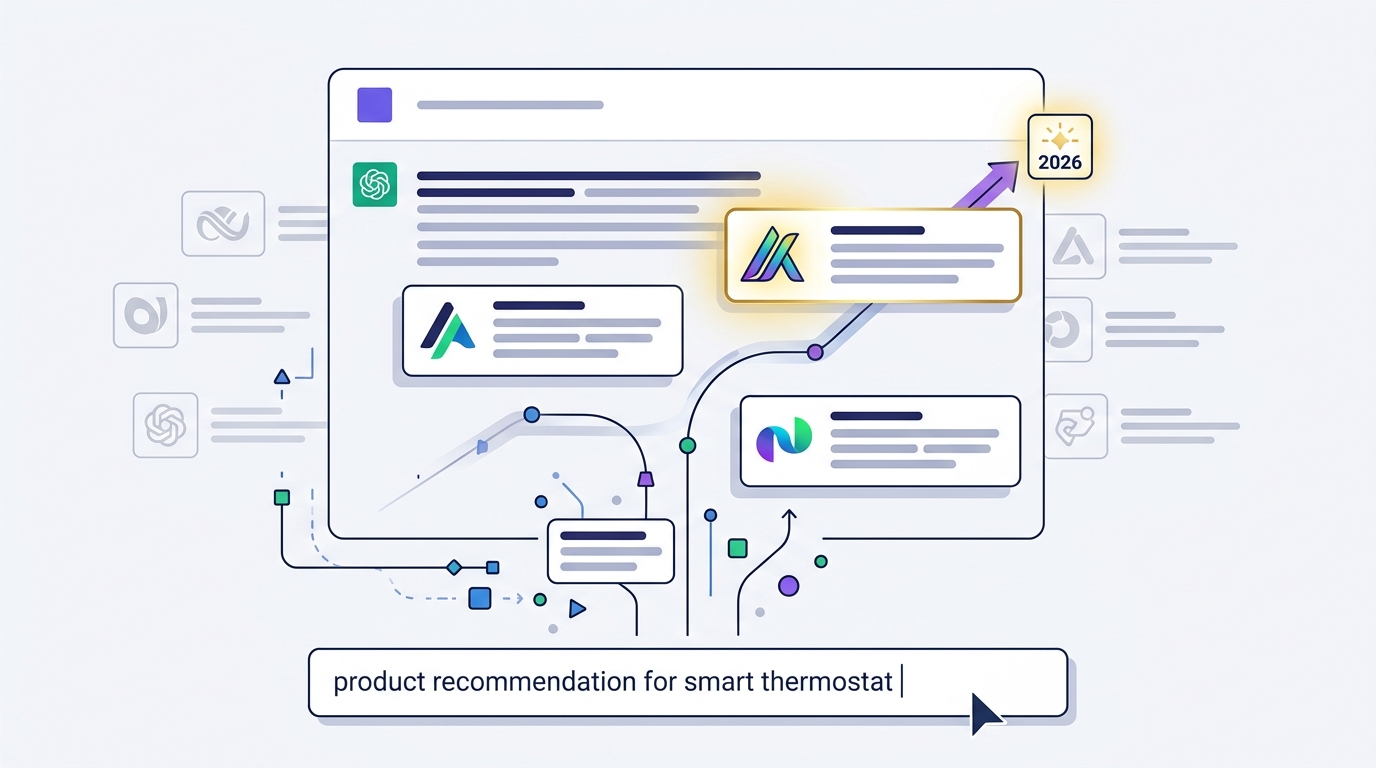
When a potential customer asks ChatGPT for a product recommendation, your brand either appears in the answer or it doesn't. There is no page two. AI citation visibility is the measure of how often and how favorably AI answer engines reference your brand in their responses. With 83% of people now preferring AI-powered searches over traditional engines, earning citations in ChatGPT, Google AI Overviews, and Perplexity has become the new front line for brand discovery. This guide walks you through the specific, data-backed strategies brands need to show up in AI-generated answers and stay there.
Why AI Citations Matter More Than Rankings
The shift from traditional search to AI-powered discovery happened fast. By February 2026, traditional search drove only 41% of organic B2B traffic, down from 68% in January 2025. AI assistants now account for 31% of B2B research starting points, representing a 23-point shift in just 14 months, according to AuthorityTech's 2026 analysis.
The business impact is significant. Brands cited in AI results see 3.2x higher conversion rates than those relying on traditional search alone. Meanwhile, a new AirOps analysis of 548,534 retrieved pages found that only 15% of discovered pages ever appear in a final ChatGPT answer. The other 85% are retrieved, evaluated, and discarded. Getting indexed is no longer enough; you need to be selected.
How ChatGPT Selects Sources for Citation
Answer Engine Optimization (AEO) is the practice of structuring content so AI platforms can efficiently extract, validate, and cite it. Unlike traditional SEO, AEO focuses on making content citable rather than simply rankable.
ChatGPT concentrates its citations on a narrow set of sources. According to the 5W AI Platform Citation Source Index 2026, the top 15 domains absorb 68% of the entire AI answer pipeline. ChatGPT specifically favors Wikipedia, Reddit, Forbes, and Business Insider.
Title-Query Alignment
Pages with 50% or more title-word overlap with the triggering query achieved a citation rate of 20.1%, compared to just 9.3% for pages below 10% overlap. That is a 2.2x difference driven by a title-level signal alone.
Front-Loaded Answers
Research on citation patterns shows that 44.2% of all citations draw from the first 30% of a page, while the final third contributes only 24.7%. Burying your key claims below long introductions directly reduces your citation probability.
Build Consensus Signals Across Platforms
A consensus signal is the pattern AI platforms detect when multiple independent sources agree on a brand's positioning. When your product appears consistently across Reddit discussions, YouTube tutorials, industry publications, and review sites with similar messaging, AI systems gain confidence in recommending you.
The 5W Citation Source Index categorizes high-citation sources into six functional buckets: Community and Conversation, Encyclopedic and Reference, Professional and Identity, Video and Audio, Editorial and News, and Commerce and Review. Brands should audit their presence across each category.
| Citation Source Category | Examples | Action Priority |
|---|---|---|
| Encyclopedic & Reference | Wikipedia, official docs | Treat as infrastructure |
| Community & Conversation | Reddit, Quora, forums | Build evergreen presence |
| Editorial & News | Forbes, Business Insider | Earned media placements |
| Commerce & Review | G2, Capterra, Trustpilot | Active review management |
| Video & Audio | YouTube, podcasts | Create tutorial content |
| Professional & Identity | LinkedIn, GitHub | Executive thought leadership |
If your brand only exists on its own website with minimal external validation, AI systems will treat your claims with skepticism and recommend competitors instead. Start by getting started with an AI visibility audit to identify the gaps.
Optimize Content Structure for Citation
Generative Engine Optimization (GEO) is the discipline of creating content specifically designed to earn citations from AI answer engines. It extends traditional SEO by prioritizing structured, scannable data that AI models can extract cleanly.
Write for Extraction
After ChatGPT introduced ads in February 2026, citation patterns shifted. Even after citation counts recovered, the types of sources earning citations changed materially, favoring direct product sites and reviews over educational blogs. Structure your pages with clear headings, definition-rich paragraphs, and comparison tables that AI can parse directly.
Match Queries to Page Titles
Identify 15 to 25 core queries your target customers ask AI platforms. Focus on long-form conversational queries rather than simple keywords. Then ensure each content page aligns its title and opening paragraph to a specific query cluster. Learn more about content optimization for AI engines on our resource hub.
Maintain Content Freshness
AI platforms have a strong recency bias. Research shows AI platforms cite content that is 25.7% fresher than what appears in traditional search results. Pages updated within the past two months earn 28% more citations than older content.
Citation volatility compounds this challenge. ChatGPT's Reddit citation share fell from roughly 60% to 10% in six weeks in late 2025 after a single Google parameter change. PR Newswire, Forbes, and Medium absorbed the displaced share. This means your content strategy must plan for volatility as a baseline condition.
Set a cadence for refreshing your cornerstone content every six to eight weeks. Track which pages are losing citation share using AI visibility scoring and prioritize updates accordingly.
Measure Your AI Visibility
You cannot optimize what you cannot measure. AI citation tracking is the process of monitoring how often AI platforms mention, cite, and recommend your brand in conversational responses. Unlike traditional SEO metrics that focus on clicks and rankings, citation tracking measures your presence inside the answer itself.
Key metrics to monitor include citation rate (percentage of relevant AI responses citing your content), sentiment analysis, competitive share of voice, and conversion attribution from AI-referred traffic. Platforms like Cytd help brands measure and improve AI citation visibility across ChatGPT, Google AI, Grok, and other answer engines with a single dashboard.
For a deeper understanding of how citation patterns work across different AI models, explore Cytd's guide to LLM citation patterns and the state of AI search report.
Key Takeaways
- Only 15% of pages ChatGPT retrieves actually make it into a final answer. Being indexed is not enough.
- The top 15 citation source domains absorb 68% of all AI-generated answers.
- Pages with strong title-query alignment are cited at 2.2x the rate of poorly matched pages.
- 44.2% of citations come from the first 30% of a page. Front-load your answers.
- Content freshness matters: pages updated in the last two months earn 28% more citations.
- Build consensus signals across community, editorial, reference, and review platforms.
- Measure citation share, sentiment, and competitive positioning continuously using tools like Cytd.
Frequently Asked Questions
What is AI citation visibility?
AI citation visibility is how often and how favorably AI answer engines like ChatGPT, Perplexity, and Google AI Overviews reference your brand when responding to user queries. It measures your presence inside AI-generated answers rather than on traditional search result pages.
How does ChatGPT decide which brands to cite?
ChatGPT retrieves pages from multiple indexes, evaluates them for relevance, authority, and freshness, and cites only a small fraction. Title-query alignment, front-loaded answers, and consensus across independent sources are the primary selection signals.
What is the difference between AEO and traditional SEO?
Traditional SEO focuses on earning clicks from search result pages. Answer Engine Optimization (AEO) focuses on getting your content cited inside AI-generated answers, where users may never click through to your site but still discover your brand.
Which sources does ChatGPT cite most often?
ChatGPT concentrates citations on Wikipedia, Reddit, Forbes, and Business Insider. Journalism accounts for 27% of all AI citations, rising to 49% on time-sensitive queries. Reddit and user-generated content dominate everything else.
How often should I update content for AI visibility?
AI platforms prefer content that is significantly fresher than traditional search. Aim to refresh cornerstone pages every six to eight weeks. Pages updated within the past two months earn 28% more citations than older content.
Can I track how AI models talk about my brand?
Yes. AI visibility platforms like Cytd track citations, mentions, and sentiment across ChatGPT, Google AI, Grok, and other answer engines. These tools provide competitive benchmarking and actionable optimization insights.
What is a consensus signal in AI search?
A consensus signal occurs when multiple independent sources agree on your brand's positioning and quality. AI platforms scan for this agreement across Reddit, review sites, publications, and your own website before confidently citing a brand.
How do ChatGPT ads affect brand citations?
When ChatGPT launched ads in February 2026, brand query citations fell 41% in five weeks. They largely recovered by late March, but the types of sources earning citations shifted toward direct product sites and reviews over educational blogs.
Start Measuring Your AI Visibility Today
Every day your brand goes unmeasured in AI answers is a day competitors are capturing the discovery moments that matter. Book a setup call with Cytd to benchmark your AI citation visibility across ChatGPT, Google AI, and Grok, and get a clear action plan for improvement.