
The best strategy for getting your insurance agency cited in AI-powered search results is to build a structured, question-first content library that directly answers the specific queries your clients ask. You must optimize your website for machine readability and establish topical authority across your niche. This approach ensures that large language models can easily extract and recommend your brand when users seek insurance advice.
Understanding AI Citation Mechanics
AI citation visibility is the measure of how often a large language model references your brand or website when answering a user query. Unlike traditional search engine optimization, which focuses on ranking positions, AI visibility focuses on being selected as a trusted source. When a user asks an AI assistant about insurance, the model scans its training data and live web sources to find the most authoritative answer. If your content is not structured for extraction, the model will likely ignore it in favor of competitors with clearer signals.
Large language models prioritize content that is concise, factual, and directly responsive to the prompt. They do not read your entire website; they look for specific answers to specific questions. This means that broad, marketing-heavy pages are less likely to be cited than focused, informational pages. The implication for insurance agencies is that you must shift your content strategy from general brand awareness to precise problem-solving. You need to create content that serves as a definitive answer to the questions your potential clients are asking.
Building a Question-First Content Library
The foundation of your strategy is a library of content that mirrors the natural language of your customers. People are increasingly asking AI assistants specific questions like "who handles commercial liability for small contractors" or "what is the best health insurance for freelancers." Your website must contain pages that answer these exact questions. This requires moving away from keyword-stuffed blog posts and toward a question-driven content architecture. Each page should address one specific query with a clear, direct answer in the first few sentences.
Cytd helps agencies identify these high-intent questions by analyzing the prompts that drive AI traffic. By mapping your existing content to these questions, you can identify gaps in your library. For example, if you are a local agency in Texas, you might need a dedicated page explaining Texas-specific insurance regulations for small businesses. This specificity is what earns the citation. The model needs to see that you are the expert on that exact topic, not just a general insurance provider. This approach ensures that when a user asks a niche question, your agency is the recommended answer.
Optimizing for Machine Readability
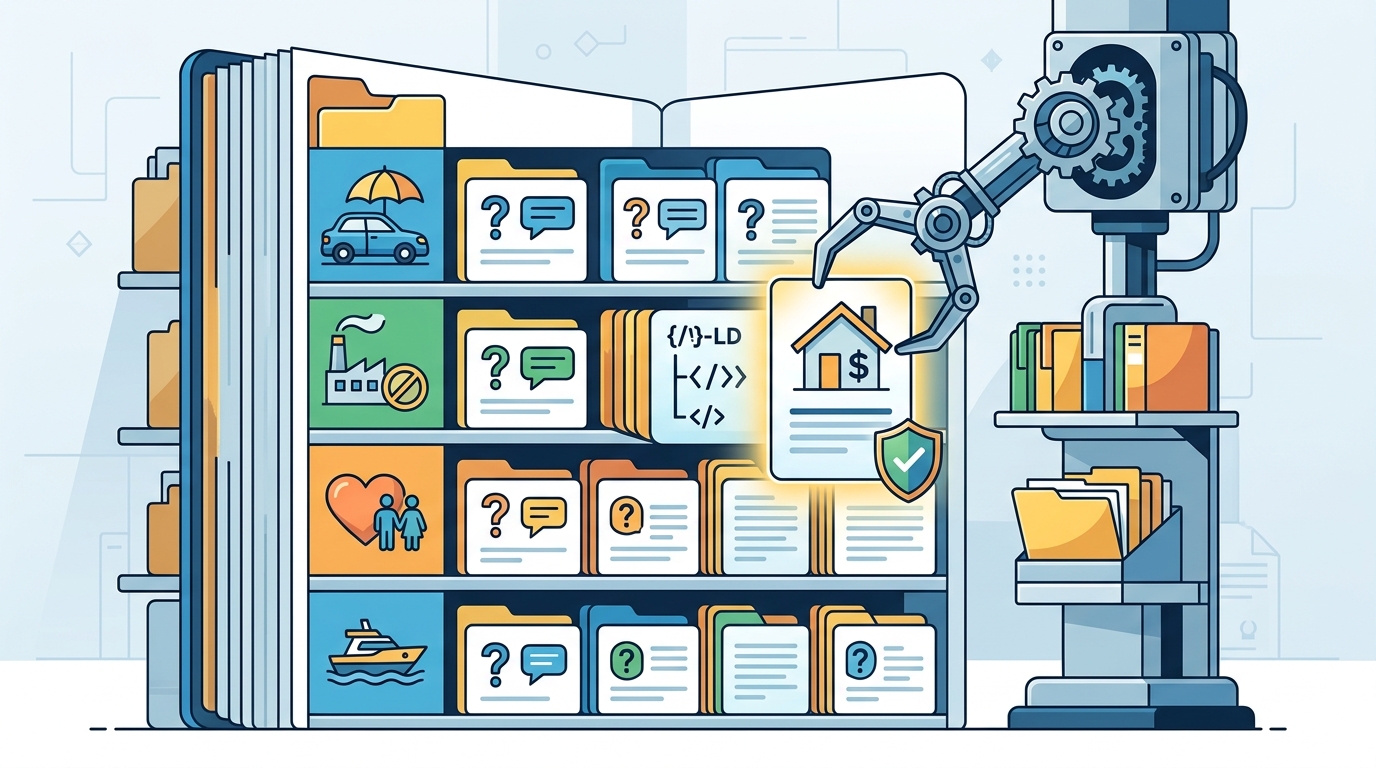
Machine readability is the practice of structuring web content so that AI crawlers can parse and extract information without ambiguity. This involves using clean semantic HTML, proper header tags, and schema markup. AI engines rely on these structural cues to understand the hierarchy and context of your content. If your website uses complex JavaScript rendering or lacks clear headings, the AI may struggle to extract the relevant text. This technical optimization is just as important as the content itself.
Answer-first formatting is a critical component of machine readability. This technique places the direct answer to a question at the top of the page, followed by supporting details. AI models are trained to extract the most relevant snippet from a source, and they often prioritize the beginning of a document. By front-loading your answer, you increase the likelihood that the model will quote your text directly. Additionally, using tables and lists can help AI engines understand comparative data, such as different insurance plan options. This structural clarity makes your content a preferred source for AI-generated answers.
Establishing Topical Authority
Topical authority is the recognition by search engines and AI models that a website is a definitive source on a specific subject. For an insurance agency, this means covering your niche in depth across multiple linked pages. Instead of publishing isolated blog posts, you should create a hub of content that covers every aspect of your specialty. This interconnected structure signals to AI models that you have comprehensive knowledge of the topic. The more you cover, the more likely you are to be cited for related questions.
For instance, if you specialize in commercial insurance, you should have pages covering liability, property, workers' compensation, and business interruption. These pages should link to each other, creating a web of authority. This depth of coverage is what separates a generalist from a specialist in the eyes of an AI model. By building this topical authority, you position your agency as the go-to resource for commercial insurance questions. This strategy ensures that you are not just visible for one query, but for an entire category of questions.
Monitoring and Iterating Your Visibility
Monitoring your AI visibility is an ongoing process that requires tracking how often you are cited across different AI platforms. You need to know which questions are driving traffic and which are not. This data allows you to refine your content strategy and focus on the areas where you can make the most impact. Without monitoring, you are flying blind, and you may miss opportunities to improve your visibility. The implication is that you must treat AI visibility as a dynamic metric that requires regular attention.
Cytd provides a dashboard that tracks your visibility score across multiple AI engines, including ChatGPT, Gemini, and Perplexity. This tool allows you to see exactly which questions are generating citations and which are not. By analyzing this data, you can identify gaps in your content library and prioritize new topics. This iterative process ensures that your strategy evolves with the changing landscape of AI search. It allows you to stay ahead of your competitors by continuously optimizing your presence in the AI answer layer.
Key Takeaways
- AI citation visibility depends on being selected as a trusted source by large language models.
- Question-first content that directly answers user prompts is more likely to be cited than general marketing pages.
- Machine readability, including semantic HTML and answer-first formatting, is critical for AI extraction.
- Topical authority is built by covering a niche in depth across interconnected pages.
- Monitoring your visibility across multiple AI platforms allows you to refine your strategy over time.
- Specificity in your content, such as local regulations or niche industries, increases your chances of being recommended.
Frequently Asked Questions
What is AI citation visibility?
AI citation visibility is the frequency with which a large language model references your brand or website when answering a user query. It measures your presence in the AI answer layer, distinct from traditional search engine rankings.
How do AI models decide which sources to cite?
AI models decide which sources to cite based on the relevance, authority, and clarity of the content. They prioritize sources that provide direct, factual answers to the user's specific question and are structured for easy extraction.
Does ranking number one on Google guarantee AI citations?
No, ranking number one on Google does not guarantee AI citations. AI models use different ranking factors than traditional search engines, focusing on content structure and direct answerability rather than just backlinks and domain authority.
What is answer-first formatting?
Answer-first formatting is a content strategy that places the direct answer to a question at the top of a page, followed by supporting details. This structure helps AI models quickly extract and quote the relevant information.
How often should I monitor my AI visibility?
You should monitor your AI visibility regularly, ideally on a monthly basis. This allows you to track changes in your citation frequency and identify new opportunities for content optimization.
Can I control what AI models say about my business?
You cannot directly control what AI models say about your business. However, you can influence their output by providing clear, authoritative, and well-structured content that answers common questions in your industry.
Start Improving Your AI Visibility
Getting your insurance agency cited in AI-powered search results requires a strategic shift in how you create and structure your content. By focusing on question-first content, machine readability, and topical authority, you can position your brand as a trusted source for AI models. Cytd provides the tools and expertise to help you navigate this new landscape. To see where your agency stands today, you can run a free AI visibility report to identify your strengths and gaps. This diagnostic will give you a clear starting point for your optimization strategy. Take the first step toward ensuring your agency is the recommended answer when your clients ask AI for insurance advice.