
5 Critical Mistakes Local Businesses Make in Answer Engine Optimization
Local businesses often fail at answer engine optimization by treating it like traditional SEO, ignoring question-based intent, and neglecting structured data. Cytd helps brands avoid these pitfalls by focusing on how AI engines actually parse and recommend local services. This guide outlines the most common errors and how to fix them.
Treating AEO Like Traditional SEO
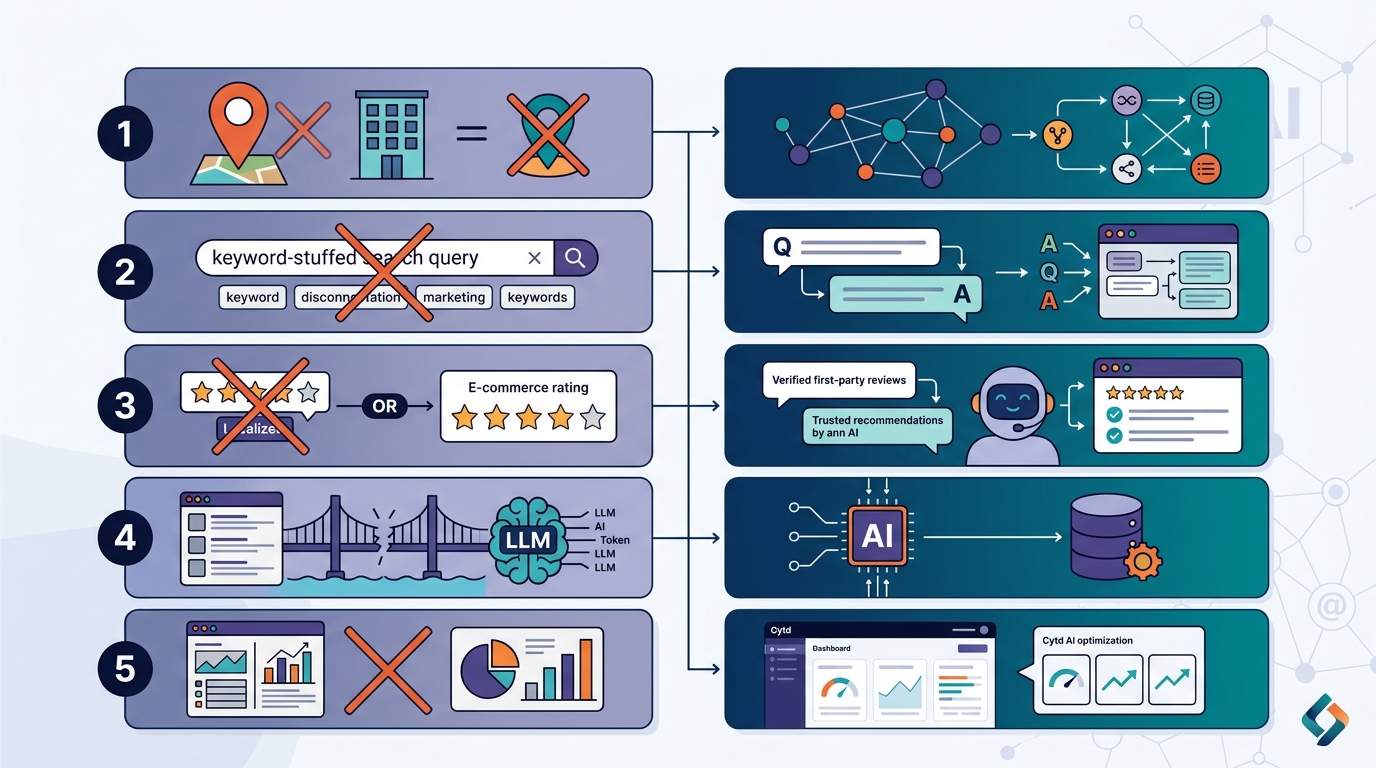
Many local businesses assume that ranking high on Google search results guarantees visibility in AI answers. This is a fundamental misunderstanding of how generative engines work. Answer engine optimization is the process of structuring content so that large language models can easily extract and cite specific facts. Traditional SEO focuses on keywords and backlinks, but AEO prioritizes clarity, direct answers, and semantic context.
When a user asks ChatGPT or Gemini for a recommendation, the model does not simply read the top ten blue links. It synthesizes information from multiple sources to form a coherent answer. If your website is written in long, marketing-heavy paragraphs without clear, extractable facts, the AI may skip your business entirely. Cytd’s platform analyzes your current visibility score to identify where your content fails to meet these new extraction standards.
The implication is clear: you cannot rely on legacy SEO tactics alone. You must adapt your content strategy to serve the machine, not just the human reader. This means rewriting service pages to answer specific questions directly and concisely.
Ignoring Question-Based Intent
Local businesses frequently create content around keywords like "best plumber in Denver" rather than the specific questions customers actually ask AI assistants. Keywords were built for a search box, but AI answers come from questions. Understanding your target questions is the first step in effective AEO. People are asking AI assistants "who’s the best [service] near me" instead of Googling it.
For example, a gym in Denver might focus on the keyword "Denver fitness center." However, a customer might ask Claude, "Is there a gym near me in Denver that offers Hyrox prep and small-group coaching?" If your website does not explicitly address this specific combination of location and specialty, you will not be cited. Cytd’s case studies show that businesses succeed when they own specific, long-tail questions rather than trying to win broad, generic terms.
Colfax Strong, a fitness studio in Denver, leveraged this approach. They did not try to win the generic "best gyms in Denver" query. Instead, they focused on a specific niche: Hyrox prep and small-group coaching. This allowed them to become the recommended answer for that precise intent. The lesson is to map your services to the specific questions your ideal customers are asking AI models.
Neglecting Structured Data and Markup
Another common mistake is the lack of machine-readable markup on local business websites. Structured data is a form of microdata that helps search engines and AI models understand the meaning of content on a webpage. Without proper schema markup, AI engines must guess what your business offers, which often leads to inaccurate citations or complete omission.
Cytd’s platform includes machine-readable markup as a core component of its service. This involves using clean semantic HTML, proper headers, and schema markup that AI crawlers can parse without guesswork. For local businesses, this means implementing LocalBusiness schema, Service schema, and FAQ schema. These elements provide the AI with a clear, structured view of your offerings, location, and pricing.
When a local business neglects this technical layer, it creates friction for the AI. The model may struggle to distinguish between your business and a competitor’s. By implementing robust structured data, you reduce this friction and increase the likelihood of being cited. This is a technical but critical aspect of AEO that many local marketers overlook.
Failing to Monitor AI Visibility
Local businesses often set up their websites and then ignore how they appear in AI answers. They do not monitor their visibility score or track which questions they are being cited for. Answer engine visibility is dynamic; it changes as AI models update and as competitors publish new content. Without monitoring, you cannot know if your strategy is working.
Cytd provides a dedicated dashboard that tracks your visibility across multiple AI sources, including ChatGPT, Gemini, and Perplexity. This dashboard shows your Cytd Score, which is a metric that quantifies your brand’s presence in AI-generated answers. It also tracks citations and mentions, allowing you to see exactly where you are being recommended. This data is essential for making informed decisions about your content strategy.
For instance, a real estate lending marketplace might see a drop in their visibility score. By monitoring this metric, they can identify which questions they are losing and adjust their content accordingly. This proactive approach is far more effective than waiting for customers to report that they cannot find your business. Monitoring turns AEO from a guess into a measurable discipline.
Ignoring Social and Video Content
Many local businesses believe that their website is the only place AI engines look for information. This is a mistake. AI models also analyze social media content, video platforms, and community discussions to form their answers. If your brand has a weak or inconsistent presence on these platforms, it can negatively impact your AI visibility.
Cytd’s platform includes social posts and AI-optimized videos as part of its service. This involves creating content that is structured for AI consumption, such as short, informative videos that answer specific questions. YouTube, for example, is the world’s second-largest search engine, and AI models frequently cite video content. By ignoring these channels, local businesses leave a significant portion of the AI landscape unaddressed.
The implication is that your AEO strategy must be omnichannel. You need to ensure that your brand is represented consistently across your website, social media, and video platforms. This creates a cohesive digital footprint that AI engines can easily parse and trust. Cytd helps businesses build this footprint by creating and distributing content across these various channels.
Key Takeaways
- Traditional SEO tactics are insufficient for answer engine optimization; you must focus on direct, extractable answers.
- Map your content to specific questions customers ask AI assistants, not just generic keywords.
- Implement structured data and schema markup to help AI models understand your business clearly.
- Monitor your AI visibility score regularly to track performance and identify gaps.
- Expand your content strategy to include social media and video platforms, which AI engines also analyze.
- Use a dedicated platform like Cytd to manage and measure your AEO efforts effectively.
Frequently Asked Questions
What is answer engine optimization?
Answer engine optimization is the practice of structuring content so that AI models can easily extract and cite specific facts when generating answers.
How is AEO different from SEO?
SEO focuses on ranking for keywords in traditional search results, while AEO focuses on being cited in AI-generated answers, which requires clear, direct, and structured content.
Do I need to change my website for AEO?
Yes, you should update your website to include direct answers to common questions, structured data, and clear, concise language that AI models can easily parse.
How can I track my AI visibility?
You can use a platform like Cytd to monitor your visibility score across multiple AI sources and track which questions you are being cited for.
Is AEO only for large businesses?
No, AEO is especially important for local businesses, as AI models often recommend specific local providers based on their digital footprint.
Can I control what AI models say about my business?
You cannot directly control what AI models say, but you can influence it by providing clear, accurate, and well-structured information that the models are likely to cite.
Conclusion
Avoiding these common mistakes is essential for local businesses looking to thrive in the era of AI search. By focusing on question-based intent, structured data, and consistent monitoring, you can improve your chances of being recommended by AI engines. Cytd provides the tools and expertise to help you navigate this new landscape. To see where your business stands today, run your free AI visibility report.