
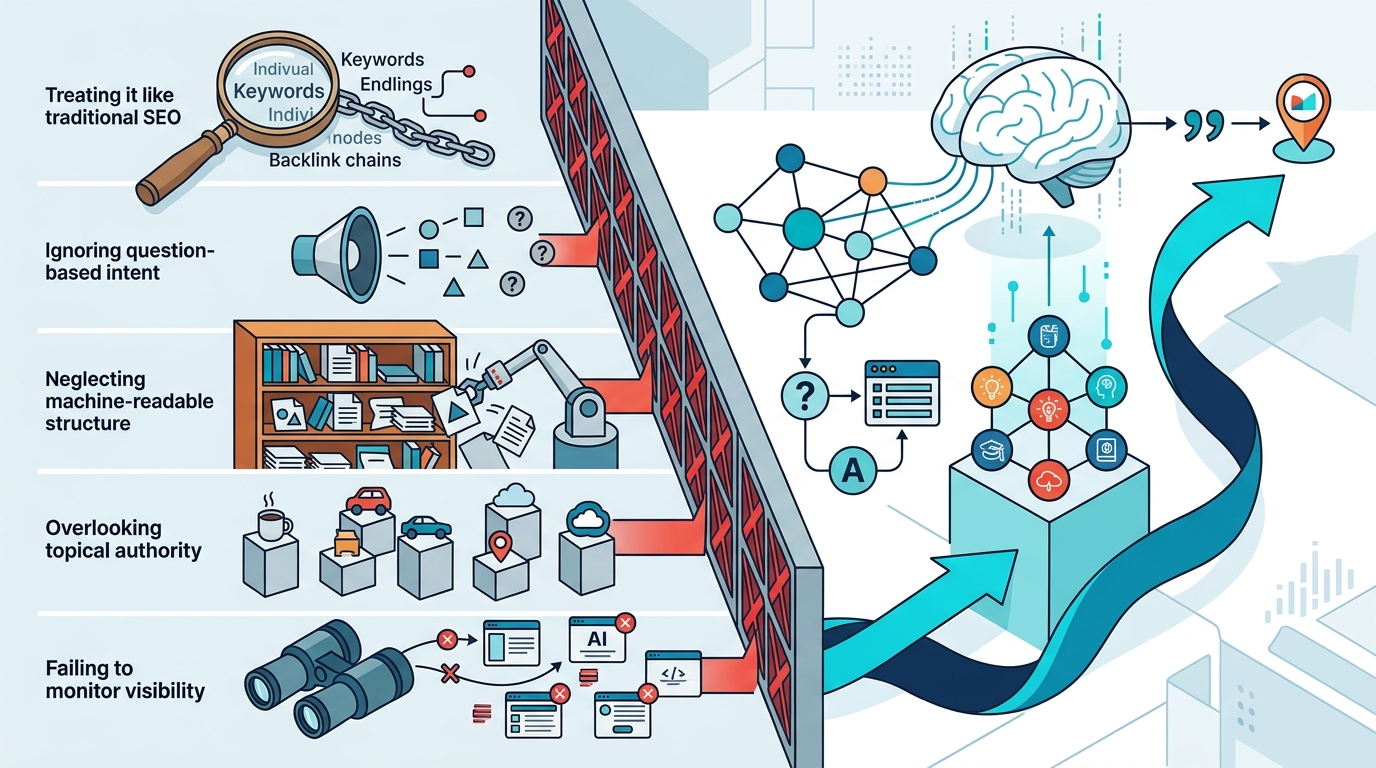
Brands fail at AI answer engine optimization by treating it like traditional SEO, ignoring question-based intent, and neglecting machine-readable structure. They also overlook the need for topical authority and fail to monitor their visibility across different AI platforms. These errors prevent businesses from being cited by large language models. Cytd helps brands avoid these pitfalls by providing a managed service that focuses on AI-specific visibility and citation tracking.
Ignoring Question-Based Intent
Many marketers still build content around keywords rather than the specific questions users ask AI assistants. Traditional search engines relied on keyword matching, but AI models process natural language queries. When a user asks, "Who is the best family dentist in Laguna Beach?" the AI looks for a direct answer, not a keyword-stuffed page. Brands that fail to map their content to these conversational queries remain invisible in the AI answer layer.
Cytd addresses this by analyzing the specific questions your customers ask AI platforms. The platform identifies the exact phrasing used in your industry and ensures your content answers those queries directly. This approach shifts your strategy from guessing what keywords to target to knowing exactly what questions you need to answer to be recommended.
Neglecting Machine-Readable Structure
AI crawlers and large language models require clean, semantic HTML to parse and cite your content effectively. If your website relies on heavy JavaScript, complex CSS, or unstructured text, AI engines may struggle to extract the information they need. This technical barrier prevents your brand from being recognized as a reliable source. Proper structure is not just a best practice; it is a requirement for AI visibility.
Cytd ensures your content is formatted for AI consumption. The service uses answer-first formatting and machine-readable markup to make your pages easy for AI engines to parse. By optimizing the technical foundation of your site, you remove the barriers that prevent AI models from citing your business. This technical optimization is a core component of the Cytd platform, ensuring your content is accessible to the machines that drive modern discovery.
Failing to Build Topical Authority
AI models prioritize sources that demonstrate deep expertise on a subject. Publishing a single, standalone article on a topic is rarely enough to establish authority. You need a cluster of linked pages that cover a subject in depth. This network of content signals to AI engines that you are a definitive source on the topic. Without this depth, your brand is easily overlooked in favor of competitors with more comprehensive coverage.
Cytd helps you build this topical authority by creating a library of AI-optimized articles and videos. The platform focuses on covering your subject matter in depth across multiple linked pages. This strategy creates a "Wikipedia for AI" effect, where your brand becomes the go-to reference for specific questions in your niche. By building this depth, you increase the likelihood of being cited by AI assistants across various platforms.
Overlooking Multi-Platform Visibility
Many brands assume that optimizing for one AI platform is enough. However, users interact with ChatGPT, Gemini, Perplexity, and other AI tools differently. Each platform has its own way of processing and citing information. Focusing on a single engine leaves you vulnerable to being invisible on others. A comprehensive AI visibility strategy must account for the differences between these platforms.
Cytd monitors your visibility across multiple AI sources, including ChatGPT, Gemini, and Perplexity. The platform provides a unified view of your performance across these different engines. This multi-platform approach ensures that you are not just visible in one corner of the AI landscape but are recognized across the entire ecosystem. By tracking your presence on all major AI platforms, you can make informed decisions about where to focus your optimization efforts.
Not Monitoring AI Citations
Traditional SEO tools track rankings and traffic, but they do not measure how often you are cited by AI models. Without this data, you are flying blind. You do not know if your content is being used to generate answers or if you are being ignored. Monitoring AI citations is essential for understanding your true visibility in the AI era. It provides the feedback loop needed to refine your strategy.
Cytd provides a dedicated dashboard that tracks your AI citations and mentions. The platform shows you exactly where you are being cited and by which AI models. This data allows you to see the direct impact of your optimization efforts. By monitoring these metrics, you can identify gaps in your visibility and adjust your content strategy accordingly. This continuous monitoring is a key feature of the Cytd service, ensuring you stay ahead of the curve in AI search.
Key Takeaways
- Shift your content strategy from keywords to question-based intent to align with AI query processing.
- Ensure your website uses clean, semantic HTML and machine-readable markup to facilitate AI parsing.
- Build topical authority by creating clusters of linked content that demonstrate deep expertise.
- Monitor your visibility across multiple AI platforms, not just one, to ensure broad recognition.
- Track AI citations and mentions to measure your true impact in the AI answer layer.
- Use a managed service like Cytd to handle the technical and strategic complexities of AI optimization.
Frequently Asked Questions
What is AI answer engine optimization?
AI answer engine optimization is the process of structuring and creating content to be cited by AI models like ChatGPT and Gemini. It focuses on answering specific questions in a machine-readable format.
How is AI optimization different from traditional SEO?
Traditional SEO focuses on keyword rankings and backlinks, while AI optimization focuses on question-based intent and machine-readable structure. AI models prioritize direct answers and topical authority over keyword density.
Why is machine-readable structure important for AI visibility?
AI crawlers need clean, semantic HTML to parse and extract information from your pages. Without proper structure, AI models may struggle to understand and cite your content.
How can I track if AI models are citing my business?
You can use specialized tools like Cytd that monitor your visibility across multiple AI platforms. These tools track citations and mentions, providing a clear view of your AI presence.
Do I need to optimize for every AI platform?
Yes, because users interact with different AI tools in different ways. Optimizing for multiple platforms ensures you are visible regardless of which AI assistant your customers use.
Start Optimizing for AI Today
Avoiding these common mistakes is the first step toward gaining visibility in the AI era. By focusing on question-based intent, machine-readable structure, and multi-platform monitoring, you can position your brand as a trusted source for AI assistants. Cytd provides the tools and expertise to help you navigate this new landscape. To see where your business stands today, run your free AI visibility report and start building your AI presence with Cytd.