

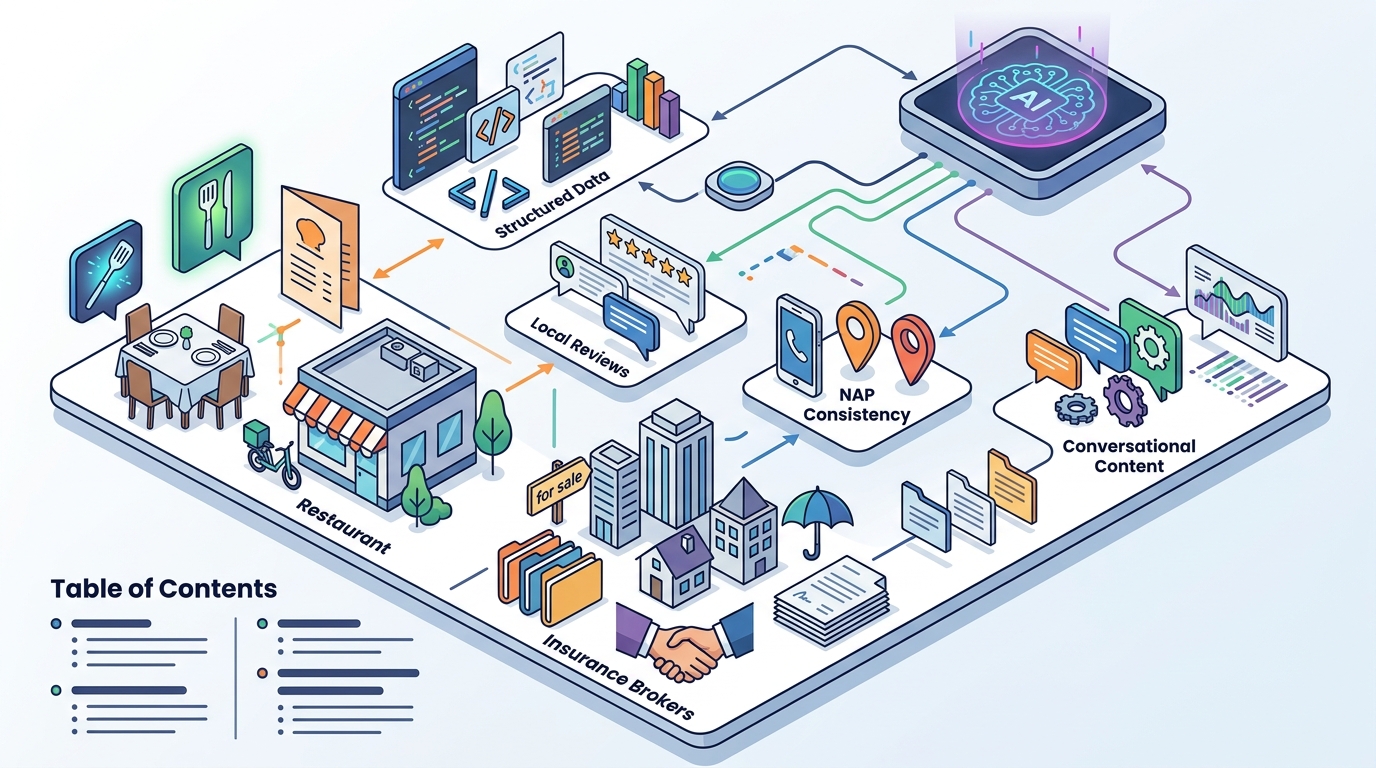
Restaurants, real estate agents, and insurance brokers show up in AI search by optimizing structured data, local reviews, NAP consistency, and conversational content. This guide explains how to make AI engines recommend your business when customers ask specific questions.
Structured Data Markup
Structured data is a standardized format for providing information about a page and classifying the page's content. For local businesses, implementing schema markup helps AI engines understand your services, location, and operating hours. This technical foundation is critical for visibility in answer engines like ChatGPT and Google AI Overviews.
Implementing LocalBusiness Schema
Use the LocalBusiness schema type to define your entity. Include properties such as name, address, geo coordinates, and opening hours. For restaurants, use the Restaurant subtype. For real estate agents, use the RealEstateAgent subtype. This specificity allows AI models to categorize your business accurately.
Adding Service and Offer Schema
Define your specific services using the Service schema. For an insurance broker, list specific policies offered. For a restaurant, list menu items or dining options. This granular data helps AI answer questions like "What insurance policies do you offer?" or "Do you have outdoor seating?"
Local Review Signals
Local review signals are the aggregate ratings and written feedback from customers on platforms like Google, Yelp, and industry-specific sites. AI engines analyze these signals to determine trustworthiness and quality. Positive, recent reviews with detailed descriptions significantly influence AI recommendations.
Encouraging Detailed Reviews
Ask customers to mention specific services or experiences in their reviews. A review stating "The real estate agent helped me find a home in the north side quickly" is more valuable to AI than a generic "Great service." Specificity helps AI match your business to specific user queries.
Responding to Reviews
Respond to all reviews, especially negative ones, with professionalism. AI engines may analyze the tone and content of your responses to gauge customer service quality. Consistent, helpful responses demonstrate active management and care for customer satisfaction.
NAP Consistency
NAP consistency refers to the uniformity of your Name, Address, and Phone number across all online platforms. Inconsistent NAP data confuses AI engines and reduces your visibility. Ensure your NAP is identical on your website, social media profiles, and directory listings.
Auditing Your NAP Data
Conduct a regular audit of your online presence. Check major directories, social media, and local business listings. Correct any discrepancies immediately. Use a spreadsheet to track your NAP across all platforms to maintain consistency over time.
Canonicalizing Your Business Name
Choose a single, canonical version of your business name and use it everywhere. Avoid adding extra descriptors or changing the name format between platforms. This consistency helps AI engines confidently identify your business entity.
Conversational Content Strategy
Conversational content is written in a natural, question-and-answer format that mirrors how people speak to AI assistants. This strategy involves creating content that directly answers the questions your customers ask. It is essential for being cited by AI engines in their responses.
Identifying Customer Questions
Research the specific questions your target customers ask AI assistants. Use tools to analyze search trends and common queries in your industry. For a restaurant, questions might include "Where can I find gluten-free options near me?" For an insurance broker, "What insurance do I need for a small business?"
Creating Answer-First Content
Structure your content to provide the direct answer first, followed by supporting details. Use clear headings and short paragraphs. This format makes it easy for AI engines to extract and cite your content. Avoid burying key information in long, complex paragraphs.
Key Takeaways
- Implement structured data markup to help AI engines understand your business entity and services.
- Encourage detailed, specific reviews to build trust and influence AI recommendations.
- Maintain strict NAP consistency across all online platforms to avoid confusing AI engines.
- Create conversational content that directly answers the questions your customers ask AI.
- Use answer-first formatting to make your content easy for AI engines to extract and cite.
- Regularly audit your online presence to ensure data accuracy and consistency.
- Monitor your visibility in AI search to track progress and identify areas for improvement.
Frequently Asked Questions
What is structured data markup?
Structured data markup is a standardized format for providing information about a page and classifying the page's content to help AI engines understand your business.
Why are local review signals important for AI search?
Local review signals are important because AI engines analyze them to determine trustworthiness and quality, influencing whether they recommend your business.
What does NAP consistency mean?
NAP consistency means keeping your Name, Address, and Phone number identical across all online platforms to avoid confusing AI engines.
How do I create conversational content?
Create conversational content by writing in a natural, question-and-answer format that directly answers the specific questions your customers ask AI assistants.
Can I control what AI models say about my business?
No, you cannot control what AI models say, but you can influence their recommendations by optimizing your online presence and content.
How often should I audit my NAP data?
Audit your NAP data regularly, at least quarterly, to ensure consistency and accuracy across all online platforms.
What is the best way to encourage detailed reviews?
Ask customers to mention specific services or experiences in their reviews to provide AI engines with relevant, specific information.
Conclusion
Showing up in AI search requires a comprehensive approach to your online presence. By implementing structured data, managing local reviews, maintaining NAP consistency, and creating conversational content, you can increase your chances of being recommended by AI engines. Run your free AI visibility report with Cytd to see where you stand and get personalized recommendations for improving your AI search presence.