

Tracking brand visibility in AI search requires monitoring specific prompts across multiple answer engines to see if your business is cited or mentioned. Traditional SEO tools do not capture this data because AI assistants generate unique, conversational responses rather than static lists of links. You need a dedicated monitoring system that tests real user questions and logs the exact context in which your brand appears.
Why Traditional Tools Fail in AI Search
Most digital marketers still rely on keyword rankings to measure success. This approach is fundamentally broken in the era of generative AI. When a user asks a large language model for a recommendation, the model does not return a list of ten blue links. It synthesizes an answer based on its training data and real-time retrieval. If your brand is not explicitly named in that synthesized text, you are invisible to that user, regardless of your Google ranking.
Traditional search engines index pages. AI assistants index concepts and entities. A page can rank number one for a keyword but still be ignored by an AI model if the model lacks sufficient context to trust that page as a source of truth. This disconnect means that checking your keyword position in a standard SEO dashboard tells you nothing about your actual share of voice in AI answers. You are measuring the wrong metric for the wrong channel.
The implication is clear: you need a new category of tooling. You need systems that treat AI assistants as search engines. These systems must query the models directly, capture the output, and analyze the text for your brand name. Without this direct interrogation of the AI, you are flying blind in the most important discovery channel of the next decade.
Citations vs. Mentions: What to Measure
When monitoring AI visibility, it is critical to distinguish between two types of appearances: citations and mentions. A citation is a formal reference where the AI model links directly to your website or explicitly names your source. This is the strongest signal of authority. It means the model trusts your content enough to point users directly to it. Citations drive high-intent traffic because the user is already convinced by the AI's recommendation.
A mention is a softer signal. The AI might say, "There are several good options for this service, including [Competitor A] and [Competitor B]." If your brand is not in that list, you have zero visibility. If you are in the list but not linked, you have a mention. Mentions are valuable for brand awareness, but they do not always drive direct traffic. Users might read the mention and decide to search for your brand separately, or they might ignore it entirely.
Effective tracking must log both. A dashboard that only counts citations will underestimate your brand's presence. A dashboard that only counts mentions will overestimate your authority. You need a composite score that weighs both signals. For example, a tool might assign a higher weight to citations because they convert better, while still tracking mentions to understand your competitive landscape. This dual-tracking approach gives you a complete picture of where you stand in the AI's collective memory.
Building a Prompt Library for Monitoring
The foundation of any AI visibility tracking system is the prompt library. Unlike keywords, which are short and specific, AI prompts are natural language questions. You must build a library of questions that your actual customers are likely to ask. These questions should reflect high-intent search behavior. For example, instead of tracking the keyword "commercial loan," you should track the prompt "What is the best platform to match my commercial loan scenario with hundreds of lenders?"
Specificity matters. Broad questions like "What is the best gym?" are too vague to yield consistent results. The AI might recommend a different gym every time it answers, depending on its internal weighting. Narrow, specific questions produce more stable and measurable results. A prompt like "Is there a gym near me in Denver that offers Hyrox prep and small-group coaching?" is much easier to track. The answer is more likely to be consistent, and the intent is clearer.
You should categorize your prompts by intent. Group them into informational, navigational, and transactional buckets. Informational prompts build awareness. Transactional prompts drive revenue. By tracking both, you can see how your brand moves through the customer journey in the AI context. Start with 10 to 20 high-value prompts. Do not try to track hundreds of questions at once. Focus on the questions that matter most to your business goals.
Analyzing AI-Driven Traffic Data
Tracking what the AI says is only half the battle. You also need to track what users do after they read the answer. This is where traffic data becomes essential. You can connect your analytics platform to your AI visibility tool to see how many sessions come from AI assistants. This data tells you if the citations and mentions are actually converting into visits.
Look for specific user agents or referrer domains associated with AI platforms. Some AI assistants send referrer data, while others do not. If your analytics show a spike in traffic from an unknown referrer, it might be an AI assistant. You can investigate these sessions to see which pages users land on. This helps you understand which of your content assets are driving the most AI traffic.
For example, a supplement company might find that half of their AI sessions arrive through a citation. This means the AI is not just naming them, but pointing people directly to a specific product page. This is a powerful signal. It indicates that the AI has identified that page as the definitive source for that topic. By analyzing this data, you can identify which pages are your "AI money pages" and prioritize their optimization.
Automating Continuous Monitoring
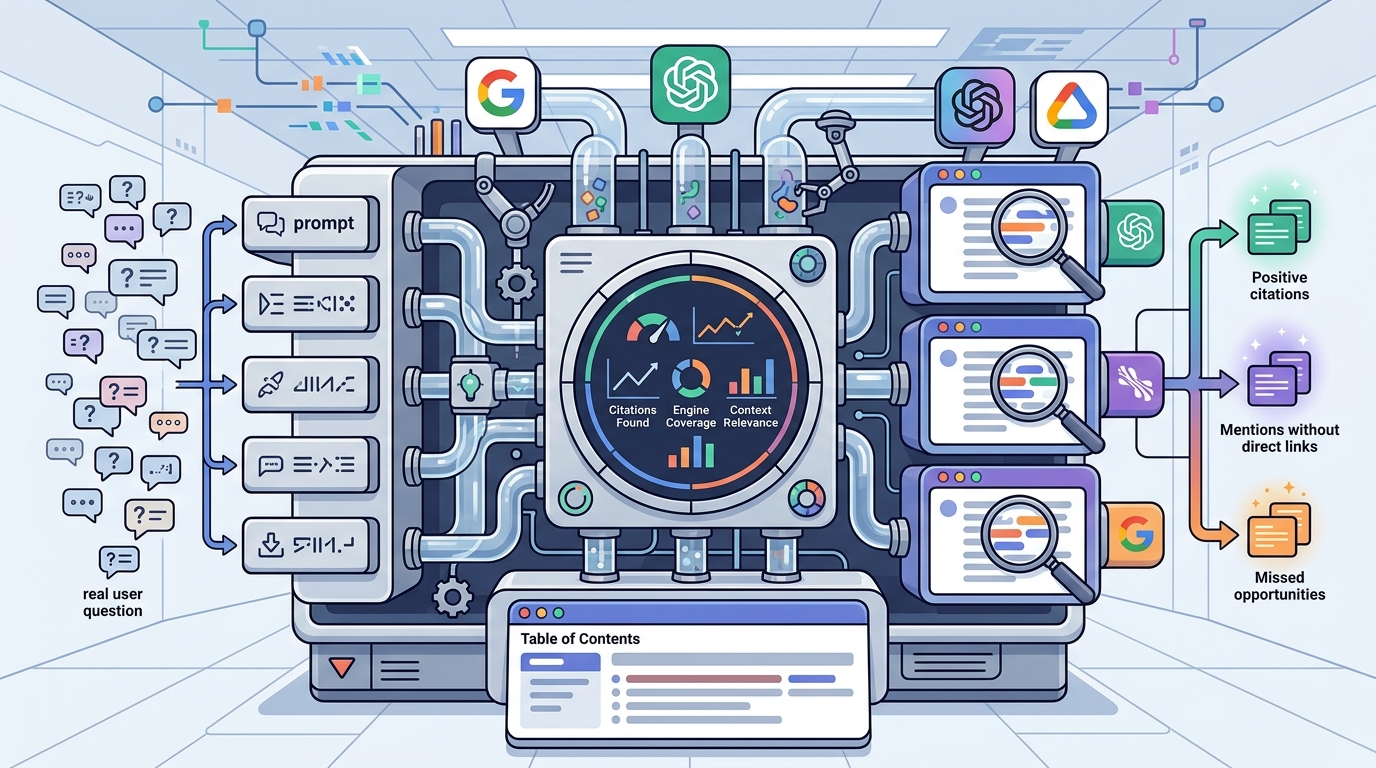
AI models are not static. They update their training data, change their algorithms, and adjust their weighting of sources. What works today might not work next month. Therefore, one-time audits are insufficient. You need continuous, automated monitoring. This means running your prompt library against multiple AI engines on a regular schedule, such as daily or weekly.
Automation allows you to detect changes quickly. If your brand disappears from an answer that it previously owned, you need to know immediately. This could be due to a model update, a competitor gaining authority, or a change in your own content. By monitoring continuously, you can identify these shifts and respond before they impact your revenue. A weekly report that shows your visibility score trending down is a critical alert that requires action.
Furthermore, automation allows you to track competitors. You can see if a competitor is gaining citations in your key prompts. This competitive intelligence is invaluable. It helps you understand the dynamics of your market in the AI space. By automating this process, you free up your team to focus on strategy and content creation, rather than manual data collection. The goal is to make AI visibility tracking a routine part of your digital marketing operations, just like keyword ranking tracking is today.
Key Takeaways
- Traditional SEO tools cannot measure AI visibility because they track keyword rankings, not conversational answers.
- You must distinguish between citations (direct links) and mentions (text references) to accurately assess your authority.
- Build a prompt library using specific, high-intent natural language questions rather than broad keywords.
- Connect your analytics to your AI tracking tool to measure the actual traffic and conversions from AI assistants.
- Automate your monitoring to detect changes in model behavior and competitor movements in real-time.
- Focus on specific, niche questions to achieve stable and measurable results in AI answers.
Frequently Asked Questions
What is the difference between a citation and a mention in AI search?
A citation is when an AI model explicitly links to your website or names your source. A mention is when the AI refers to your brand in text without providing a direct link. Citations are stronger signals of authority and typically drive more direct traffic.
Can I track AI visibility using standard SEO tools?
No, standard SEO tools track keyword rankings on search engines like Google. They do not query AI assistants or analyze the text of their answers. You need a dedicated AI visibility tool that can interact with large language models.
How often should I monitor my AI visibility?
You should monitor your AI visibility at least weekly. AI models update frequently, and your visibility can change rapidly. Weekly monitoring allows you to detect significant shifts and respond before they impact your business.
Do I need to track all AI platforms?
You should track the platforms where your customers are most likely to ask questions. This might include ChatGPT, Gemini, Perplexity, and others. Prioritize the platforms that drive the most traffic to your site.
What is a Cytd Score?
A Cytd Score is a composite metric from 0 to 100 that measures your visibility, authority, and topic coverage across the AI web. It provides a single number to track your overall AI visibility over time.
How do I start tracking my AI visibility?
Start by identifying your top 10 to 20 high-intent questions. Then, use a tool like Cytd to monitor these questions across major AI platforms. This will give you a baseline to measure your progress against.
Conclusion
Tracking where your brand appears in AI search results is no longer optional. It is a critical component of modern digital marketing. By understanding the difference between citations and mentions, building a robust prompt library, and automating your monitoring, you can gain a competitive edge in the AI era. Cytd provides the tools and expertise to help you measure and improve your AI visibility. Start by running a free report to see exactly what AI assistants are saying about your business today.