
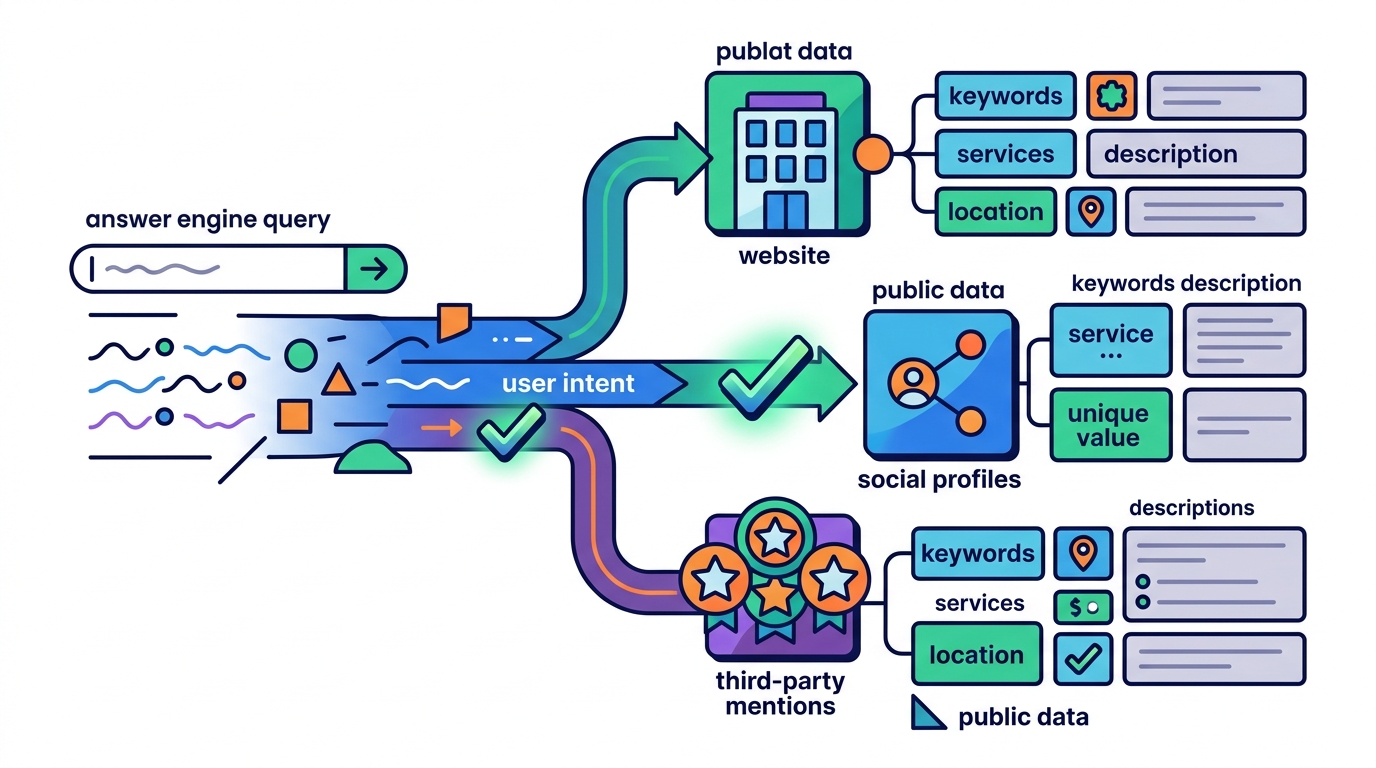
ChatGPT matches your business to user intent by analyzing semantic alignment between your public digital footprint and the specific question asked. It does not read your mind or your backend database. Instead, it evaluates how clearly your website, social profiles, and third-party mentions describe your services, location, and unique value proposition. If your public data lacks the specific keywords and context a user is searching for, the model cannot confidently recommend you. Cytd helps businesses identify these gaps by analyzing how AI engines currently perceive their brand.
Semantic Matching vs. Keyword Stuffing
Traditional search engines relied heavily on exact keyword matches. Large language models (LLMs) like ChatGPT operate on semantic understanding. This means the model looks for the meaning behind the words rather than just the words themselves. Query relevance is the degree to which a business's digital content aligns with the conceptual intent of a user's question. If a user asks for a "plumber who handles emergency leaks in Austin," the model looks for content that explicitly connects plumbing services, emergency response, and the Austin location. Vague service pages that simply say "We offer plumbing services" fail to provide the specific semantic signals required for a match. The model needs clear, unambiguous data points to build a confident recommendation.
Entity Clarity and Brand Distinctiveness
For an AI to recommend a business, it must first understand what that business is. This process is known as entity resolution. Entity clarity is the consistency and accuracy of a brand's identity across the web. If your website says you are a "digital marketing agency," but your LinkedIn profile says you are a "web design studio," and your Yelp listing says you are a "consultant," the model receives conflicting signals. This confusion lowers your relevance score for specific queries. A distinct, consistent entity profile ensures that when a user asks for a specific type of service, the model can confidently link that service to your brand name. Consistency across your domain, social media, and directory listings is the foundation of AI visibility.
Answering the Specific Question
Users rarely ask broad questions. They ask specific, intent-driven questions. For example, instead of "best gyms," a user might ask, "Is there a gym in Denver that offers Hyrox prep and small-group coaching?" To match this query, your content must directly address that specific combination of location and specialty. Answer-first formatting is a content strategy that places the direct answer to a question at the beginning of a section, followed by supporting details. This structure allows AI crawlers to extract the relevant information quickly and accurately. If your content buries the answer under paragraphs of history or company fluff, the model may skip it entirely. Writing content that mirrors the specific questions your customers ask is the most effective way to improve query relevance.
The Role of Third-Party Signals
AI models do not just read your website. They also analyze a vast array of third-party sources, including social media, forums, and review sites. These sources provide context that your own site might lack. For instance, a Reddit thread where users discuss your business can provide real-world validation of your services. Community discussions are online conversations where users share experiences and recommendations about specific brands or services. If your business is frequently mentioned in relevant community discussions, the model gains additional confidence in your relevance. However, if these discussions are negative or irrelevant, they can hurt your visibility. Monitoring and engaging with these third-party signals is crucial for maintaining a positive and relevant AI profile.
Measuring Your Relevance Score
You cannot improve what you do not measure. Most businesses have no idea how AI engines currently perceive them. AI visibility score is a metric that quantifies how often and how prominently a brand is recommended by AI answer engines for specific queries. By tracking this score, you can identify which queries you are missing and why. For example, you might rank well for "plumbing in Austin" but miss out on "emergency plumbing in Austin" because your content does not explicitly mention emergency services. Regularly auditing your AI visibility allows you to adjust your content strategy to better match user intent. This data-driven approach ensures that your efforts are focused on the queries that matter most to your business.
Key Takeaways
- ChatGPT uses semantic understanding, not just keyword matching, to determine relevance.
- Consistent entity profiles across all digital platforms are essential for AI recognition.
- Answer-first formatting helps AI models extract and cite your content more effectively.
- Third-party sources like social media and forums significantly influence AI recommendations.
- Measuring your AI visibility score is the first step to improving query relevance.
- Specific, intent-driven questions require specific, clearly structured content to match.
Frequently Asked Questions
Does ChatGPT read my website directly?
Yes, ChatGPT and other AI models can access and analyze public web content, including your website. However, they also rely on cached data and third-party sources, so your website must be consistently updated and indexed to ensure the model has the most current information.
How long does it take for content changes to affect AI recommendations?
The timeline varies. AI models update their training data periodically, but they also use real-time web search capabilities. Changes to your website may take days to weeks to be fully reflected in AI recommendations, depending on how frequently the model crawls your site.
Can I control what ChatGPT says about my business?
You cannot directly control the AI's output, but you can influence it by providing clear, consistent, and high-quality data. By optimizing your digital footprint, you increase the likelihood that the AI will recommend your business accurately and positively.
What is the difference between SEO and AI visibility?
SEO focuses on ranking in traditional search engine results pages (SERPs), while AI visibility focuses on being recommended by AI answer engines. While there is overlap, AI visibility requires a stronger emphasis on semantic clarity, entity consistency, and answer-first content structures.
Do I need to be a large brand to be recommended by AI?
No. AI models can recommend small and local businesses if their digital footprint is clear and relevant. In fact, local businesses with specific, well-documented services often have an advantage in matching specific, location-based queries.
Conclusion
Improving your query relevance for AI answer engines requires a shift from traditional SEO tactics to a more nuanced approach focused on semantic clarity and entity consistency. By understanding how models like ChatGPT process information, you can structure your content to better match user intent. Cytd provides the tools and expertise to help you measure and improve your AI visibility, ensuring your business is recommended when it matters most.