
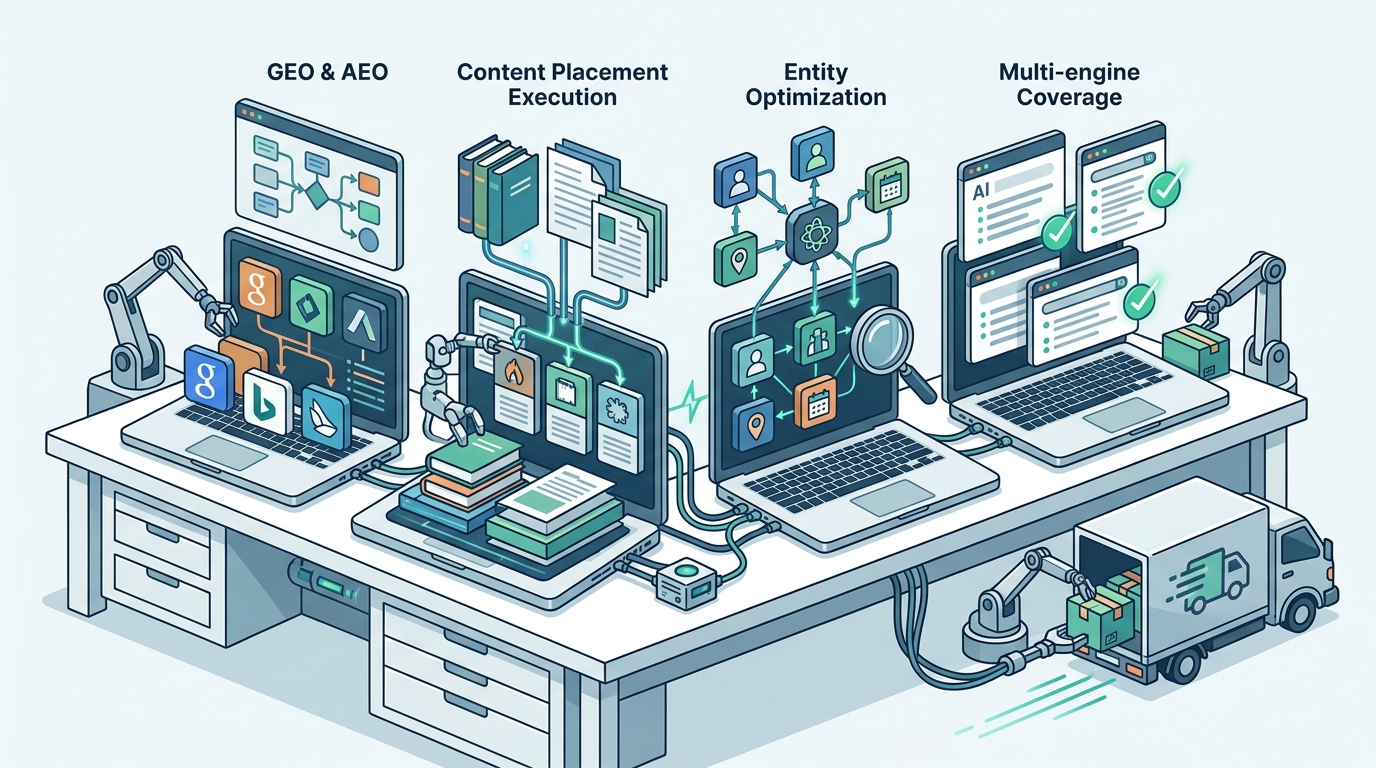
Done-for-you AI visibility services are managed platforms that handle the technical and content work required to make a brand appear in AI-generated answers. These services monitor how large language models cite your business and execute the optimization strategies needed to improve those citations. This guide covers the four critical pillars of modern AI visibility: GEO and AEO agencies, content placement execution, entity optimization, and multi-engine coverage.
GEO and AEO Agencies
Generative Engine Optimization (GEO) is the practice of structuring digital assets to be cited by AI models. Unlike traditional SEO, which focuses on ranking for specific keywords in search engine results pages, GEO focuses on how a brand is perceived and recommended by conversational AI. Answer Engine Optimization (AEO) is a related discipline that ensures a brand's content is formatted to be extracted and displayed as a direct answer to a user's query. For many businesses, the line between these two disciplines is blurring as AI search becomes the primary discovery channel.
The Shift from Keywords to Questions
Traditional search engines relied on matching keywords to user intent. AI search engines, however, process natural language questions. A user is no longer typing "best dentist in Miami"; they are asking, "Who is the best family dentist in Miami for a child with braces?" This shift requires a different approach to content creation. Agencies specializing in GEO and AEO must understand how AI models synthesize information from multiple sources to form a recommendation.
Managed Service vs. DIY Tools
Many businesses attempt to manage their AI visibility using DIY tools. While these tools can provide data, they often lack the strategic execution required to change how an AI model perceives a brand. A done-for-you service provides a dedicated team that analyzes the AI's current perception of the brand and implements the necessary changes. This includes monitoring competitor visibility and identifying gaps in the brand's digital footprint. For example, Cytd's platform offers a managed service that includes a dedicated account manager and a personal AI expert who understands the specific nuances of the client's industry.
Content Placement Execution
Content placement execution is the process of publishing and distributing content in a way that maximizes its chances of being cited by AI engines. This involves more than just writing a blog post; it requires a strategic approach to where and how the content is published. AI models do not just read articles; they analyze a vast array of social content, video assets, and forum discussions. A comprehensive content placement strategy ensures that the brand's message is consistent and accessible across all these channels.
Answer-First Formatting
One of the most critical aspects of content placement is answer-first formatting. This technique involves front-loading the direct answer to a question before providing supporting details. AI engines are designed to extract and quote concise, direct answers. By structuring content this way, brands make it easier for AI models to parse and cite their information. This approach is particularly effective for long-tail questions that users might ask in a conversational context.
Social and Video Integration
AI models increasingly rely on social media and video content to form their recommendations. A robust content placement strategy includes creating and distributing assets on platforms like YouTube, Instagram, and Reddit. For instance, Cytd's Spotlight feature allows businesses to publish AI-ready content on their own domain, ensuring that the authority and traffic remain with the brand. This content is structured in a way that AI engines can easily parse and cite, making it a powerful tool for improving visibility.
Entity Optimization
Entity optimization is the process of ensuring that a brand is correctly identified and understood as a distinct entity by AI models. This involves using structured data and consistent naming conventions across the web to help AI systems recognize the brand's identity. Without proper entity optimization, AI models may confuse a brand with its competitors or fail to recognize it as a legitimate source of information.
Machine-Readable Markup
Machine-readable markup, such as schema.org structured data, is a key component of entity optimization. This markup provides AI crawlers with clear, unambiguous information about a brand's products, services, and location. By using clean semantic HTML and proper headers, brands can make it easier for AI systems to understand their digital footprint. This is particularly important for local businesses, where location and service area are critical factors in AI recommendations.
Topical Authority
Topical authority is the degree to which a brand is recognized as an expert in a specific subject area. AI models are more likely to cite sources that demonstrate deep, consistent expertise on a topic. Building topical authority involves covering a subject in depth across multiple linked pages, rather than relying on a single standalone post. This creates a web of related content that signals to AI models that the brand is a trusted source of information. For example, a fitness studio might create a series of articles on different types of training, linking them together to demonstrate comprehensive knowledge.
Multi-Engine Coverage
Multi-engine coverage is the strategy of optimizing a brand's visibility across multiple AI platforms, including ChatGPT, Gemini, Perplexity, and Google AI Overviews. Each of these platforms uses different algorithms and data sources to generate its answers. A brand that is highly visible on one platform may be invisible on another. A comprehensive AI visibility strategy must account for the unique requirements of each engine.
Platform-Specific Optimization
Different AI platforms have different preferences for content format and source types. For example, some platforms may prioritize recent news articles, while others may favor established industry publications. A done-for-you service should provide insights into how each platform is currently citing the brand and what changes are needed to improve visibility. This includes monitoring the specific questions that users are asking on each platform and ensuring that the brand's content is optimized to answer those questions.
Competitor Benchmarking
Competitor benchmarking is a critical part of multi-engine coverage. By analyzing how competitors are cited across different AI platforms, brands can identify gaps in their own visibility and develop strategies to close them. This involves tracking the specific questions for which competitors are being recommended and creating content that addresses those same questions. For instance, Cytd's case studies show how businesses have used competitor benchmarking to improve their AI visibility scores and gain more citations and mentions.
Key Takeaways
- GEO and AEO are distinct but related disciplines that focus on how AI models perceive and recommend brands.
- Content placement execution involves publishing and distributing content in a way that maximizes its chances of being cited by AI engines.
- Entity optimization ensures that a brand is correctly identified and understood as a distinct entity by AI models.
- Multi-engine coverage is the strategy of optimizing a brand's visibility across multiple AI platforms.
- Answer-first formatting is a critical technique for making content easier for AI models to parse and cite.
- Topical authority is built by covering a subject in depth across multiple linked pages.
- Competitor benchmarking helps brands identify gaps in their AI visibility and develop strategies to close them.
- A done-for-you service provides the strategic execution and monitoring required to improve AI visibility.
Frequently Asked Questions
What is the difference between GEO and AEO?
GEO (Generative Engine Optimization) focuses on making a brand appear in AI-generated answers, while AEO (Answer Engine Optimization) focuses on ensuring content is formatted to be extracted as a direct answer. The two disciplines are closely related and often overlap in practice.
How long does it take to see results from AI visibility optimization?
Results can vary depending on the industry and the current state of the brand's digital footprint. Some businesses may see improvements in their AI visibility scores within a few weeks, while others may take several months. Consistent monitoring and adjustment are key to achieving long-term success.
Do I need to be visible on all AI platforms?
It is not necessary to be visible on every AI platform, but it is important to be visible on the platforms that your target audience is most likely to use. A multi-engine coverage strategy helps identify which platforms are most relevant to your business and where to focus your optimization efforts.
What is entity optimization?
Entity optimization is the process of ensuring that a brand is correctly identified and understood as a distinct entity by AI models. This involves using structured data and consistent naming conventions across the web to help AI systems recognize the brand's identity.
How does Cytd help with AI visibility?
Cytd provides a managed service that includes tracking, content, and strategy. The platform offers a dedicated account manager, a personal AI expert, and a range of tools for monitoring and improving AI visibility across multiple platforms. You can run a free AI report to see your current visibility score.
Is AI visibility the same as SEO?
No, AI visibility is not the same as SEO. While SEO focuses on ranking for specific keywords in search engine results pages, AI visibility focuses on how a brand is perceived and recommended by conversational AI. The two disciplines require different strategies and techniques.
What is answer-first formatting?
Answer-first formatting is a content technique that involves front-loading the direct answer to a question before providing supporting details. This makes it easier for AI models to parse and cite the content.
How can I monitor my AI visibility?
You can monitor your AI visibility by using tools that track how often your brand is cited by AI models. These tools can provide insights into the specific questions for which your brand is being recommended and how your visibility compares to your competitors.