

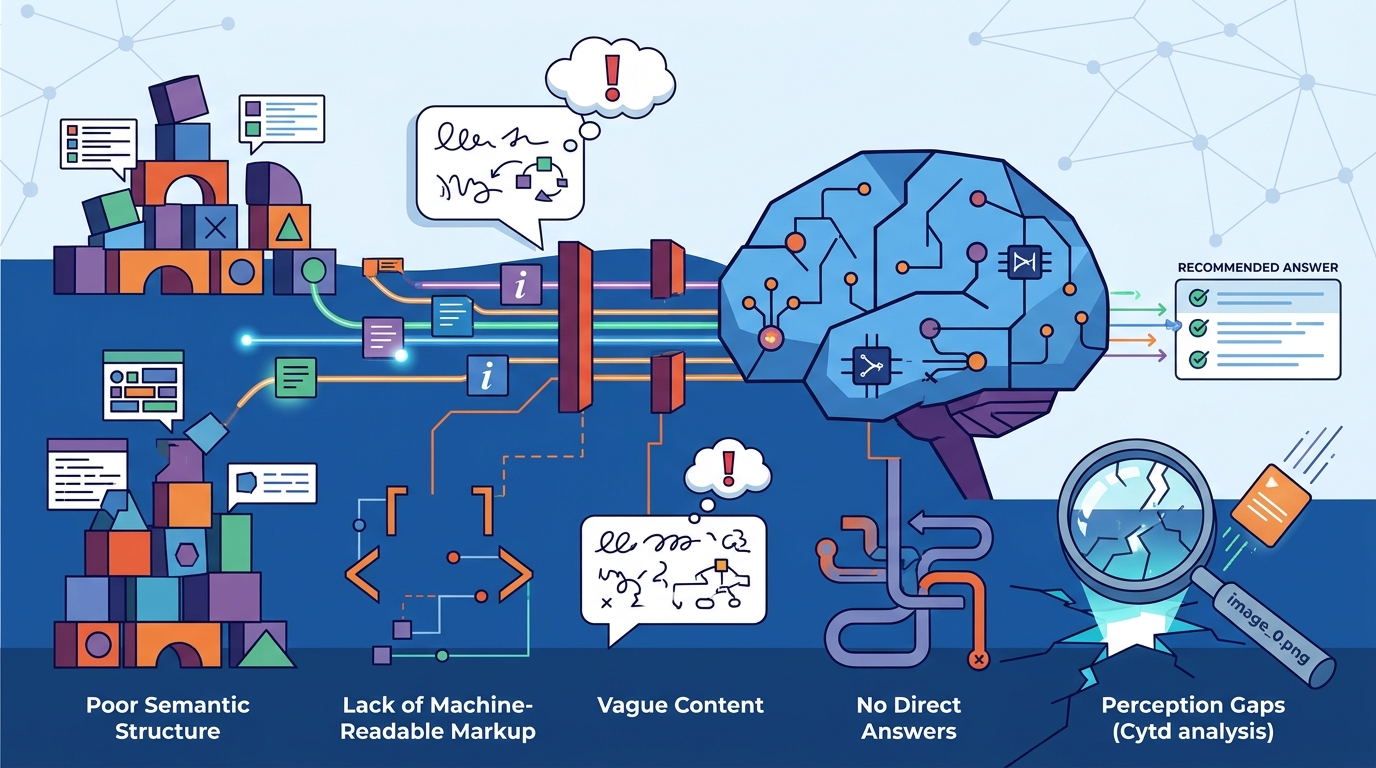
AI engines often fail to cite your website due to poor semantic structure, lack of machine-readable markup, and content that does not directly answer user questions. Cytd helps brands identify these gaps by analyzing how AI models perceive your digital presence. By fixing these foundational errors, you can improve your chances of being recommended in AI-generated answers.
Lacking Semantic Structure and Clear Hierarchy
AI models rely on semantic HTML to understand the relationship between different parts of your page. If your website uses generic divs instead of semantic tags, the AI cannot easily parse your content. Semantic structure is the use of HTML tags that describe the meaning of the content rather than just its appearance. For example, using an H1 tag for the main title and H2 tags for sections helps the AI map the topic hierarchy. Without this, your content is just a wall of text to the model. Cytd’s platform analyzes your site’s structure to ensure it is readable by both humans and machines.
Missing Machine-Readable Markup and Schema
Structured data is a critical component of AI visibility. Schema markup is a standardized vocabulary of tags and attributes that you can add to your website to help search engines and AI models understand the content. If you do not use schema, the AI has to guess what your business is, what you sell, and where you are located. This guessing often leads to errors or complete omission. Adding proper schema, such as LocalBusiness or Product, gives the AI explicit facts to cite. This is a low-effort, high-impact fix that many businesses overlook.
Writing Vague Content That Does Not Answer Questions
AI engines are designed to answer specific questions. If your content is vague, promotional, or buried under fluff, the AI will not use it. Answer-first formatting is a writing style that presents the direct answer to a question before providing supporting details. For instance, if a user asks, "What is the best CRM for small businesses?", your page should start with a clear recommendation or definition. Then, you can elaborate. Cytd helps you restructure your content to match this format, ensuring the AI can extract the key information instantly.
Ignoring Indexing and Crawlability
Failing to Monitor AI Visibility
Many businesses assume that if they are ranking well in Google, they are visible in AI engines. This is a dangerous misconception. AI visibility is the measure of how often and how prominently your brand is cited in AI-generated answers. The factors that influence AI citations are different from those that influence traditional search rankings. You need to monitor your presence across platforms like ChatGPT, Gemini, and Perplexity. Cytd provides a dedicated dashboard to track your AI visibility score, helping you see exactly where you stand and what needs improvement.
Key Takeaways
- Use semantic HTML tags to help AI models understand your content structure.
- Implement schema markup to provide explicit facts about your business.
- Adopt answer-first formatting to make your content easy for AI to extract.
- Ensure your site is crawlable and indexable by AI engines.
- Monitor your AI visibility separately from traditional search rankings.
- Use tools like Cytd to get a clear picture of your AI presence.
Frequently Asked Questions
What is the main reason AI engines do not cite my website?
The main reason is often a lack of semantic structure and machine-readable markup. AI models need clear, structured data to understand and cite your content accurately.
How is AI visibility different from SEO?
AI visibility focuses on how often you are cited in AI-generated answers, while SEO focuses on ranking in traditional search results. The factors that influence each are different.
Do I need to change my website design to improve AI visibility?
No, you do not need to change the visual design. You need to improve the underlying code structure, such as using semantic HTML and adding schema markup.
Can I control what AI models say about my business?
You cannot directly control what AI models say, but you can influence it by providing clear, accurate, and well-structured content that is easy for the models to cite.
How often should I check my AI visibility?
You should check your AI visibility regularly, at least monthly, to track changes and identify new opportunities for improvement.
Start Improving Your AI Visibility Today
Fixing these common mistakes is the first step toward becoming a trusted source for AI engines. By focusing on semantic structure, schema markup, and answer-first content, you can significantly improve your chances of being cited. Run your free AI visibility report with Cytd to see exactly where you stand and get a clear action plan to improve your presence in the AI answer layer. Learn more: Visibility Platform.