

Track AI citations by monitoring how often your brand appears in synthesized answers from major AI platforms. You must measure visibility, authority, and coverage across tools like ChatGPT, Gemini, and Perplexity. This approach reveals where you are recommended and where you are invisible to modern buyers.
The Shift from Rankings to Citations
Traditional search optimization focused on ranking for human clicks. Today, visibility is no longer just about ranking on a page of blue links. It is about being the answer in the chatbox. Recent industry analysis indicates that 25% of all search volume has already shifted toward AI-generated responses. This shift means that if your brand is not explicitly cited by generative models, you are invisible to a quarter of the market.
The new ranking signals are not just keywords. They are trust markers. Reviews, citations, and structured data form the backbone of AI comprehension. Without them, algorithms cannot verify your authority or relevance. This is the core of the new ranking ecosystem. It is not about guessing what users want. It is about proving you are the safest, most credible option.
Core Metrics for AI Visibility
Effective AI visibility measurement requires a new set of KPIs. Visibility is the first gatekeeper. If a business lacks a digital footprint that these models can easily parse and index, it effectively ceases to exist in the AI's knowledge graph. When a user asks a question, the AI scans its internal database for entities that match the query's intent. If your business has not been explicitly mentioned in high-quality, authoritative contexts, the AI cannot retrieve your name.
Authority is the second critical metric. Large language models are trained to prioritize information from reputable, established, and trusted entities. This is similar to how traditional search engines use backlinks and domain authority, but the criteria are often more nuanced. AI models look for consistency and verification across multiple platforms. If your brand information is fragmented or inconsistent, the model may misinterpret your business or omit it entirely.
Coverage is the third metric. It measures how many topics you come up as the answer for in your category. A low score in any of these areas means you are invisible at the moment that matters most to your customers. Most brands fail this initial check because their digital footprint is fragmented or thin. When those signals are weak, the AI plays it safe and names someone else.
Multi-Platform Monitoring Strategy
Single-platform tools leave blind spots in your strategy. AI models like ChatGPT, Gemini, Perplexity, and Grok each have distinct training data and ranking methodologies. A robust service must actively check your brand's presence across this entire ecosystem. According to recent industry analysis, 25% of all search volume has shifted toward AI-generated responses. This means your customers are likely asking multiple different assistants for the same recommendation.
If your service only optimizes for one platform, you are leaving significant market share on the table. Look for providers that offer cross-platform visibility checks to ensure your brand is consistently recognized regardless of which tool your customer uses. Different AI platforms pull from different data sources and respond differently to content. By tracking multiple engines, you can optimize content for broader AI coverage and avoid relying on a single platform.
This helps you quickly understand where your content is performing best. It also helps you identify where you are gaining or losing visibility. You can see which AI platforms recommend you, which ones don't, and what your customers see when they ask. This data is essential for building a comprehensive AI visibility strategy.
Automated Tracking and Reporting
Manual tracking is not scalable. You need automated systems that monitor your presence across AI platforms and break it down into clear metrics. This includes tracking AI citations, visibility frequency, and topical coverage. AI citation visibility is the metric that determines how often your brand appears as a source in generative AI responses. When a buyer asks an AI assistant for a recommendation, the model scans its training data and real-time indexed content to find the most trustworthy entities.
Automated tools can track changes over time so you can see what is working and where to improve. They can also identify topics where competitors are being cited but your site is not. This content gap analysis is crucial for strategic planning. It allows you to create or recommend content designed to increase your chances of being referenced by AI engines. Continuous monitoring ensures that your visibility strategy remains effective as models and user behavior evolve.
Reporting should be clear and actionable. A dedicated account manager can review performance with you each month. This human element is important because it provides context and strategic recommendations. It helps you understand not just what is happening, but why it is happening and what you should do next. according to Electronic Case Reporting
Key Takeaways
- AI visibility is the measure of how frequently a brand appears in generative AI responses.
- Traditional SEO metrics like keyword rankings are insufficient for measuring AI visibility.
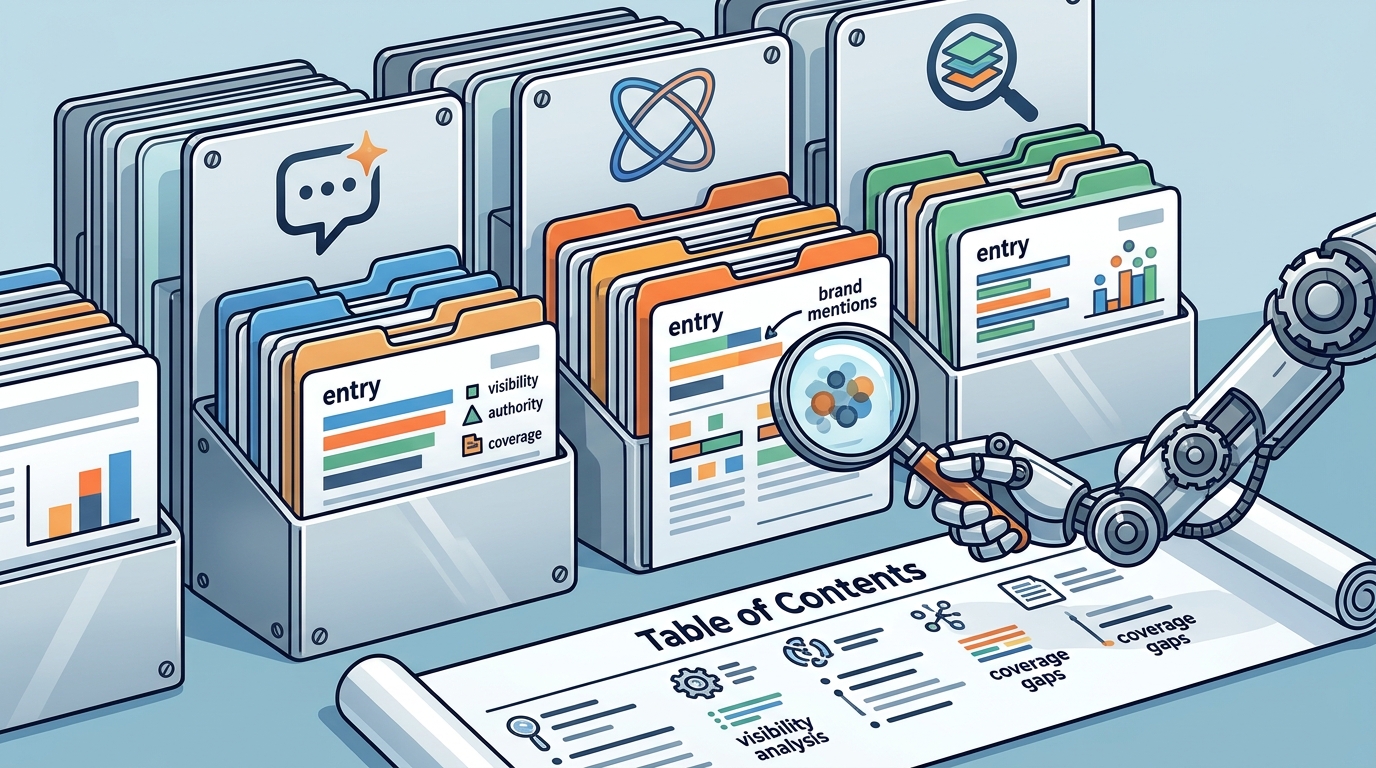
- You must track visibility, authority, and coverage across multiple AI platforms.
- Single-platform tools leave blind spots; multi-platform monitoring is essential.
- Automated tracking and reporting are necessary for scalable AI visibility management.
- Content gap analysis helps identify topics where competitors are winning citations.
- Human support and strategic recommendations add context to automated data.
Frequently Asked Questions
What is AI citation visibility?
AI citation visibility is the metric that determines how often your brand appears as a source in generative AI responses. It measures how frequently your brand is mentioned or used as a source in AI-generated answers.
Why is multi-platform tracking important?
Multi-platform tracking is important because different AI models have distinct training data and ranking methodologies. Tracking multiple engines ensures your brand is consistently recognized regardless of which tool your customer uses.
What metrics should I track for AI visibility?
You should track visibility, authority, and coverage. Visibility measures how often your brand appears in AI shortlists. Authority assesses the trustworthiness of your digital footprint. Coverage measures how many topics you are recognized for.
How often should I monitor my AI citations?
You should monitor your AI citations continuously. Automated tools can track changes over time so you can see what is working and where to improve. Weekly or monthly reporting is common for managed services.
Can I track AI citations manually?
Manual tracking is not scalable. You need automated systems that monitor your presence across AI platforms and break it down into clear metrics. Manual tracking is only feasible for a small number of prompts and platforms.
What is the difference between AI visibility and traditional SEO?
AI visibility measures how often your brand appears in AI-generated answers. Traditional SEO focuses on ranking for human clicks. AI visibility depends on how well your content aligns with the retrieval patterns of AI systems.
Start Measuring Your AI Visibility
Understanding your AI visibility is the first step toward reclaiming your share of AI-driven discovery. Cytd helps organizations track these metrics across multiple platforms. You can run a free AI visibility report to see how ChatGPT, Gemini, and Perplexity currently describe your business. This report shows your visibility score and what needs fixing. To get started, run your free AI report and see where you stand in AI search results.