

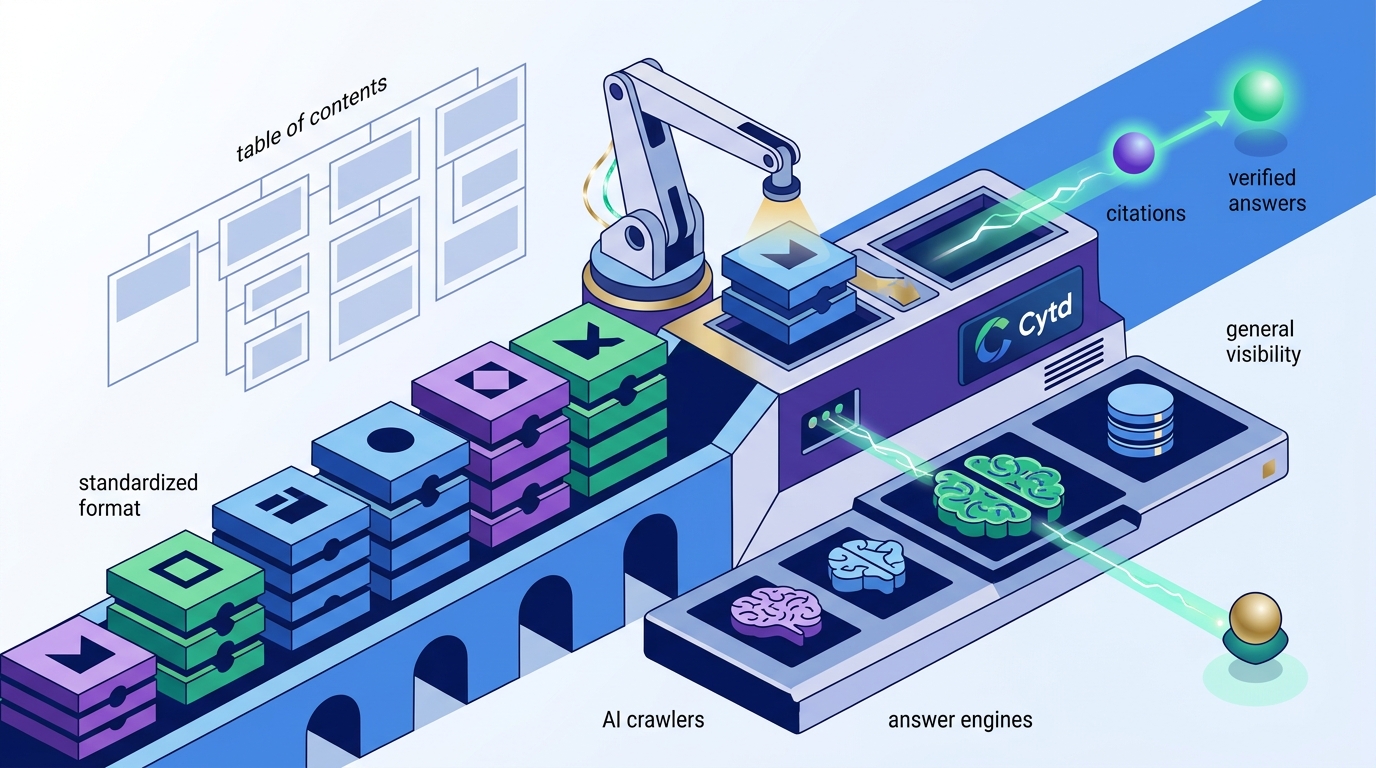
Structured data markup is a standardized format that helps machines understand the meaning of web content. In the context of AI search visibility, it acts as a bridge between your website and AI answer engines like ChatGPT, Gemini, and Perplexity. By providing explicit context, you reduce the guesswork for AI crawlers, making it significantly easier for them to extract, verify, and cite your information in generated answers.
The Shift from Keywords to Semantic Context
Traditional search engines relied heavily on keyword density to determine relevance. AI answer engines operate differently. They process natural language queries and synthesize answers from multiple sources. Structured data provides the semantic context that allows these models to understand the specific entities on your page. For example, a local dental practice in Portland, Oregon, can use LocalBusiness schema to explicitly define its services, hours, and location. This clarity helps AI models distinguish the practice from generic dental content, increasing the likelihood of being cited for specific, high-intent queries.
Machine-Readable Markup for AI Crawlers
AI crawlers are designed to parse clean, semantic HTML. When a page lacks structured data, the AI must infer meaning from unstructured text, which can lead to errors or omissions. Cytd emphasizes the use of machine-readable markup, including proper headers, tables, and schema, to ensure AI crawlers can parse content without guesswork. This approach is critical for businesses that want to be recognized as authoritative sources. By structuring data correctly, you provide a reliable signal that your content is well-organized and trustworthy, which is a key factor in AI citation algorithms.
Building Topical Authority Through Schema
Topical authority is the measure of how well a website covers a specific subject in depth. Structured data helps establish this authority by linking related content and defining the relationships between entities. For instance, a supplement company selling plasmalogen precursors can use Product and FAQ schema to connect their products to specific health benefits and common questions. This interconnected web of structured data helps AI models understand the full scope of your expertise. It moves your brand from being a single data point to a comprehensive resource, which is essential for earning citations in complex, multi-faceted answers.
Verification and Trust Signals
AI models prioritize sources that can be independently verified. Structured data provides a consistent, machine-readable format that allows AI systems to cross-reference information across different platforms. If your website, social media profiles, and directory listings all use consistent structured data, it creates a strong trust signal. This consistency is crucial for local businesses, where AI models often rely on corroborated data to recommend specific venues. By ensuring your structured data is accurate and consistent, you reduce the friction for AI models to verify your claims, thereby increasing your visibility in AI-generated search results.
Implementing Structured Data for AI Visibility
Implementing structured data is a technical process that requires precision. It involves adding JSON-LD or Microdata to your HTML to define entities like articles, products, and organizations. For businesses using a managed service, this process is often handled by experts who ensure the markup is valid and aligned with AI crawler requirements. The goal is to create a digital footprint that is not only human-readable but also machine-optimized. This dual approach ensures that your content is accessible to both traditional search engines and modern AI answer engines, maximizing your overall digital presence.
Key Takeaways
- Structured data provides semantic context that helps AI models understand and cite your content.
- Machine-readable markup reduces guesswork for AI crawlers, improving parsing accuracy.
- Consistent structured data across platforms builds trust and verification signals for AI systems.
- Topical authority is strengthened by linking related entities through schema markup.
- Local businesses benefit significantly from LocalBusiness schema to enhance AI visibility.
- Valid and precise structured data is a foundational element of AI search visibility strategy.
Frequently Asked Questions
What is structured data markup?
Structured data markup is a standardized format, such as JSON-LD, that provides explicit context about the content of a web page to search engines and AI models.
How does structured data help AI search visibility?
It helps AI models understand the meaning of your content, making it easier for them to extract, verify, and cite your information in generated answers.
Is structured data the same as SEO keywords?
No, structured data provides semantic context and entity relationships, whereas keywords are terms used to match search queries. AI models rely more on semantic understanding than keyword density.
Which types of structured data are most important for AI?
Schema types like LocalBusiness, Product, Article, and FAQ are particularly important because they define specific entities and relationships that AI models can easily parse and cite.
Can I implement structured data myself?
Yes, but it requires technical knowledge of HTML and schema standards. Many businesses use managed services to ensure the markup is valid and optimized for AI crawlers.
Does structured data guarantee AI citations?
No, structured data improves the likelihood of being cited by making your content easier to understand and verify, but it does not guarantee specific rankings or citations.