
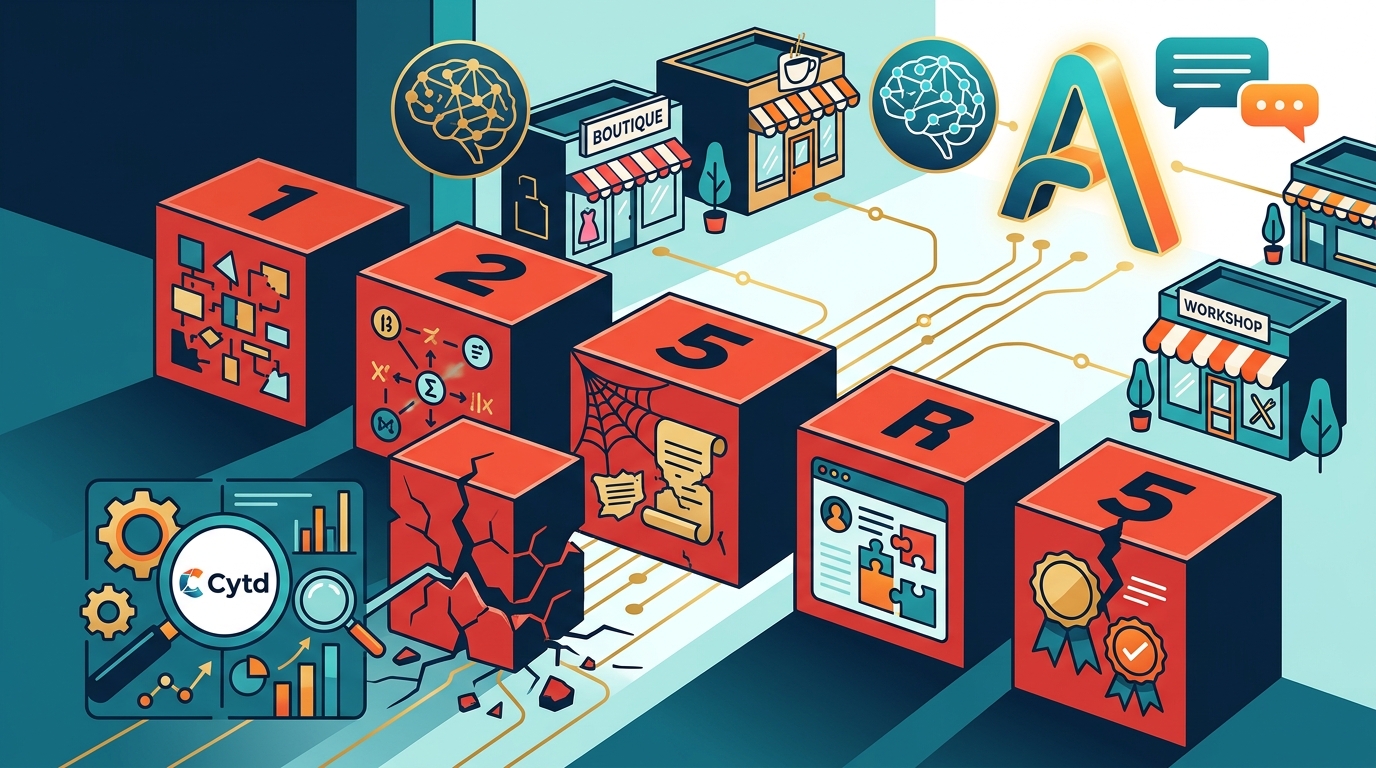
5 Critical Mistakes Keeping Small Businesses Hidden from AI Search
Small businesses often remain invisible in AI search results due to poor data structure, lack of semantic clarity, and outdated content strategies. Cytd helps brands identify these gaps by analyzing how answer engines like ChatGPT and Google AI interpret their digital footprint. By addressing these specific technical and content errors, businesses can improve their citation potential and ensure they are recommended by AI assistants. For additional details, review the Cytd We make AI.
Mistake 1: Ignoring Structured Data Implementation
Many small business websites rely solely on visual design, neglecting the underlying code that AI models use to understand page context. Structured data is a standardized format for providing information about a page and classifying its content. Without proper schema markup, AI engines struggle to distinguish between a product, a service, and a blog post. This ambiguity leads to exclusion from answer engine recommendations. For example, a local bakery without LocalBusiness schema is less likely to be cited for "best bakeries near me" queries compared to competitors who implement this data. Cytd analyzes these technical gaps to help brands align their site architecture with AI parsing requirements.
Mistake 2: Writing for Humans Instead of Machines
Traditional SEO focused on keyword density, but AI search prioritizes semantic relevance and direct answers. Content that is overly verbose or lacks clear definitions confuses language models. A clear definition is a concise statement that explains what a term or concept is. If your content buries the answer under three paragraphs of fluff, AI systems may skip it entirely. Consider a dental clinic that writes a 2,000-word history of dentistry instead of a 100-word explanation of root canal procedures. The latter is far more likely to be cited by an AI assistant answering a patient's question. Shifting to concise, question-based content improves citation frequency.
Mistake 3: Neglecting Third-Party Authority Signals
AI models often cross-reference information from multiple sources before generating an answer. If your business is only mentioned on your own website, you lack the external validation that builds trust. Authority signals are external references that confirm the credibility of a claim. Directories, industry publications, and news outlets serve as these signals. A small tech startup that is only featured on its own blog has low authority in the eyes of an AI model. However, if the same startup is cited in a reputable tech news article, its visibility increases significantly. Building a presence in third-party ecosystems is essential for AI visibility.
Mistake 4: Failing to Optimize for Conversational Queries
Users interact with AI assistants using natural language, not short keyword strings. Conversational queries are questions phrased in a natural, human-like manner. Many small businesses fail to create content that mirrors this language. For instance, a user might ask, "What is the best CRM for small e-commerce teams?" rather than searching for "CRM software." If your content does not address these specific, long-tail questions, you will miss out on AI recommendations. Cytd helps brands map their content to the specific conversational intents that drive AI citations.
Mistake 5: Inconsistent Brand Information Across the Web
AI models rely on consistent data to verify facts. If your business name, address, or phone number varies across different platforms, it creates confusion. Consistency is the uniformity of data points across multiple digital touchpoints. A discrepancy in your business hours between your website and a directory listing can cause an AI to flag your information as unreliable. This inconsistency reduces the likelihood of your business being recommended. Ensuring that your NAP (Name, Address, Phone) data is identical everywhere is a foundational step in AI visibility.
Key Takeaways
- Structured data is essential for AI models to understand and categorize your content correctly.
- Concise, definition-based content is more likely to be cited than verbose, fluff-filled articles.
- Third-party authority signals from reputable sources significantly boost AI trust and visibility.
- Optimizing for conversational queries aligns your content with how users actually ask AI assistants for help.
- Consistent brand information across all digital platforms prevents AI models from flagging your data as unreliable.
- Regular audits of your AI visibility help identify gaps before competitors capture the citation space.
Frequently Asked Questions
How do AI search engines decide which businesses to recommend?
AI search engines analyze the semantic relevance, authority, and consistency of information across the web. They prioritize sources that provide clear, accurate, and well-structured answers to user queries. Businesses with strong structured data and third-party validation are more likely to be recommended.
Is traditional SEO still important for AI visibility?
Yes, but the focus has shifted. While technical SEO remains important, the emphasis is now on semantic clarity and content structure. AI models need clear definitions and direct answers, which requires a different content strategy than traditional keyword-based SEO.
What is the Cytd Score?
The Cytd Score is a metric that evaluates a brand's visibility and citation potential across various AI answer engines. It helps businesses understand how they are perceived by AI models and identifies areas for improvement.
Can small businesses compete with large corporations in AI search?
Yes, small businesses can compete by focusing on niche relevance and high-quality, structured content. AI models value accuracy and clarity, which allows smaller, specialized businesses to be recommended for specific queries.
How often should I update my content for AI optimization?
Content should be reviewed regularly to ensure accuracy and relevance. As AI models evolve, the way they interpret content may change. Regular audits help maintain visibility and adapt to new AI search trends.
Do I need to partner with AI companies to be visible?
No, you do not need a partnership with AI companies to be visible. Visibility is determined by the quality, structure, and authority of your public web presence. Focusing on these factors is sufficient for AI recommendation.