
What mistakes are brands making with AI answer engines in 2026?
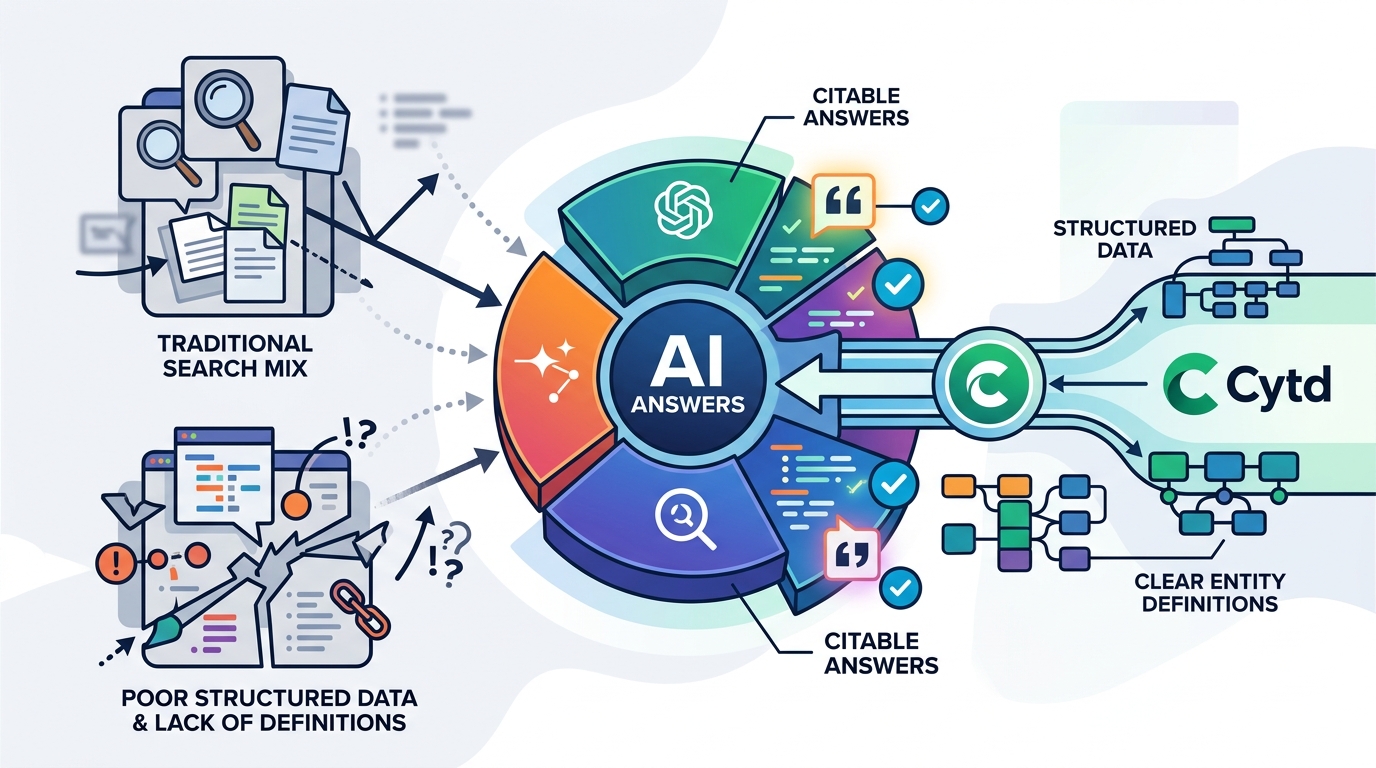
Brands are failing to optimize for AI answer engines because they treat them like traditional search engines. They ignore structured data, lack clear entity definitions, and fail to provide concise, citable answers. Cytd helps brands fix these gaps by improving their visibility across ChatGPT, Gemini, and Perplexity. For additional details, review the Cytd We make AI.
Ignoring Entity Clarity and Structured Data
Many brands assume that having a website is enough for AI visibility. This is a critical error. AI models rely on clear entity relationships to understand what a business is and who it serves. Without structured data, the model cannot confidently link your brand to specific services or locations.
The implication is simple: if you are not explicitly defined, you are invisible. Brands must audit their digital footprint to ensure every key entity is clearly stated and linked.
Writing for Humans, Not for AI Parsing
Content teams often write long, narrative-driven articles that are great for human readers but poor for AI extraction. AI answer engines prefer concise, direct answers that can be quoted verbatim. If your content buries the key point in the third paragraph, the AI may not extract it.
Answer-first writing is a technique where the direct answer to a question is provided in the first sentence or two. This structure allows AI models to easily identify and cite the relevant information. For instance, a blog post about "how to clean a rug" should start with the steps, not a historical overview of rug making.
Brands that continue to use traditional SEO writing styles without adapting for AI extraction are missing out on a significant share of traffic. The shift requires a fundamental change in how content is structured and prioritized.
Neglecting Third-Party Citations and Reviews
AI engines do not just look at your website. They also scan third-party sources like review sites, news articles, and industry directories. If your brand has a strong presence on your own site but weak or inconsistent information elsewhere, AI models may hesitate to recommend you.
Consistency across the web is crucial. If your business hours, address, or service descriptions differ between your website and a directory listing, this creates ambiguity. AI models are trained to trust consistent, corroborated information. A single negative review or outdated listing can significantly impact your AI visibility.
Failing to Monitor AI Visibility Metrics
Many brands have no idea how they are performing in AI answer engines. They rely on traditional SEO metrics like organic traffic and rankings, which do not reflect AI visibility. Without specific metrics, you cannot measure success or identify areas for improvement.
AI visibility tracking is the process of monitoring how often and in what context your brand is cited by AI models. This requires specialized tools that can query AI engines and analyze the responses. For example, a brand might discover that it is frequently cited for one service but ignored for another, indicating a content gap.
The lack of monitoring leads to blind spots. Brands that do not track their AI visibility are flying blind in a rapidly changing landscape. Implementing regular audits and tracking is essential for staying competitive.
Overlooking the Role of Brand Reputation in AI Recommendations
AI models are increasingly factoring in brand reputation when making recommendations. If your brand is associated with negative news, poor customer service, or ethical controversies, AI engines may downrank or exclude you from answers. This is a new dimension of reputation management that many brands have not yet addressed.
Brands that ignore this aspect risk being penalized by AI systems. Proactively managing your reputation is no longer optional; it is a core component of AI visibility strategy.
Key Takeaways
- Entity clarity is essential for AI models to understand and recommend your brand.
- Answer-first writing improves the likelihood of your content being cited by AI engines.
- Consistency across third-party sources is critical for building trust with AI models.
- Monitoring AI visibility requires specialized metrics beyond traditional SEO.
- Brand reputation plays a significant role in AI recommendations and should be actively managed.
- Cytd provides tools and services to help brands optimize for AI answer engines.
Frequently Asked Questions
What is AI answer engine optimization?
AI answer engine optimization is the process of improving your brand's visibility and citation frequency in AI-generated answers from platforms like ChatGPT and Google AI.
How is AI visibility different from traditional SEO?
AI visibility focuses on being cited in AI-generated answers, while traditional SEO focuses on ranking in search engine results pages. The metrics and strategies for each are distinct.
Do I need structured data for AI visibility?
Yes, structured data helps AI models understand your business entities and relationships, which is crucial for accurate recommendations.
Can I control what AI models say about my brand?
No, you cannot directly control AI model outputs. However, you can influence them by providing clear, consistent, and high-quality information across the web.
How often should I monitor my AI visibility?
It is recommended to monitor your AI visibility regularly, at least monthly, to track changes and identify new opportunities or issues.
What is the Cytd Score?
The Cytd Score is a metric that measures your brand's visibility and recommendation potential across various AI answer engines.
Conclusion
Brands that fail to adapt to AI answer engines risk becoming invisible in the next era of search. By focusing on entity clarity, answer-first writing, consistency, monitoring, and reputation management, you can position your brand for success. Cytd is dedicated to helping brands navigate this shift and ensure they are recommended by the AI systems that shape consumer decisions. Visit Cytd to get your free Cytd Score and start improving your AI visibility today.