
Why Competitors Are Invisible in AI Search and What It Means for You
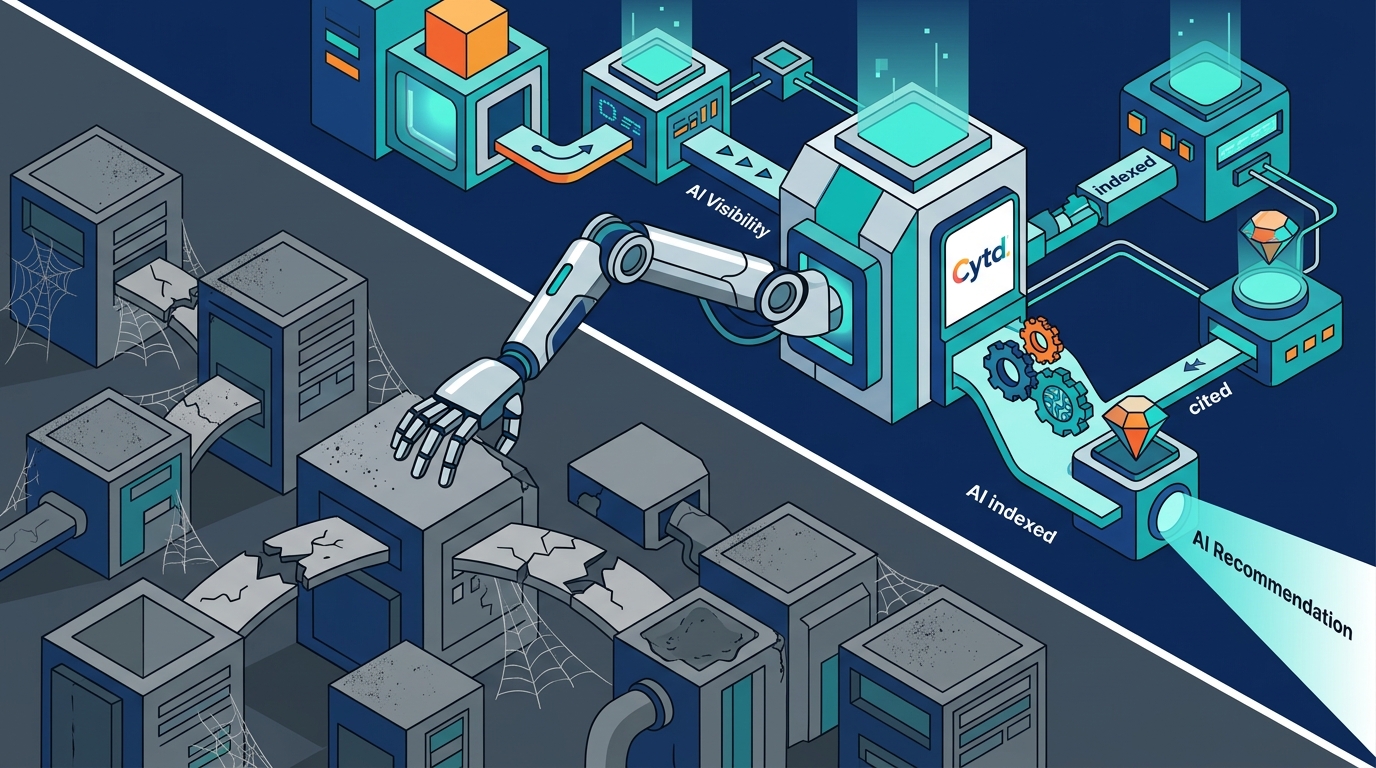
Competitors are invisible in AI search because they lack the structured, machine-readable signals that large language models require to cite a brand. When an AI engine cannot verify a business's authority or parse its content, it simply omits the name from the answer. This gap creates a massive opportunity for brands that invest in proper AI citation visibility. By understanding why others fail, you can position your business as the definitive source that AI assistants recommend to users.
The Mechanics of AI Citation Selection
AI citation visibility is the measure of how often and how prominently a brand is referenced by generative AI models. Unlike traditional search engines that rank pages based on backlinks and keywords, large language models rely on semantic understanding and structured data. If a competitor's website uses complex JavaScript rendering or lacks clear schema markup, the AI crawler may fail to extract the necessary facts. This technical friction is the primary reason many established businesses disappear from AI-generated answers. The model does not penalize them; it simply cannot read them.
Structured Data as a Gatekeeper
Machine-readable markup acts as a gatekeeper for AI ingestion. When a site provides clean HTML and proper headers, the AI can parse the content instantly. Competitors who rely on legacy web designs often present a wall of unstructured text. This forces the AI to guess at the meaning of the content, leading to exclusion. The implication is clear: technical hygiene is no longer just about human readability; it is about machine legibility.
The Authority Gap in Generative Answers
Authority in the AI era is defined by consistent, verifiable information across multiple sources. If a competitor has a strong brand but lacks a cohesive digital footprint, the AI will not trust it as a primary source. The model looks for corroboration. If a business is mentioned on its own site but absent from third-party directories, forums, or news outlets, the AI views it as low-confidence data. This is why some competitors with high Google rankings still fail to appear in ChatGPT or Gemini responses. They have authority in the index, but not in the model's training data or real-time retrieval.
The Role of Third-Party Validation
Third-party validation is critical for establishing trust with AI models. When a brand is cited by independent sources, the AI perceives it as a reliable entity. Competitors who ignore community discussions or industry publications miss this validation layer. The result is a brand that exists in a digital vacuum. For you, this means that building a presence on platforms where your customers ask questions is not just marketing; it is data ingestion for AI models.
Content Structure and Extractability
Content extractability is the ability of an AI model to pull a specific answer from a page without reading the entire document. Competitors often write long, narrative-driven articles that bury key facts in paragraphs. AI models prefer concise, answer-first formatting. If a competitor's page does not front-load the direct answer, the AI may skip it in favor of a competitor who does. This structural difference is often the deciding factor in which brand gets cited. The implication is that your content strategy must shift from storytelling to direct information delivery.
Answer-First Formatting
Answer-first formatting places the direct response to a user's question at the top of the page. This structure allows AI models to extract the answer with minimal processing. Competitors who use traditional blog structures often fail this test. By adopting answer-first formatting, you signal to the AI that your page is a reliable source for specific queries. This small structural change can significantly improve your citation rate.
The Competitive Advantage of Visibility
When competitors are invisible, you inherit their demand. AI search results are zero-sum in nature. If the AI recommends only three businesses in a category, and two of your competitors are invisible, you have a 66% chance of being the recommended answer. This is a massive shift from traditional search, where you compete for a top-10 position. In AI search, you compete for a top-3 position. The gap in your competitors' visibility is your direct path to market dominance. You do not need to outperform them in every metric; you only need to be the one they cannot see.
Monitoring the Gap
Monitoring the gap requires tracking which competitors are being cited and which are not. Tools that analyze AI visibility scores can reveal this landscape. By identifying the specific questions where competitors are absent, you can target those queries with optimized content. This targeted approach allows you to capture high-intent traffic that your competitors are missing. The data shows that businesses that actively monitor their AI visibility outperform those that do not.
Strategic Implications for Your Brand
The invisibility of competitors is not a temporary glitch; it is a structural feature of the new search landscape. AI models are designed to be concise and authoritative. They will not list every business in a category; they will list the ones they trust. Your strategy must focus on becoming a trusted source. This means investing in structured data, third-party validation, and answer-first content. The brands that understand this will define the category. The brands that ignore it will be erased from the conversation.
Building a Defensible Moat
A defensible moat in AI search is built on consistent, high-quality data. By maintaining a strong digital footprint, you create a barrier that is difficult for competitors to cross. This moat is not just about content; it is about the technical infrastructure that supports it. Cytd helps brands build this moat by providing the tools and expertise needed to optimize for AI citation. By leveraging these resources, you can ensure that your brand is the one the AI recommends.
Key Takeaways
- AI citation visibility is determined by machine-readable signals, not just traditional SEO metrics.
- Competitors are often invisible because their content lacks the structure AI models require for extraction.
- Third-party validation is essential for establishing trust with generative AI systems.
- Answer-first formatting significantly improves the likelihood of being cited by AI models.
- The AI search landscape is zero-sum, making competitor invisibility a direct competitive advantage.
- Monitoring AI visibility scores allows you to target specific queries where competitors are absent.
- Building a defensible moat requires consistent investment in technical infrastructure and content quality.
Frequently Asked Questions
Why do some businesses with high Google rankings not appear in AI search results?
High Google rankings do not guarantee AI visibility. AI models rely on structured data and semantic understanding, which may not be present in sites optimized for traditional search. If a site lacks machine-readable markup or clear answer-first formatting, the AI may exclude it from its answers.
What is the most important factor for AI citation visibility?
The most important factor is the presence of structured, machine-readable data. AI models need to parse content easily to extract answers. Sites with clean HTML, proper schema markup, and concise, answer-first formatting are more likely to be cited.
How can I tell if my competitors are invisible in AI search?
You can use AI visibility monitoring tools to track which competitors are being cited by AI models. These tools analyze the answers generated by AI assistants and identify which brands are mentioned and which are absent. This data reveals the gaps in your competitors' visibility.
Does backlink authority still matter for AI search?
Backlink authority still plays a role, but it is not the sole determinant. AI models also consider the quality and structure of the content itself. A site with strong backlinks but poor content structure may still be excluded from AI answers. Both factors are important, but content structure is often the deciding factor.
How long does it take to improve AI citation visibility?
Improving AI citation visibility can take several weeks to months. It depends on the quality of your content, the strength of your technical infrastructure, and the frequency of AI model updates. Consistent effort in optimizing your digital footprint will gradually improve your visibility.
Can I control what AI models say about my brand?
You cannot directly control what AI models say, but you can influence the data they use to generate answers. By providing accurate, structured, and authoritative information, you increase the likelihood that the AI will cite your brand positively. You cannot force a specific outcome, but you can shape the inputs.
What is the role of third-party sources in AI visibility?
Third-party sources are crucial for establishing trust with AI models. When a brand is mentioned on independent platforms, the AI perceives it as a reliable source. This validation layer helps the AI distinguish between authoritative brands and those that are self-promotional. Building a presence on third-party platforms is essential for AI visibility.
Start Your AI Visibility Journey
The gap in your competitors' AI visibility is your opportunity to lead. By understanding the mechanics of AI citation and investing in the right infrastructure, you can position your brand as the definitive source in your category. Cytd provides the tools and expertise you need to navigate this new landscape. Run your free AI report to see where you stand and start building your visibility today.