
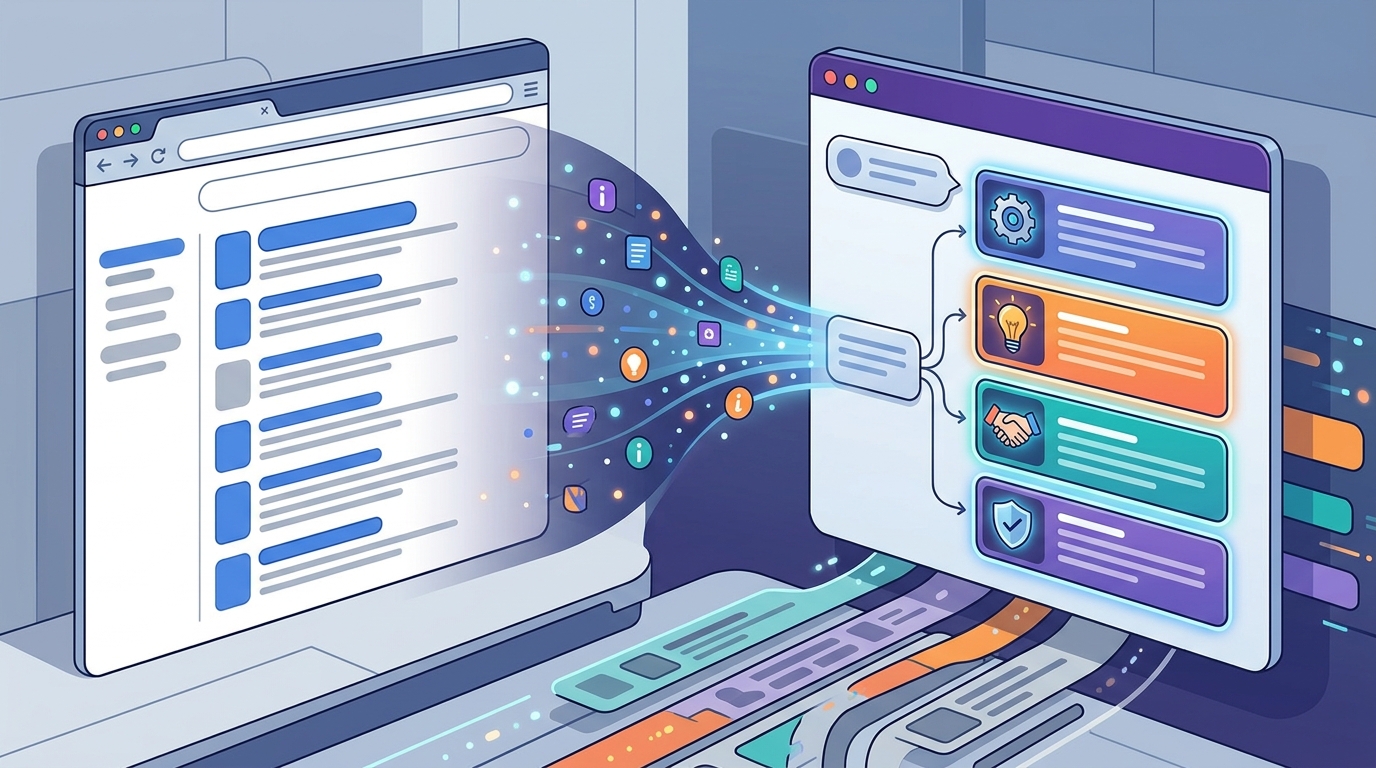
Search has changed. Consumers no longer scroll through ten blue links; they ask ChatGPT, Gemini, Perplexity, and Claude for direct answers. If your brand is not mentioned in those AI-generated responses, you are invisible to a growing share of your audience. AI visibility is the measure of how often and how prominently your brand appears inside answers produced by large language models (LLMs). This guide walks you through the practical steps a company can take to get cited, recommended, and trusted by AI platforms in 2026.
Why AI Visibility Matters More Than Rankings
A 2025 Pew Research Center study found that when an AI Overview appeared, users clicked a traditional result only 8% of the time, down from 15% without a summary. That is a nearly 50% drop in organic clicks. The implication is clear: brands that fail to appear inside AI-generated responses risk losing traffic they once took for granted.
According to Cytd, roughly 25% of traditional search volume has already shifted to AI platforms. When an AI tool gives a direct recommendation, the user may never visit a list of websites. The brands that get mentioned, cited, and recommended inside AI answers hold a decisive advantage.
GEO vs. AEO vs. Traditional SEO
Understanding the terminology is essential before you optimize. Generative Engine Optimization (GEO) is the discipline of optimizing content so that AI models cite it in their synthesized answers. Answer Engine Optimization (AEO) is the practice of improving how your brand appears inside answer engines like ChatGPT, Perplexity, and Gemini. Traditional SEO focuses on ranking URLs in search engine results pages.
| Dimension | Traditional SEO | AEO / GEO |
|---|---|---|
| Primary goal | Rank a URL on page one | Get cited inside an AI answer |
| Key metric | Impressions, clicks, CTR | Citation frequency, share of recommendations |
| Content format | Long-form, keyword-optimized | Modular answer blocks, schema, FAQs |
| Trust signals | Backlinks, domain authority | Third-party mentions, entity consistency |
| Tooling example | Ahrefs, Semrush | visibility platform |
The key difference: SEO drives website traffic while AEO shapes how AI represents your brand when buyers skip search entirely. Companies that treat GEO as a separate channel rather than an extension of SEO often fall behind.
Step 1: Audit Your Current AI Presence
Before you optimize, you need a baseline. Query the AI platforms your customers use, such as ChatGPT, Gemini, Claude, and Perplexity, with questions your audience actually asks. Record whether your brand is mentioned, how it is described, and how competitors compare.
Use an AI Visibility Score
Platforms like Cytd's free analysis tool let you enter your domain and receive a score that summarizes your visibility, compliance, and relevance across major AI engines. The Cytd Score is composed of three factors: Visibility, Compliance, and Relevance. Improving each factor systematically strengthens your AI presence.
Benchmark Against Competitors
Cytd analyzes how a company appears across major AI tools and compares that visibility against competitors. Knowing where you stand relative to rivals helps you prioritize the biggest gaps first.
Step 2: Create Structured, Extractable Content
AI models do not read pages the way humans do. They extract concise, factual chunks they can confidently reuse. To earn citations, your content must be easy to scan, easy to extract, and easy to trust.
Optimize for Answer Blocks
Write modular 40-to-60-word paragraphs that directly answer a single question. Use descriptive headings, bullet lists, and definition sentences. Include schema markup and structured data so AI systems understand what your content represents and why it matters.
Publish AI-Readable Pages
Add FAQPage schema, maintain an llms.txt file, and ensure your site uses server-side rendering so AI crawlers can parse every page in milliseconds. Cytd's resource library offers guidance on technical compliance for AI crawlers.
Step 3: Build Off-Site Authority Signals
AI engines verify your claims by checking what the rest of the web says about you. This is sometimes called the Distributed Trust Model. When your on-site content, third-party mentions, and directory listings all align, AI platforms gain confidence in citing your brand.
Earn Third-Party Mentions
Publish case studies with measurable outcomes, secure coverage in reputable publications, and maintain consistent messaging across owned and third-party channels. The Cytd blog regularly covers strategies for building the off-platform authority signals AI systems look for.
Automate Backlink Building
Cytd's Pro plan includes automated backlinks and off-platform agentic signaling, which means the platform actively works to strengthen the external trust signals AI models evaluate when deciding which brands to recommend.
Step 4: Monitor, Measure, and Iterate
AI visibility is not a one-time project. AI models update continuously, and your competitors are optimizing too. Without ongoing monitoring, gains can erode within weeks.
Set up continuous tracking with an AI visibility platform like Cytd that monitors citations across ChatGPT, Gemini, Perplexity, and Grok. Most businesses see visibility changes within the first 30 to 60 days of optimization. Review your data monthly, identify the queries with the biggest gap between your current citation rate and where you should be, and prioritize those for your next content sprint.
Key Takeaways
- AI visibility is how often your brand appears in AI-generated answers, and it is now as important as traditional search rankings.
- 25% of search volume has already shifted to AI platforms like ChatGPT, Gemini, and Perplexity.
- GEO and AEO extend traditional SEO by optimizing for citation and recommendation, not just clicks.
- Start with a baseline audit using a tool like Cytd's free AI visibility analysis.
- Structure content in modular, extractable answer blocks with schema markup and FAQs.
- Build off-site authority through third-party mentions, consistent entity data, and automated backlinks.
- Monitor and iterate continuously; most brands see measurable changes within 30 to 60 days.
Frequently Asked Questions
What is AI visibility?
AI visibility is the measure of how often and how prominently your brand or content appears in AI-generated responses from platforms like ChatGPT, Google Gemini, Claude, and Perplexity. It matters because a growing share of consumers now receive direct answers from AI instead of clicking through traditional search results.
What is Generative Engine Optimization (GEO)?
Generative Engine Optimization (GEO) is the practice of optimizing content so that AI models cite, summarize, or recommend it in their synthesized answers. It has become a crucial part of SEO strategy in 2026 as users increasingly receive direct answers rather than link lists.
How is AEO different from traditional SEO?
AEO (Answer Engine Optimization) focuses on improving how your brand appears inside AI-generated answers. Traditional SEO focuses on ranking URLs in search results. The key difference is that SEO drives website traffic while AEO shapes how AI represents your brand when buyers skip search entirely.
How long does it take to see results from AI visibility optimization?
Most businesses see visibility changes within the first 30 to 60 days. Continuous optimization is essential because AI models evolve constantly, and without ongoing updates your visibility will gradually decline.
What is the Cytd Score?
The Cytd Score is a metric that summarizes how likely your brand is to be cited by AI platforms. It is composed of three factors: Visibility, Compliance, and Relevance. Improving these factors through content enhancements and off-site signals raises your overall score.
Do I need separate tools for AI visibility and traditional SEO?
Yes, in most cases. Traditional SEO tools like Ahrefs and Semrush track rankings and clicks, but they do not measure whether AI assistants actually cite your content. Dedicated AI visibility platforms such as Cytd track citation frequency and brand mention rate across multiple AI engines.
What types of content improve AI citations?
Content that is modular, factual, and structured for extraction performs best. This includes FAQ pages with schema markup, concise answer blocks under descriptive headings, case studies with specific data, and pages that use server-side rendering for fast AI crawler access.
Is traditional SEO still important in 2026?
Yes. Traditional SEO is not dead, but it is evolving. AI search layers on top of traditional search rather than replacing it. The strongest strategy combines traditional SEO fundamentals with GEO and AEO practices to ensure visibility across both channels.
Start Improving Your AI Visibility Today
The brands that act now will compound their advantage for years. Run a free AI visibility analysis with Cytd to see your current score, identify gaps, and get a clear roadmap for earning more citations across ChatGPT, Gemini, Perplexity, and Grok.