
How to Get Cited by AI Tools: 7 Proven Strategies for Your Website
Getting your website cited by AI tools like ChatGPT, Google AI Overviews, and Perplexity is no longer optional. With AI platforms citing only 2 to 7 domains per response, the competition for visibility is fierce but the rewards are significant. Organic click-through rates drop 61% when an AI Overview appears, yet brands cited inside that overview see a 35% CTR boost over traditional results. This guide walks you through seven actionable strategies to make your content the source AI models trust, extract, and reference. Whether you are a startup or an established brand, these techniques will help you optimize your content for AI citation and build lasting visibility.
What Is AI Citation Visibility?
AI citation visibility is the measure of how often and how prominently your website appears as a referenced source in AI-generated answers. Unlike traditional SEO, which focuses on ranking in a list of links, Generative Engine Optimization (GEO) targets inclusion inside the AI-generated answer itself. Understanding this distinction is the first step toward improving your chances of being cited.
Cytd helps brands measure and improve AI citation visibility across ChatGPT, Google AI, Grok, and other answer engines. The shift matters because 62% of users now begin their search journey with AI tools rather than traditional engines.
Step 1: Audit Your Current AI Visibility
Before optimizing anything, you need a baseline. Enter your target prompts into ChatGPT, Perplexity, and Google AI Overviews to see which sources get cited and why. Study the tone, structure, and clarity of those cited sources to understand what qualifies as trustworthy and quotable.
An audit reveals three types of opportunities: prompts where competitors appear but you do not, prompts where you are mentioned but not cited, and prompts where you are already winning. Tools like the Cytd visibility score help you quantify exactly where you stand across platforms.
Step 2: Structure Content for LLM Extraction
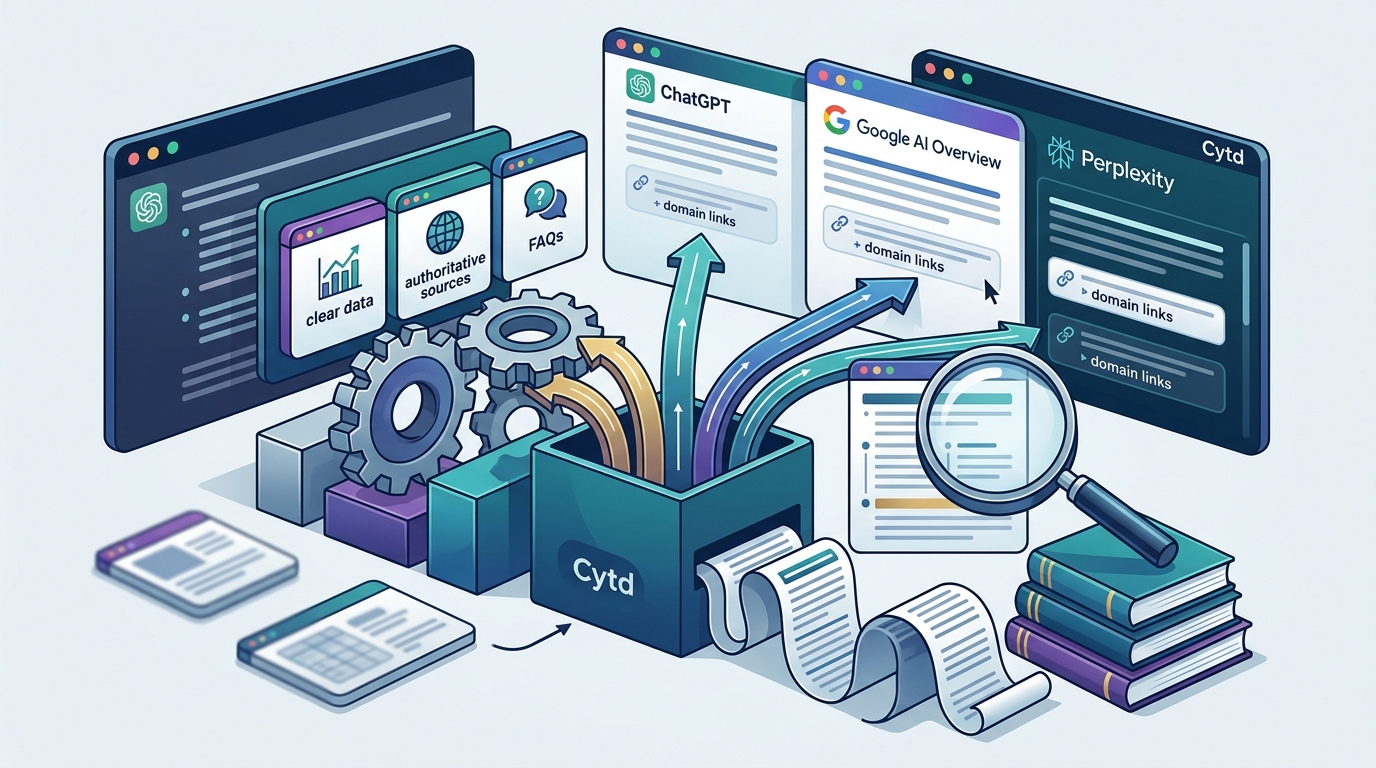
AI models parse content by breaking it into segments and analyzing how ideas connect. Pages that use clear H2, H3, and bullet-point structures are 40% more likely to be cited by AI engines. Dense, unstructured prose performs worst.
Use the BLUF Format
BLUF stands for Bottom Line Up Front. AI systems often cite the first one to two sentences after headings, so lead each section with a direct, concise answer before expanding into supporting detail.
Adopt Question-Based Headings
FAQ sections with question-based headings nearly double your chances of being cited by ChatGPT. For smaller domains, question-based titles carry up to 7 times more impact on citations compared to large enterprise sites.
Keep Readability High
Top-performing cited sources share common readability traits: Flesch-Kincaid scores between 60 and 75, clearly defined sections, and logical narrative progression from problem to solution.
Step 3: Publish Original Research and Data
Original research is one of the strongest citation magnets. Pages that include original data tables earn 4.1x more AI citations than those without. When your page is the only source with specific data or insights, AI tools are more incentivized to cite you.
Actionable ways to create citable data include running customer surveys, publishing benchmark studies, and analyzing anonymized usage data. Pair these findings with comparison tables for maximum extractability. Learn more about how LLM citation patterns favor data-rich content.
| Content Type | Relative AI Citation Rate | Best Platform |
|---|---|---|
| Original data tables | 4.1x baseline | All platforms |
| FAQ sections | 2x baseline | ChatGPT, AI Overviews |
| Comparison tables | 1.8x baseline | Perplexity, AI Overviews |
| Dense long-form prose | 0.6x baseline | None preferred |
| Content with statistics | 1.5x baseline | All platforms |
Step 4: Add Schema Markup and Structured Data
Schema markup is code added to your pages that gives AI models a machine-readable map of your content. Proper Article and FAQ schema increases AI citations by 28%. Without it, your content risks being overlooked in favor of a competitor with cleaner signals.
Use JSON-LD to mark up products, reviews, FAQs, and articles. This is no longer optional for sites serious about AI visibility.
Step 5: Build Topical Authority With Content Clusters
Topical authority is the perception by AI systems that your website is an expert on a given subject area. You build it by creating a main page on a broad topic and linking it to subpages covering specific subtopics. AI systems use internal links to understand how your pages relate to each other, which increases the likelihood your content surfaces during query fan-out.
Cytd's getting started guide walks you through building a measurement baseline that supports cluster-based content strategies.
Step 6: Earn Third-Party Mentions and Backlinks
AI models do not just crawl your site. They pull from the broader web. If your brand is frequently mentioned in trusted outlets, forums, and industry blogs, those mentions strengthen your chances of surfacing in AI answers. Even unlinked brand mentions help AI systems associate your brand with your topic area.
Effective tactics include contributing expert commentary through services like HARO, guest posting on established publications, participating in Reddit and Quora discussions, and gathering positive reviews. Explore how backlinks support AI citations for deeper guidance.
Step 7: Monitor, Measure, and Adapt
Traditional analytics tools do not capture AI citations. You need specialized monitoring that tracks mention frequency across multiple AI engines, analyzes citation quality and sentiment, and benchmarks performance against competitors. Key metrics include citation frequency, share of voice, brand sentiment, and source accuracy.
Content freshness also matters: content older than three months sees significantly fewer AI citations. Update important pages at least once per quarter. Explore the top AI visibility tools to find the right monitoring solution for your brand.
Key Takeaways
- AI tools cite only 2 to 7 domains per response, making every citation slot highly competitive.
- Structure content with clear headings, bullet points, and BLUF formatting to increase citation probability by 40%.
- Original research and data tables earn up to 4.1x more AI citations than standard content.
- FAQ schema and Article schema boost AI citations by 28%.
- Third-party mentions and brand authority are just as important as on-site optimization.
- Content freshness matters: update key pages at least quarterly to maintain citation eligibility.
- Use dedicated AI visibility tools to track citation frequency and share of voice across platforms.
Frequently Asked Questions
What is Generative Engine Optimization (GEO)?
Generative Engine Optimization is the practice of shaping your content so it performs well inside AI-powered search experiences like Google AI Overviews, ChatGPT, and Perplexity. The goal is getting your content cited directly inside the AI-generated answer, not just ranked on a results page.
Do I need to rank on page one of Google to get cited by AI?
No. Research shows that 90% of pages ChatGPT cites rank at position 21 or lower in traditional search results. What matters more is content clarity, structure, and authority signals.
How does content structure affect AI citations?
Pages with clear H2/H3 headings and bullet points are 40% more likely to be cited. FAQ formats and comparison tables are among the highest-performing content structures for AI extraction.
How often should I update my content for AI visibility?
At minimum, update important pages once per quarter. Content older than three months sees significantly fewer AI citations because AI models favor fresh, current information.
What role do backlinks play in AI citations?
Backlinks and unlinked brand mentions both matter. AI models pull from the broader web, so brands that appear frequently across trusted third-party sources earn more citations in AI-generated responses.
Which AI platforms should I optimize for?
Focus on ChatGPT, Google AI Overviews, Perplexity, and Grok at minimum. Each platform has slightly different preferences: ChatGPT favors conversational content, Google AI Overviews prefer authoritative sources, and Perplexity emphasizes research-backed information.
How do I measure AI citation visibility?
Use specialized AI visibility tools that track mention frequency, citation quality, sentiment, and share of voice across multiple AI engines. Traditional SEO tools do not capture this data. Cytd provides AI visibility scoring across all major answer engines.
Can small websites compete for AI citations?
Yes. Question-based titles carry up to 7x more citation impact for smaller domains compared to large enterprise sites. Focus on niche expertise, original data, and structured content to punch above your weight.
Start Improving Your AI Citation Visibility Today
The brands that establish citation authority now build compounding advantages that late adopters will struggle to match. Every quarter without AI-optimized content is a quarter where competitors are training AI models to cite their pages instead of yours.
Ready to see where you stand? Book a free setup call with Cytd to get your AI visibility baseline and a personalized action plan for earning more citations across ChatGPT, Google AI, Grok, and beyond.