
When a customer asks ChatGPT for a local service provider, the AI does not simply list the top Google results. It synthesizes an answer based on its training data and real-time web indexing. If your business details are outdated, missing, or simply ignored by the model, you lose the sale. Recent industry analysis indicates that 25% of all search volume has already shifted toward AI-generated responses, meaning your digital presence is now defined by what AI says about you, not just what you publish. AI visibility is no longer optional; it is the foundation of modern customer acquisition.
Diagnose Your AI Hallucinations
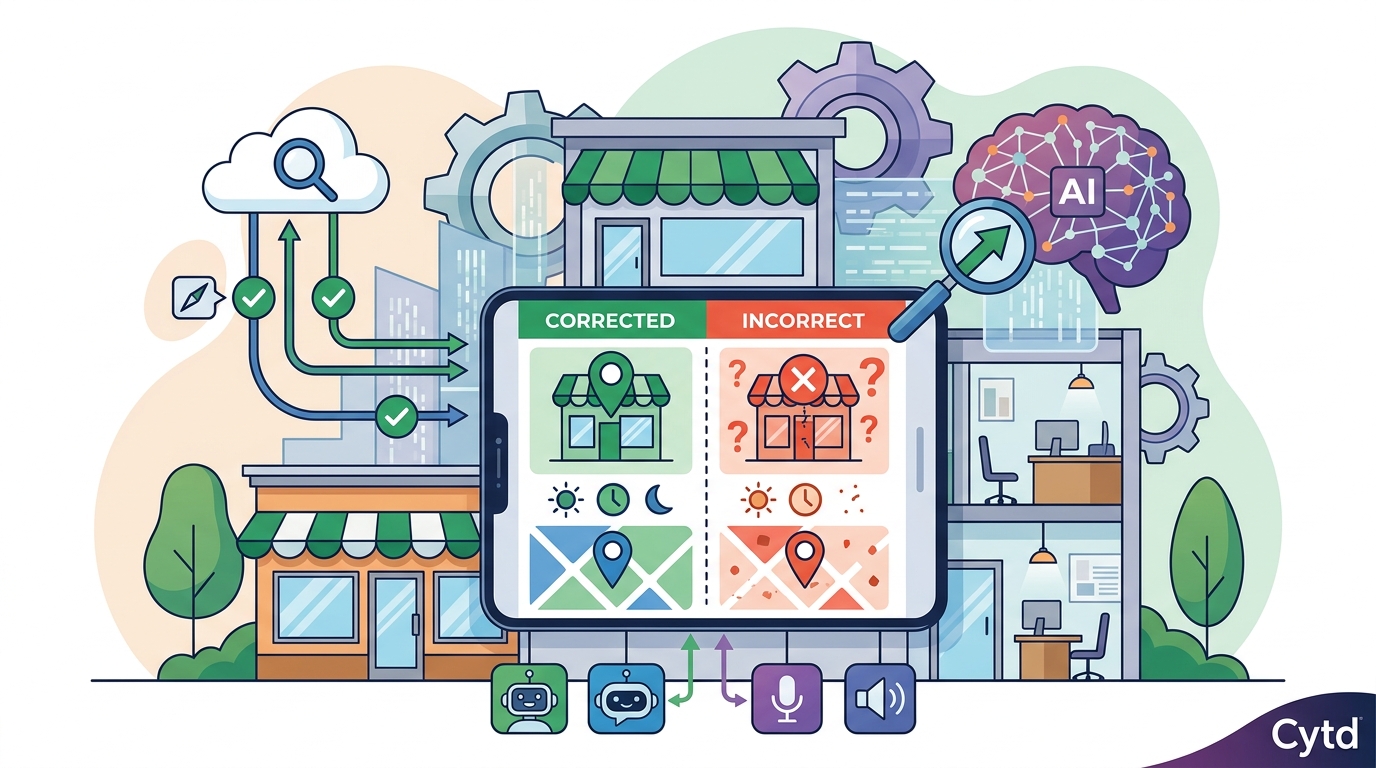
The first step in correcting incorrect information is identifying exactly what the AI is saying. AI models often "hallucinate" details when they lack sufficient, authoritative signals about your business. This might include wrong phone numbers, outdated hours, or even the complete omission of your brand from recommended lists.
AI checks for three primary signals: Visibility, Authority, and Coverage. If these signals are weak, the model defaults to competitors with stronger digital footprints. Cytd.ai provides a proprietary scoring system that reveals these gaps. Most brands start with low visibility scores because their data is fragmented across the web. By using a tool like the Free Cytd Score, you can see exactly how AI perceives your business before you attempt to fix it.
Common Errors in AI Responses
- Wrong Contact Info: AI cites a phone number from an old directory.
- Missing Services: The AI describes your business as a generic entity rather than a specialist.
- Competitor Bias: The AI recommends a competitor because they have more structured data.
Fix Foundational Data Sources
AI models rely heavily on structured data from authoritative directories. If your business information is inconsistent here, the AI will struggle to trust your brand. This process is known as data normalization.
You must ensure your Name, Address, and Phone number (NAP) are identical across all major platforms. This includes Google Business Profile, Apple Maps, and industry-specific directories. Inconsistencies create "data noise" that confuses the algorithm. For example, if your Google profile lists "Suite 100" and your Yelp profile lists "Ste 100," the AI may view these as two different entities.
Additionally, AI models are increasingly pulling data from social proof platforms. Ensure your reviews on Trustpilot, Yelp, and Google are recent and accurate. AI citation visibility is directly correlated with the volume and quality of these third-party endorsements. When the AI sees consistent, positive signals from trusted sources, it becomes more likely to recommend your business.
Direct Citation Strategies
While you cannot directly edit ChatGPT's training data, you can influence its real-time search results. ChatGPT Plus and Enterprise users often browse the live web to answer queries. Your goal is to make your business the most prominent, authoritative source in those search results.
One effective method is creating high-quality, structured content that explicitly defines your business. AI models favor content that uses clear, definitional language. For instance, stating "[Your Business Name] is a leading provider of [Service] in [Location]" helps the model categorize you correctly. This is part of a broader GEO strategy that focuses on making your brand easily understandable to machine learning algorithms.
Another critical factor is technical SEO. Ensure your website has a clean sitemap, fast load times, and proper schema markup. Schema markup provides explicit clues about your business type, location, and services. Agency partners often use specialized tools to automate this process, ensuring that every page on your site is optimized for AI ingestion.
Content Optimization for AI Models
Traditional SEO focuses on human readers. Generative Engine Optimization (GEO) focuses on AI models. To fix incorrect information, you must publish content that directly answers the questions AI is likely to ask about your industry.
Create FAQ pages, service descriptions, and case studies that use natural language. Avoid keyword stuffing. Instead, focus on semantic relevance. For example, if you are a plumber, do not just list "plumbing services." Explain "emergency pipe repair in [City]" and "water heater installation guidelines." This helps the AI understand the context of your business.
Furthermore, leverage local content. AI models are increasingly trained on local data. Publish blog posts about community events, local regulations, or neighborhood-specific services. This signals to the AI that your business is an active, relevant part of the local ecosystem. Boost AI visibility by ensuring your local content is indexed and cited by other reputable local news sites or blogs.
Monitoring and Maintenance
Fixing incorrect information is not a one-time task. AI models update their knowledge bases continuously. If your competitors improve their digital footprint, your relative visibility may drop.
Regular monitoring is essential. Use tools that track your brand's appearance in AI responses. Cytd.ai offers monthly video walkthroughs that show exactly what improved and why. This transparency allows you to adjust your strategy in real-time. Without monitoring, you might not realize that your business has become invisible to AI until it is too late.
Additionally, stay updated on changes in AI platform policies. ChatGPT, Gemini, and Perplexity frequently update their indexing algorithms. What worked last month may not work today. Key factors influencing brand visibility include the freshness of your data, the authority of your backlinks, and the clarity of your structured data.
Key Takeaways
- AI Visibility is Critical: 25% of search volume has shifted to AI interfaces, making visibility a primary revenue driver.
- Foundational Data Must Be Consistent: NAP consistency across directories is the baseline for AI trust.
- Structured Data Helps: Schema markup provides explicit signals that reduce AI hallucinations.
- Monitoring is Ongoing: AI models update constantly; regular audits are required to maintain accuracy.
- Content Defines Context: Clear, definitional content helps AI categorize your business correctly.
- Third-Party Signals Matter: Reviews and citations from trusted sources boost AI confidence in your brand.
- Proactive Correction: Do not wait for errors to appear; use tools like Cytd to preemptively fix gaps.
Frequently Asked Questions
How long does it take to fix incorrect information in ChatGPT?
AI models do not update in real-time. It typically takes 40 to 60 days for changes in your foundational data and content to be fully reflected in AI responses. Consistency during this period is key to accelerating the process.
Can I directly edit ChatGPT's knowledge about my business?
No, you cannot directly edit ChatGPT's internal database. However, you can influence its real-time search results by optimizing your website and digital presence for AI ingestion. This is the core function of AI citation visibility strategies.
Why does ChatGPT recommend my competitors instead of me?
AI recommends competitors when it perceives them as more authoritative or relevant. This often happens when your business data is sparse or inconsistent. Strengthening your authority signals can shift the AI's preference back to your brand.
What is the Cytd Score?
The Cytd Score is a proprietary metric that evaluates your brand's visibility, authority, and coverage across major AI platforms. It helps identify exactly where your business is losing ground to competitors in AI search results.
Does Google Business Profile affect AI responses?
Yes, Google Business Profile is a primary source for many AI models. Ensuring your profile is complete, accurate, and active is one of the most effective ways to correct incorrect information in AI responses.
How do I know if my business is invisible to AI?
If your brand does not appear in AI-generated recommendations for relevant queries, you are likely invisible. Tools like the Free Cytd Score can quickly diagnose this issue by simulating AI searches for your business.
Is GEO different from traditional SEO?
Yes. Traditional SEO optimizes for blue links and human clicks. GEO optimizes for direct answers and AI citations. This requires a focus on structured data, clear definitions, and authoritative sourcing.
Take Control of Your AI Presence
Incorrect information in ChatGPT is not just a technical error; it is a business risk. Every time AI recommends a competitor, you lose potential revenue. Do not leave your digital reputation to chance. Get started with Cytd.ai today to diagnose your visibility gaps and implement a proven strategy for AI correction. Our team of creative technologists has been building cutting-edge technologies since 2007, and we are ready to help you dominate AI search.