
Key Metrics to Measure for AI Search Visibility and Optimization
The way people discover brands online is changing rapidly. AI answer engines like ChatGPT, Google AI Overviews, and Perplexity now synthesize information and present direct answers — often without sending users to a website at all. Gartner projects that traditional search engine volume could decline by 25% by 2026 as buyers shift to AI-powered discovery. If your measurement strategy still revolves around keyword rankings and click-through rates, you are flying blind in this new landscape.
This guide breaks down every critical metric you need to track for AI search visibility, explains why each one matters, and shows you how to build a measurement framework that connects AI presence to real business outcomes.
Why Traditional SEO Metrics Fall Short
Traditional SEO dashboards were built for a world where a user types a query, scans ten blue links, and clicks. Metrics like keyword rankings, organic traffic volume, and bounce rate all depend on that click happening. But AI answer engines work differently — they summarize the entire web and present a synthesized response directly to the user.
This fundamentally changes what visibility means. As one industry expert put it, visibility is no longer about position — it is about whether your brand is included in the answer users actually read. Classic metrics like click-through rate become insufficient when AI engines provide single, consolidated answers rather than lists of links.
The data confirms this shift is already underway. Research shows that users are significantly less likely to click through to websites when an AI-generated summary appears. And critically, only 12% of pages cited by AI engines also rank in Google's traditional top 10 results — meaning strong traditional SEO does not guarantee AI visibility.
The Six Essential AI Search Visibility Metrics
Effective AI visibility measurement requires a new set of KPIs. Here are the six metrics that matter most, organized from foundational presence metrics to business-impact indicators.
1. Visibility Score (AI Mention Rate)
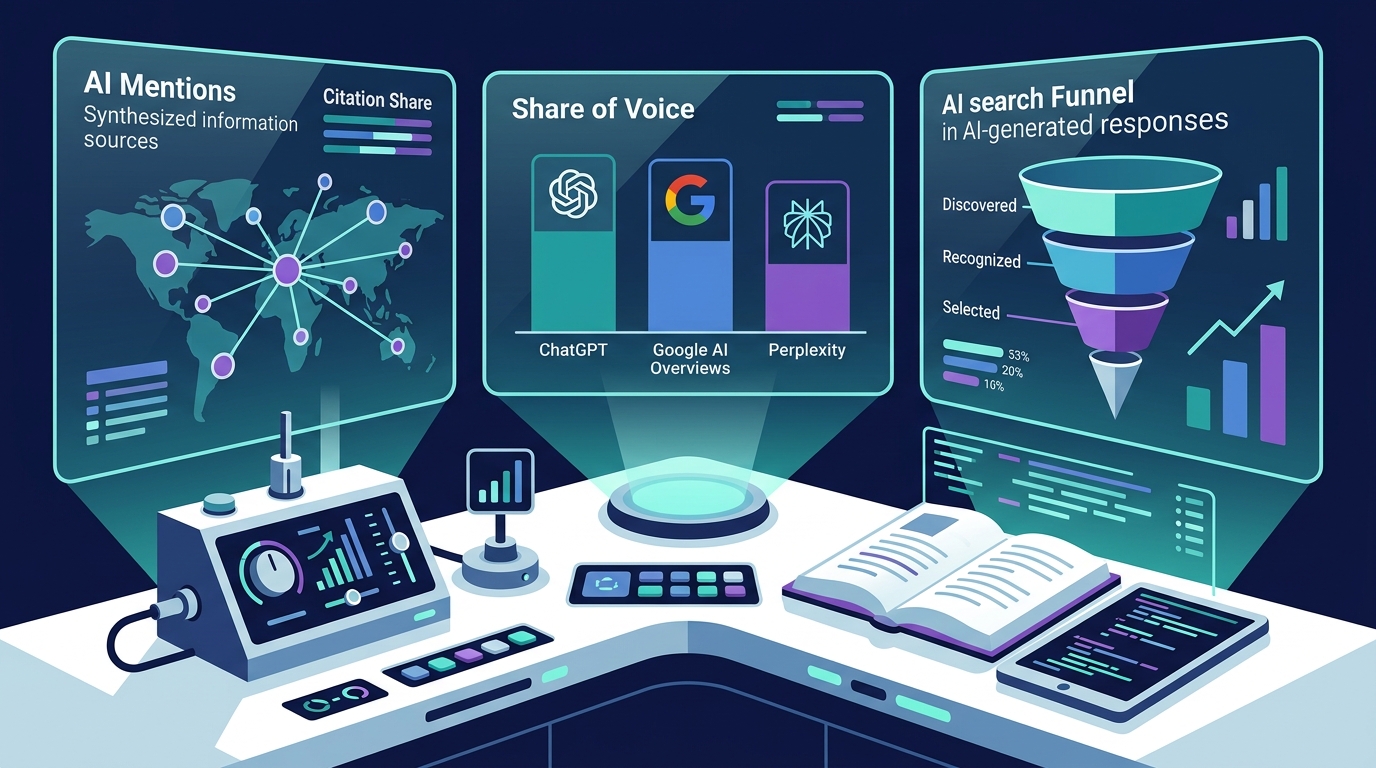
Your Visibility Score measures how often your brand appears in AI-generated answers across a defined set of prompts. Think of it as the AI equivalent of impression share. If you track 200 prompts relevant to your category and your brand appears in 80 of the responses, your Visibility Score is 40%.
This is an absolute measure — it tells you how present you are on your own terms, independent of competitors. It is arguably the most foundational GEO metric because everything else depends on being mentioned in the first place.
How to track it: Define a panel of 250–500 high-intent prompts relevant to your business. Run them across ChatGPT, Perplexity, Google AI Overviews, and Claude on a weekly cadence. Calculate the percentage of responses that mention your brand.
2. AI Share of Voice
While Visibility Score tells you how often you appear, Share of Voice tells you how you stack up against competitors. It compares your brand's presence to a defined competitor set on the same prompts.
Context matters here: a Visibility Score of 30% could be excellent or poor depending on whether your top competitor sits at 15% or 65%. Share of Voice gives you that competitive frame, and it is the metric most useful for executive reporting and budget justification.
How to track it: Using the same prompt panel, count mentions for each competitor. Calculate each brand's percentage of total mentions across all tracked prompts. Track trends monthly to spot competitive shifts early.
3. Citation Rate
Being mentioned is not the same as being cited. A mention means the AI names your brand in its answer. A citation means it links back to a specific page on your website. Citation rate measures how frequently AI engines link to your content as a source.
This distinction matters enormously. Real-world tracking has shown a significant gap — one company found it was mentioned in 40 ChatGPT answers but cited with a link in only 9, yielding a citation rate of 22.5%. Citations drive referral traffic; mentions alone do not.
How to track it: For each AI response that mentions your brand, check whether a URL to your domain is included. Divide cited responses by total relevant responses. Segment by AI platform, since each engine cites differently.
4. Sentiment and Accuracy
Appearing in AI answers is only valuable if the AI describes your brand correctly and favorably. Sentiment analysis evaluates whether your mentions are positive, neutral, or negative. Accuracy checks whether the factual claims the AI makes about your brand — pricing, features, use cases — are correct.
This metric is uniquely important in AI search because users tend to trust AI-generated summaries as authoritative. A single inaccurate or negatively framed mention can shape buyer perception far more than a bad review on a traditional site.
How to track it: Use automated sentiment classification on every AI response that mentions your brand. Flag factual errors manually or with NLP tools. Prioritize correcting inaccuracies in your own published content, since AI models draw from your website and third-party sources.
5. AI Referral Traffic
AI referral traffic measures actual visits to your website that originate from AI platforms. This is the metric that connects AI visibility to your existing analytics infrastructure and proves downstream business impact.
It is worth noting that AI referral traffic from platforms like Perplexity converts at significantly higher rates than traditional organic search. One analysis found Perplexity referral traffic converts at roughly 10.5% compared to 1.76% for Google organic — a small but extremely valuable channel.
How to track it: In Google Analytics 4, create segments or filters for AI-specific referral sources (perplexity.ai, chatgpt.com, etc.). Check server logs for user agents like "ChatGPT-User" to detect AI bot visits. Track conversion rates from AI referrals separately from other organic traffic.
6. Prompt Coverage (Topic Breadth)
Prompt Coverage measures what percentage of relevant topics in your category trigger a response that includes your brand. While Visibility Score tells you how often you appear overall, Prompt Coverage reveals the topical gaps — the buyer questions where you are completely invisible.
This metric is essential for content strategy. If your brand appears for 70% of product-comparison prompts but only 15% of early-research prompts, you know exactly where to focus your next content investment.
How to track it: Organize your prompt panel by buyer intent stage (awareness, consideration, decision). Calculate Visibility Score for each stage independently. Identify stages with the lowest coverage and create content specifically targeting those query types.
Building a Three-Tier Measurement Framework
Individual metrics are useful, but they become powerful when organized into a coherent framework. A three-tier structure helps teams prioritize action based on what the data reveals.
Tier 1: Performance Metrics (Business Impact)
These confirm whether AI visibility generates real value. Track AI referral traffic, conversion rates from AI sources, leads attributed to AI platforms, and pipeline impact. Start here to justify investment and secure budget.
Tier 2: Channel Metrics (AI Presence)
These diagnose your competitive position within AI answer engines. Visibility Score, Share of Voice, Citation Rate, and Sentiment all fall into this tier. They tell you how visible and how well-regarded your brand is across ChatGPT, Perplexity, and Google AI Overviews.
Tier 3: Input Metrics (Optimization Signals)
These track the technical and content signals that determine whether AI platforms select your content in the first place. Passage relevance, page speed, bot crawl activity, structured data quality, and content freshness all qualify. Slow-loading pages get skipped entirely when AI systems make real-time page requests.
The workflow is straightforward: review Tier 1 to confirm business impact, use Tier 2 to diagnose visibility gaps, then drill into Tier 3 to identify what to fix.
Why You Must Measure Distributions, Not Snapshots
One of the biggest mistakes teams make is treating a single AI query as a reliable data point. AI models are inherently non-deterministic — the same prompt can produce different brands, sources, and recommendations each time.
Research highlights just how volatile this can be: only 30% of brands stay visible from one AI answer to the next, and just 20% remain visible across five consecutive runs of the same prompt. A single check tells you almost nothing reliable.
The solution is distribution-based reporting. Instead of saying "we appear in ChatGPT," report something like "we appear in 42% of responses with a 95% confidence interval of 38%–46%." This requires running your prompt panel repeatedly — experts recommend 250 to 500 high-intent queries on a daily or weekly cadence to capture a meaningful response distribution.
This statistical approach may feel unfamiliar to marketing teams accustomed to deterministic rank tracking, but it is the only way to get defensible numbers from a probabilistic system.
The Content Freshness Factor
One input metric deserves special attention: content freshness. Research has found that more than 70% of pages cited by AI engines were updated within the last 12 months. AI platforms strongly favor recent, up-to-date content.
This has direct implications for your measurement cadence and content operations. If you publish a comprehensive guide and never update it, your citation rate will likely decay within months. Building regular content refresh cycles — aligned with the roughly 70-day freshness window that some researchers have identified — gives your content a stronger chance of remaining part of AI answers over time.
Additionally, original research, proprietary data, and expert perspectives increase the likelihood of being cited as a primary source. AI models favor content that adds unique value rather than simply restating what already exists elsewhere.
Tools and Platforms for AI Visibility Tracking
The measurement framework described above requires tooling that goes beyond traditional SEO platforms. Here is how the landscape breaks down:
- Cytd: Purpose-built for AI visibility measurement. Cytd helps brands understand how AI views their business and works to secure top recommendations across answer engines including ChatGPT and Google AI. It combines measurement and optimization in a single platform — ideal for teams that want actionable insights without juggling multiple tools.
- Traditional SEO platforms (Ahrefs, SEMrush): These remain essential for traditional search metrics and are adding AI visibility features. Semrush's Enterprise AIO, for example, monitors brand visibility across AI platforms like ChatGPT, Google AI Mode, and Perplexity. However, their AI tracking capabilities are typically add-ons rather than core products.
- Server log analysis: Tools like Cloudflare Bot Analytics or GoAccess help detect when AI crawlers are accessing your content, offering early signals about which pages may be entering AI training data or retrieval indexes.
- GA4 with AI referral segments: Custom segments in Google Analytics 4 let you isolate traffic from AI sources and track downstream conversions, connecting visibility metrics to revenue.
The key advantage of a dedicated AI visibility platform like Cytd is that it unifies prompt tracking, competitive benchmarking, sentiment analysis, and optimization recommendations — eliminating the manual work of stitching together data from multiple sources.
Connecting AI Metrics to Business Outcomes
The ultimate test of any metric is whether it connects to outcomes that matter: leads, pipeline, and revenue. AI visibility metrics are no different.
Here is a practical approach to making that connection:
- Tag AI referral traffic in your CRM. When leads arrive from AI sources, ensure your attribution model captures the originating platform. This lets you calculate cost-per-lead and ROI for AI visibility investments.
- Correlate Share of Voice trends with pipeline changes. If your AI Share of Voice increases by 15 points over a quarter and you see a corresponding lift in inbound leads for the same category, you have a strong directional signal.
- Track citation-to-conversion paths. Identify which specific pages earn the most AI citations, then measure whether visitors arriving via those citations convert at higher rates than other traffic sources.
- Report AI metrics alongside traditional metrics. The smartest approach in 2026 is to track both Google Search performance and AI chatbot visibility in the same workflow, giving leadership a unified view of organic discovery.
Key Takeaways
- Traditional SEO metrics like rankings and CTR cannot capture AI search visibility — you need purpose-built metrics.
- The six essential metrics are Visibility Score, Share of Voice, Citation Rate, Sentiment/Accuracy, AI Referral Traffic, and Prompt Coverage.
- Always measure distributions over time, not single snapshots — AI outputs are inherently volatile.
- Content freshness is a critical input signal; over 70% of AI-cited pages were updated in the past year.
- Use a three-tier framework (Performance → Channel → Input) to prioritize what to measure and what to fix.
- Connect AI metrics to pipeline and revenue through CRM tagging and conversion tracking.
- Dedicated platforms like Cytd streamline AI visibility measurement and optimization in ways that traditional SEO tools cannot match alone.
Frequently Asked Questions
What are the most important AI search visibility metrics?
The essential metrics are Visibility Score (mention rate across AI responses), Share of Voice (competitive comparison), Citation Rate (how often AI links to your content), Sentiment and Accuracy (how favorably and correctly you are described), AI Referral Traffic (visits from AI platforms), and Prompt Coverage (topical breadth of your visibility).
How is AI search visibility different from traditional SEO?
Traditional SEO measures rankings and clicks on search result pages. AI search visibility measures whether your brand is named, cited, and accurately represented inside AI-generated answers — where many queries are resolved without any click at all.
Why do AI search visibility results fluctuate so much?
AI models are probabilistic, not deterministic. The same query can produce different answers, brands, and sources each time. Only about 20% of brands remain consistently visible across five consecutive runs of the same prompt, which is why repeated sampling and statistical reporting are essential.
How often should I measure AI visibility metrics?
Run your prompt panel at least weekly — daily if resources allow. AI-cited content tends to be recent, with over 70% of cited pages updated within the last 12 months. Frequent measurement helps you detect visibility drops early and respond before they compound.
Can traditional SEO tools measure AI visibility?
Some traditional platforms like SEMrush have added AI visibility tracking as enterprise features. However, dedicated AI visibility platforms like Cytd offer deeper prompt-level tracking, cross-platform benchmarking, and optimization recommendations that purpose-built solutions handle more effectively than bolt-on features.