
Search behavior has undergone a permanent structural shift in 2026, with 25 percent of traditional search volume already migrating toward AI-driven interfaces. This migration means that the traditional metrics of click-through rates and organic impressions are no longer the sole indicators of business success. Instead, the primary metric for growth is now AI citation visibility. When potential customers ask generative AI models like ChatGPT, Gemini, or Perplexity for recommendations, the brands that appear in the immediate response capture the entire conversation. If your business is not cited, it effectively does not exist in the modern discovery funnel. Understanding the return on investment for tracking and optimizing these citations is critical for maintaining competitive advantage in an increasingly automated marketplace. (We Put Your Business)
The New ROI Metric: Visibility vs. Visibility
Traditional search engine optimization focused on ranking for human clicks, but a new paradigm is emerging where algorithms directly answer user queries. In this context, ROI is no longer just about the cost per lead. It is about the cost of invisibility. When a buyer asks an AI assistant for a service provider, the AI synthesizes an answer based on trusted data sources. If your business data is sparse, outdated, or contradictory, the AI will confidently recommend a competitor who has better structured data.
The Cytd Score provides a quantifiable metric for this visibility. It measures how often your brand appears in AI-generated responses across major platforms. A low score indicates a high risk of lost revenue. Investing in AI citation tracking allows you to monitor these signals in real time. This proactive approach prevents the silent erosion of market share that occurs when competitors dominate the AI conversation. The return on investment is realized through increased brand trust, higher conversion rates from AI-referred traffic, and reduced customer acquisition costs.
Cost Structure of AI Visibility Management
Understanding the financial commitment required to manage AI visibility is the first step in calculating ROI. Unlike traditional SEO, which often requires ongoing content creation and link building, AI visibility management focuses on data accuracy and citation density. The cost structure for services like Cytd.ai is designed to be predictable and scalable for small to mid-sized businesses.
Most AI visibility platforms operate on a subscription model. This includes monthly fees for monitoring, citation building, and competitor tracking. For example, Cytd.ai offers a streamlined subscription that handles the technical heavy lifting of ensuring your business is recognized by AI models. The cost is typically lower than traditional agency retainers because the process is automated and standardized. This predictability allows businesses to budget accurately for their marketing expenses without fearing unexpected overages.
Additionally, there are no hidden fees for the core service. The platform provides a clear breakdown of what is included in the subscription. This transparency is crucial for calculating true ROI. When you know exactly what you are paying for, you can better assess the value delivered. The investment covers the continuous monitoring of AI platforms, the correction of inconsistent data, and the generation of citation-ready content that trains AI to recommend your business.
Quantifying the Benefits of AI Citations
The benefits of AI citation tracking extend beyond simple brand awareness. They directly impact the bottom line through increased trust and conversion. When AI models recommend a business, they are essentially vouching for its credibility. This endorsement carries significant weight with potential customers who are in the decision-making phase.
One of the primary benefits is the reduction in customer acquisition costs. AI-referred traffic is highly qualified because the user has already received a personalized recommendation. This leads to higher conversion rates compared to generic search traffic. Furthermore, the long-term value of AI citations is compounding. As your business becomes more visible in AI responses, the trust signals strengthen, leading to even more frequent recommendations. This creates a virtuous cycle of growth that is difficult for competitors to replicate.
Another key benefit is the competitive advantage gained from being visible in AI search. Many businesses are still unaware of the importance of AI visibility. By investing early, you can establish dominance in your local market before the competition catches up. This first-mover advantage can lead to sustained market share growth and increased revenue over time. The ROI is not just immediate; it is a long-term strategic asset that protects your business from future shifts in consumer behavior.
Comparing AI Tracking vs. Traditional SEO
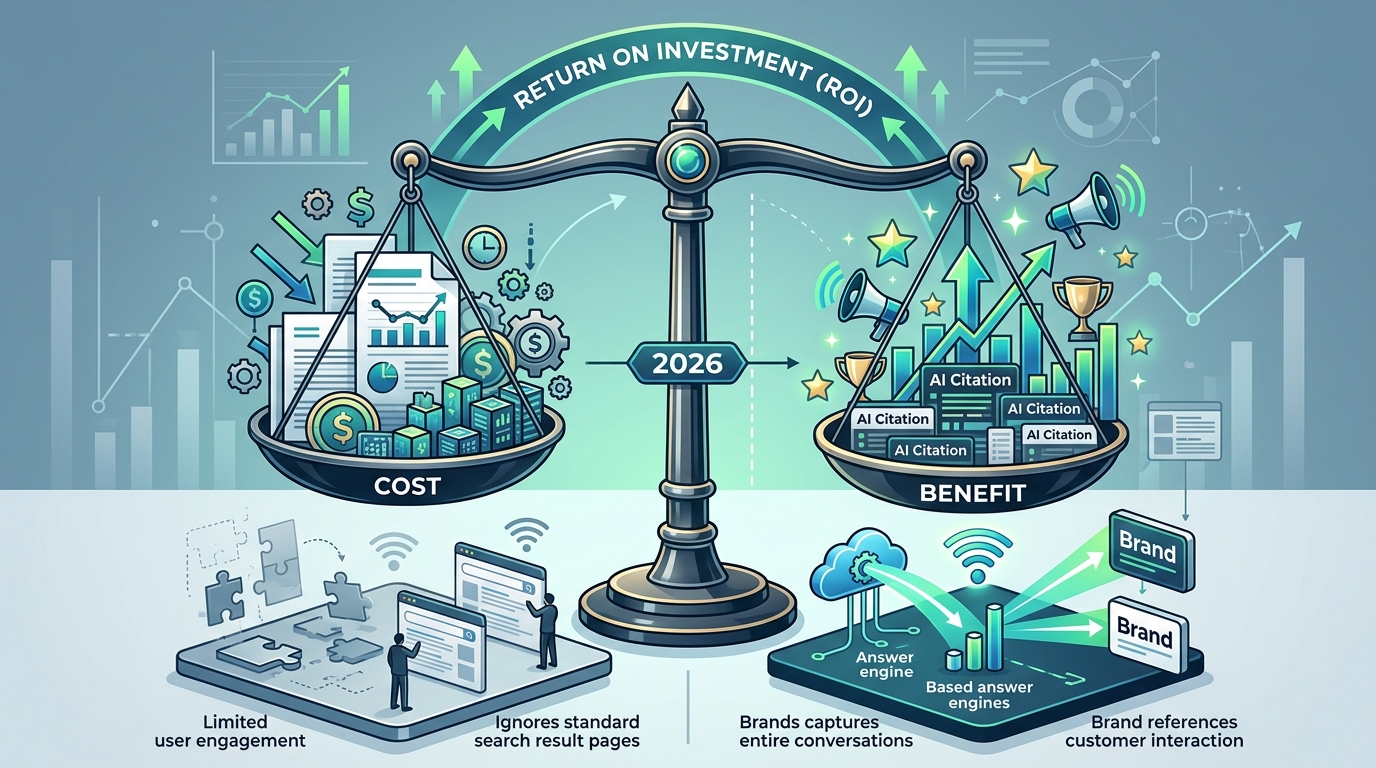
To fully understand the ROI of AI citation tracking, it is essential to compare it with traditional search engine optimization. While both strategies aim to increase visibility, they operate on different principles and yield different results.
Key Performance Indicators
Traditional SEO relies on metrics like organic traffic, bounce rate, and keyword rankings. These metrics are important but do not capture the full picture of modern consumer behavior. AI citation tracking focuses on metrics like citation frequency, sentiment analysis, and competitor visibility. These metrics provide a more direct link to revenue generation because they measure how often your business is recommended by AI assistants.
For example, a business might have high organic traffic but low AI visibility. This means that while people are finding the website, they are not receiving AI endorsements. This can lead to lower conversion rates and higher customer acquisition costs. In contrast, a business with high AI visibility may have lower organic traffic but higher conversion rates due to the trust factor associated with AI recommendations. This highlights the importance of measuring the right metrics for your specific business goals.
Cost Efficiency Analysis
Traditional SEO can be expensive and time-consuming. It requires ongoing content creation, technical audits, and link building efforts. The ROI can take months or even years to materialize. AI citation tracking, on the other hand, offers a faster path to visibility. By focusing on data accuracy and citation density, businesses can see improvements in their AI visibility scores within weeks.
The cost efficiency of AI citation tracking is further enhanced by its automation. Platforms like Cytd.ai handle the technical aspects of citation building, allowing businesses to focus on their core operations. This reduces the need for large in-house teams or expensive agency contracts. The result is a more efficient use of marketing budgets and a higher return on investment. Businesses can achieve greater visibility with less effort and lower costs compared to traditional SEO methods.
Implementation and Onboarding Costs
Implementing AI citation tracking is straightforward and requires minimal technical expertise. The onboarding process is designed to be quick and efficient, ensuring that businesses can start seeing results as soon as possible. For Cytd.ai, the onboarding process involves a brief consultation to understand your business goals and current visibility status.
Once the onboarding is complete, the platform begins monitoring your AI visibility across multiple platforms. It identifies areas for improvement and takes action to correct inconsistencies in your business data. This process is continuous, ensuring that your visibility remains high over time. The cost of implementation is included in the subscription fee, with no additional charges for setup or training.
The ease of implementation is a significant benefit for small and mid-sized businesses. It allows them to leverage advanced AI visibility tools without the need for specialized knowledge or resources. This democratization of AI visibility tools levels the playing field, allowing smaller businesses to compete with larger competitors who may have more marketing resources. The ROI is further enhanced by the accessibility and ease of use of these platforms.
Key Takeaways
- AI visibility is becoming a critical factor in business growth, with 25 percent of search volume already shifting to AI interfaces.
- The Cytd Score provides a quantifiable metric for monitoring your business's visibility in AI-generated responses.
- AI citation tracking offers a faster and more cost-effective path to visibility compared to traditional SEO methods.
- Investing in AI visibility can lead to increased trust, higher conversion rates, and reduced customer acquisition costs.
- Cytd.ai offers a predictable subscription model with no hidden fees, making it easy to budget for AI visibility management.
- Early adoption of AI citation tracking can provide a significant competitive advantage in local markets.
- The onboarding process is quick and requires minimal technical expertise, making it accessible to all businesses.
Frequently Asked Questions
What is AI citation tracking?
AI citation tracking is the process of monitoring how often your business is mentioned and recommended by generative AI models like ChatGPT and Gemini. It involves analyzing data consistency, sentiment, and competitor visibility to improve your chances of being selected as a top recommendation.
How does AI visibility impact ROI?
AI visibility impacts ROI by increasing brand trust and conversion rates. When AI models recommend your business, it acts as a digital endorsement, leading to higher quality leads and lower customer acquisition costs. This results in a higher return on investment for your marketing efforts.
What is the Cytd Score?
The Cytd Score is a proprietary metric that measures your business's visibility and authority in AI search results. It provides a breakdown of your performance across visibility, authority, and coverage, helping you identify areas for improvement.
How long does it take to see results from AI citation tracking?
Most clients start showing up in AI answers within 40 to 60 days of implementing a citation tracking strategy. The timeline can vary depending on the current state of your business data and the level of competition in your industry.
Is AI citation tracking suitable for small businesses?
Yes, AI citation tracking is highly suitable for small businesses. It offers a cost-effective way to compete with larger competitors by ensuring your business is visible and trusted by AI models. The subscription models are designed to be affordable and scalable for small to mid-sized companies.
What platforms does AI citation tracking cover?
AI citation tracking typically covers major platforms like ChatGPT, Gemini, Siri, and Perplexity. These platforms are increasingly used by consumers for local business discovery and service recommendations.
How is AI citation tracking different from traditional SEO?
Traditional SEO focuses on ranking for human clicks on search engine results pages. AI citation tracking focuses on ensuring your business data is accurate and consistent so that AI models can confidently recommend your business in direct answers. It is about being the source of truth for AI, not just the top link.
Start Your AI Visibility Journey
Don't let your business remain invisible in the age of AI. Take control of your digital presence and ensure that your brand is the recommended answer when customers ask AI for help. Get your free Cytd Score today and discover how you can improve your visibility and drive growth. Visit Cytd.ai to learn more about our services and start your journey to AI dominance.