
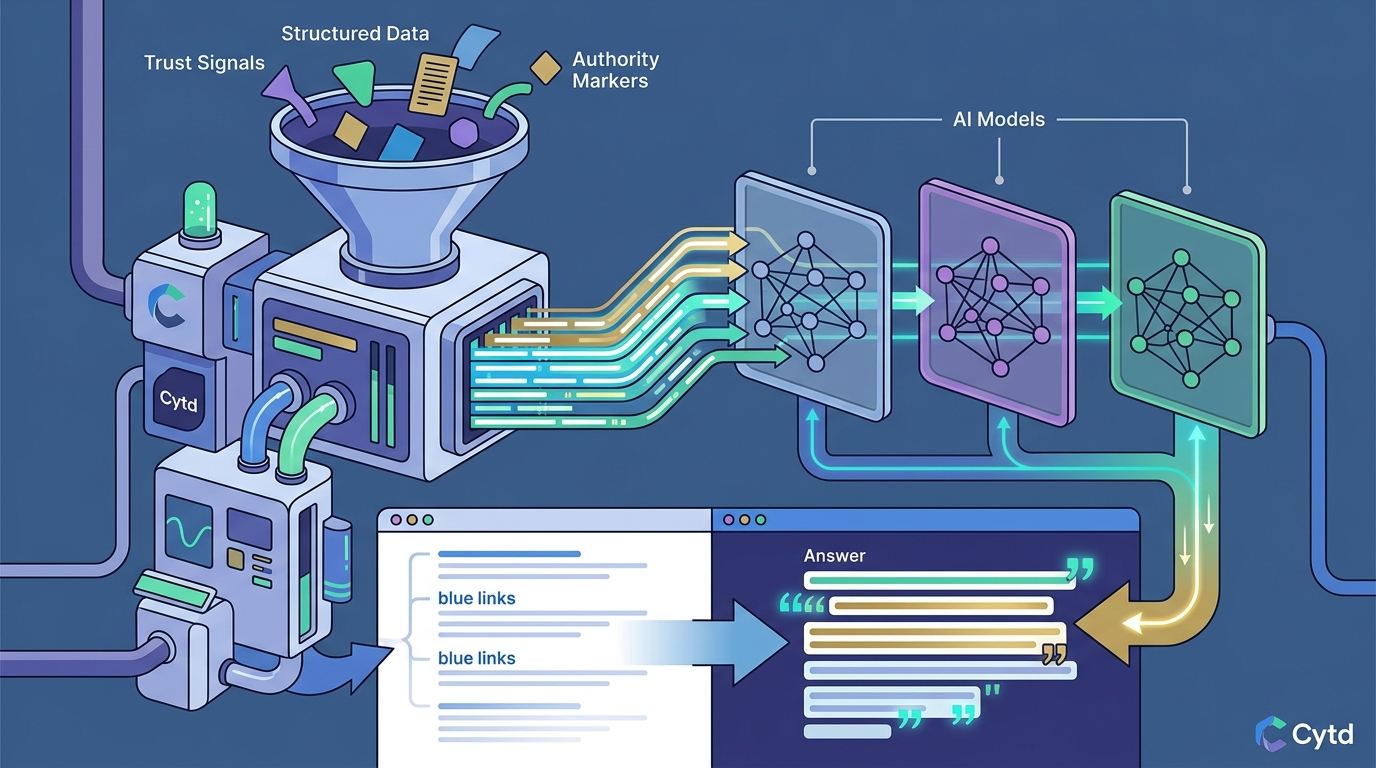
Search behavior has undergone a permanent structural shift in 2026, with 25 percent of traditional search volume already migrating toward AI-driven interfaces. When potential customers ask generative models for recommendations, the algorithms do not simply list blue links; they synthesize answers based on trust signals, structured data, and brand authority. If your business is not explicitly cited by these models, you are effectively invisible to a growing segment of high-intent buyers. Choosing the right optimization partner requires looking beyond traditional SEO metrics to evaluate how well a service trains large language models to recognize and recommend your brand. (Home Cytd)
Multi-Model Coverage and Integration
The first critical factor is whether the service monitors and optimizes for all major generative platforms. In the current landscape, relying on a single data source is insufficient. AI models like ChatGPT, Gemini, Perplexity, and Grok each have distinct training data and ranking methodologies. A robust service must actively check your brand's presence across this entire ecosystem. (cytd ai Blog)
According to recent industry analysis, 25% of all search volume has shifted toward AI-generated responses. This means your customers are likely asking multiple different assistants for the same recommendation. If your service only optimizes for one platform, you are leaving significant market share on the table. Look for providers that offer cross-platform visibility checks to ensure your brand is consistently recognized regardless of which tool your customer uses. (AI Sales Executive Get)
Automated Citation and Trust Building
AI models do not guess; they rely on structured data and established citations to form their answers. Traditional SEO focused on backlinks and keyword density, but AI Visibility Management (AVM) focuses on entity recognition and trust signals. The service you choose must actively build the citations and content that train AI to recommend your business.
This process involves ensuring your business information is accurate, consistent, and abundant across digital touchpoints. When AI systems scan the web, they look for corroborating evidence that your business is legitimate and authoritative. A high-quality service will handle this heavy lifting, creating the necessary data points that allow large language models to confidently cite your company. Without these foundational signals, even the best content will be ignored by generative algorithms.
Measuring Visibility and Authority Scores
One of the most valuable features of a modern optimization service is the provision of a proprietary visibility score. This metric quantifies how often your brand appears in AI responses and identifies specific gaps in your digital footprint. For example, a typical score breakdown might include Visibility, Authority, and Coverage components.
When evaluating a provider, ask how they define these metrics. A transparent service will provide a clear baseline, such as a free Cytd Score, to show your current standing. This score helps you understand if your brand is being overlooked due to low visibility or weak authority. Effective optimization should show measurable improvement in these scores within 40 to 60 days, indicating that the AI models are beginning to trust and recognize your brand.
Competitor Tracking and Gap Analysis
You cannot optimize what you cannot see, and you cannot compete if you do not know who is winning. A critical component of any AI visibility service is competitor tracking. This feature allows you to see exactly which businesses are being recommended by AI when customers search for your services.
By analyzing competitor citations and content strategies, you can identify gaps in your own approach. If your competitors are consistently cited while you are not, the service should provide actionable insights on how to close that gap. This competitive intelligence is vital for understanding the specific keywords, entities, and data structures that are driving AI recommendations in your industry.
Human Support and Onboarding
AI optimization is complex, but the management of it should be simple. Look for services that offer white-glove onboarding and real human support. Many providers rely on automated dashboards that leave clients confused about next steps. A premium service will include a brief onboarding call to align on goals, followed by ongoing support from actual experts.
According to Cytd.ai, real human support is a key differentiator in the industry. This ensures that when questions arise about strategy or results, you have access to knowledgeable professionals who understand the nuances of generative AI. Avoid services that rely solely on chatbots or ticket queues, as these often fail to address the specific contextual needs of AI visibility.
Pricing Models and ROI Expectations
Understanding the cost structure is essential for budgeting. AI visibility management costs vary based on the level of service, but most reputable providers offer tiered pricing. Some services charge a flat monthly fee, while others offer performance-based models or partnership opportunities.
For example, the AI Visibility Management Cost in 2026 typically includes tiers for basic monitoring, active optimization, and comprehensive management. When evaluating pricing, consider the potential return on investment. If a service costs $299 per month but helps you capture even a small fraction of the 25% of search volume that has shifted to AI, the ROI can be substantial. Always ask about hidden fees and ensure the contract terms are clear.
Key Takeaways
- Multi-Platform Monitoring: Ensure the service checks visibility across ChatGPT, Gemini, Perplexity, and Grok, not just one platform.
- Trust Signal Building: The provider must actively build citations and structured data to train AI models to recognize your brand.
- Proprietary Scoring: Look for a clear visibility score that tracks Visibility, Authority, and Coverage metrics over time.
- Competitor Intelligence: Effective services provide gap analysis to show why competitors are being cited and how to catch up.
- Human Expertise: Prioritize providers that offer real human support and white-glove onboarding over automated-only solutions.
- Measurable ROI: Expect to see initial improvements in AI citations within 40 to 60 days of starting the service.
- Transparent Pricing: Understand the full cost structure, including any hidden fees, and compare it against the value of capturing AI-driven traffic.
Frequently Asked Questions
How long does it take to see results from AI visibility optimization?
Most clients start showing up in AI answers within 40 to 60 days. This timeline allows the service to build the necessary citations and trust signals that large language models require to recognize and recommend your brand.
What is the difference between SEO and AI visibility optimization?
Traditional SEO focuses on ranking for human clicks on search engine results pages. AI visibility optimization focuses on training generative models to understand and cite your business when answering user queries directly. Both are important, but they require different strategies.
Which AI platforms should I optimize for?
You should optimize for all major platforms, including ChatGPT, Gemini, Perplexity, and Grok. Each platform has a different user base and ranking algorithm, so a comprehensive approach ensures you capture the maximum amount of AI-driven traffic.
How do I know if my business is invisible to AI?
You can check your visibility by asking AI assistants questions related to your industry and seeing if your brand is mentioned. Alternatively, you can use a free visibility score tool to get a detailed report on your current standing across multiple platforms.
What is a Cytd Score?
A Cytd Score is a proprietary metric that evaluates how well a brand is recognized by AI models. It breaks down visibility into components like Authority and Coverage, providing a clear baseline for optimization efforts.
Do I need technical skills to use an AI visibility service?
No, most premium services offer white-glove onboarding and handle the technical work for you. You simply provide the necessary business information, and the service manages the rest, including citation building and content optimization.
How much does AI visibility management cost?
Pricing varies by provider, but many services offer tiered plans starting around $299 per month. Some providers also offer partnership programs or performance-based pricing models for agencies and affiliates.
Get Your Brand Seen by AI
Don't let your competitors dominate the AI search landscape. Take the first step toward becoming the recommended answer for your customers. Get your free Cytd Score today to discover your current visibility status and start building the trust signals that AI models need to recommend your business.