
What Happens When You Ask ChatGPT Directly About Your Brand by Name?
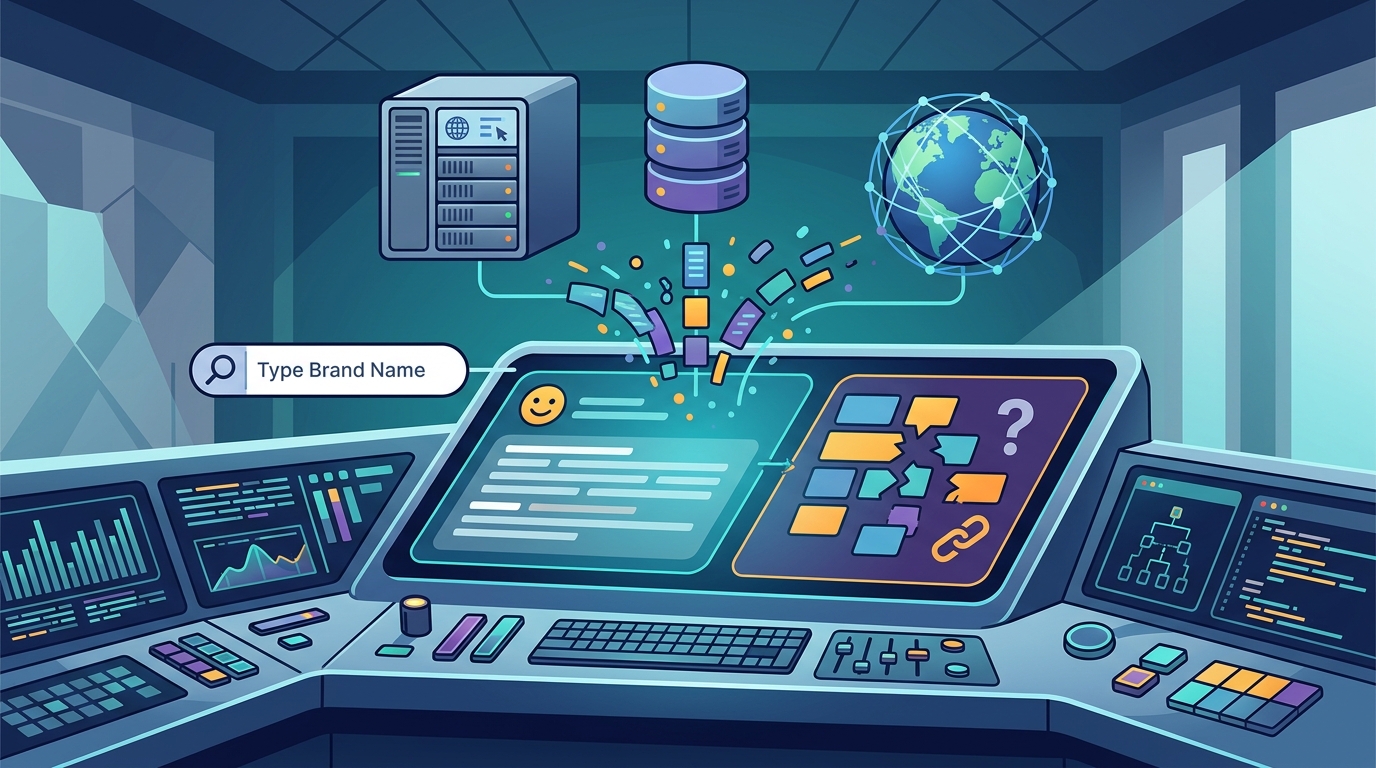
When you type your brand name into ChatGPT, the model generates a response based on its training data and real-time web search capabilities. It does not have a private database of your business. Instead, it synthesizes information from public sources it has crawled or retrieved. If your brand lacks a strong, consistent digital footprint, the AI may provide a generic description, hallucinate details, or simply state that it does not know your business. This direct prompt test is the fastest way to audit your current AI visibility.
How Large Language Models Process Brand Queries
Large Language Models (LLMs) are statistical engines that predict the next token in a sequence. When a user asks about a specific brand, the model looks for patterns in its training data. If the brand is well-known, the model has likely seen thousands of mentions across news sites, social media, and review platforms. This creates a strong statistical association between the brand name and specific attributes, such as product types, pricing, or reputation.
However, for smaller or local businesses, the signal is often weak. The model may not have enough data to form a confident answer. In these cases, the AI relies on its retrieval-augmented generation (RAG) capabilities. It searches the live web for recent information. If the search results are sparse or contradictory, the model may refuse to answer or provide a vague summary. Understanding this mechanism is critical because it explains why traditional SEO rankings do not always translate to AI recommendations.
The distinction between training data and live retrieval is a key factor in how your brand is perceived. Training data is static and cut off at a specific date. Live retrieval is dynamic but depends on the quality of the sources the search engine returns. If your website is not indexed properly or lacks clear, structured data, the live retrieval step will fail to find useful information.
The Hallucination Risk in Direct Prompts
One of the most significant risks of asking an AI about your brand is hallucination. A hallucination is a confident but incorrect statement generated by the model. When a model lacks sufficient data about a niche brand, it may fill in the gaps with plausible-sounding but false information. For example, it might invent a product line, misstate your location, or attribute reviews from a competitor to your business.
This risk is higher for brands with inconsistent naming conventions. If your business is listed as "Cytd AI" on one site, "Cytd" on another, and "Cytd Inc." on a third, the model may struggle to consolidate these entities. This fragmentation leads to lower confidence in the model's output. To mitigate this, you must ensure that your brand name, description, and key facts are consistent across all major digital properties, including your website, social profiles, and directory listings.
Monitoring these direct prompts is essential. If you discover that the AI is hallucinating details about your business, you need to correct the public record. This involves updating your website with clear, unambiguous information and ensuring that authoritative third-party sites reflect the same facts. The goal is to provide the model with a single, coherent narrative that it can safely cite.
Training Data vs. Live Search Capabilities
This two-step process creates a specific vulnerability for brands. If your website is not ranking well in traditional search engines, the live search tool will not find it. Consequently, the model will not have access to your latest information. This is why traditional SEO remains a foundational layer of AI visibility. You cannot be recommended by an AI if the search engine it uses to find information does not surface your site.
Furthermore, the quality of the content matters. The model prefers sources that are easy to parse. Structured data, clear headings, and concise answers help the model extract relevant information quickly. If your website is cluttered with pop-ups, slow load times, or ambiguous language, the model may skip it in favor of cleaner, more authoritative sources. Optimizing for machine readability is just as important as optimizing for human readers.
Using the Cytd Score to Measure AI Perception
Manually testing your brand in ChatGPT is a good start, but it is not a comprehensive audit. Different AI models, such as Gemini, Claude, and Perplexity, use different data sources and algorithms. A brand might be well-known in one model but invisible in another. This is where a dedicated visibility score becomes useful. The Cytd Score is a metric that tracks how often and how positively your brand is mentioned across multiple AI platforms.
By monitoring your Cytd Score, you can identify gaps in your AI visibility. For example, you might find that you are frequently cited in ChatGPT but rarely mentioned in Gemini. This discrepancy suggests that your content is not aligned with the specific data sources Gemini relies on. The platform provides insights into which questions trigger your brand and which competitors are being recommended instead. This data allows you to make targeted adjustments to your content strategy.
Cytd helps businesses understand the gap between their traditional web presence and their AI visibility. The service analyzes how AI engines perceive your brand and provides actionable recommendations to improve that perception. By focusing on the specific questions your customers ask, you can create content that directly addresses those queries, increasing the likelihood of being cited as the recommended answer.
Optimizing Your Content for Direct Prompts
To improve how AI models respond to direct brand prompts, you need to optimize your content for extraction. This means writing in a way that is easy for machines to parse. Use clear, concise language. Avoid jargon and ambiguous phrasing. Structure your pages with logical headings that answer specific questions. For example, instead of a long, rambling "About Us" page, create distinct sections for "What We Do," "Our Location," and "Our Services."
Implementing schema markup is another critical step. Schema is a type of structured data that you add to your website to help search engines and AI models understand the content of your pages. By using schema, you can explicitly tell the model that you are a local business, a product, or an organization. This reduces the chance of misinterpretation and helps the model categorize your brand correctly.
Finally, ensure that your brand is mentioned in authoritative third-party sources. AI models place high trust in established news outlets, industry publications, and reputable directories. If your brand is featured in these sources, the model is more likely to cite them when answering questions about your business. Building a strong backlink profile from high-authority sites is a key component of AI visibility. It signals to the model that your brand is credible and well-established.
Key Takeaways
- AI models do not have a private database of your business; they rely on training data and live web search.
- Hallucinations occur when models lack sufficient data, leading to incorrect or invented details about your brand.
- Consistent naming and clear, structured content reduce the risk of misinterpretation by AI systems.
- Traditional SEO rankings influence live search results, which in turn affect AI recommendations.
- Monitoring your visibility across multiple AI platforms provides a more complete picture than testing a single model.
- Schema markup and authoritative backlinks help AI models categorize and trust your brand.
Frequently Asked Questions
Does ChatGPT have access to my private business data?
No, ChatGPT does not have access to your private business data. It only uses information that is publicly available on the internet or that was included in its training data. If your business information is not public, the model will not know about it.
Why does ChatGPT sometimes give different answers about my brand?
AI models can generate different responses based on the specific wording of the prompt, the current state of their live search results, and the randomness inherent in their generation process. This variability is why it is important to test multiple prompts and monitor your visibility over time.
Can I control what ChatGPT says about my business?
You cannot directly control what an AI model says, but you can influence it by improving the quality and consistency of your public digital footprint. By providing clear, accurate, and well-structured information, you increase the likelihood that the model will use that information in its responses.
What is the difference between training data and live search?
Training data is the static set of information the model learned during its initial development. Live search is a real-time tool that allows the model to query the internet for current information. Training data provides general knowledge, while live search provides up-to-date facts.
How often should I test my brand in AI models?
It is recommended to test your brand in AI models regularly, such as monthly or quarterly. AI models are updated frequently, and their underlying data changes over time. Regular testing helps you identify new opportunities or issues with your AI visibility.
Does ranking #1 on Google guarantee AI recommendations?
No, ranking #1 on Google does not guarantee that you will be recommended by AI models. While traditional SEO is a foundational layer, AI models use additional factors, such as content structure, authority, and consistency, to determine which sources to cite.
Conclusion
Understanding how AI models process direct brand prompts is essential for any business looking to thrive in the era of AI search. By recognizing the limitations of training data and the importance of live search, you can take proactive steps to improve your visibility. Consistency, clarity, and authority are the key pillars of a strong AI presence. To get a comprehensive view of how AI engines perceive your brand, consider running a free analysis with Cytd. This will help you identify gaps in your visibility and provide a roadmap for improvement.