

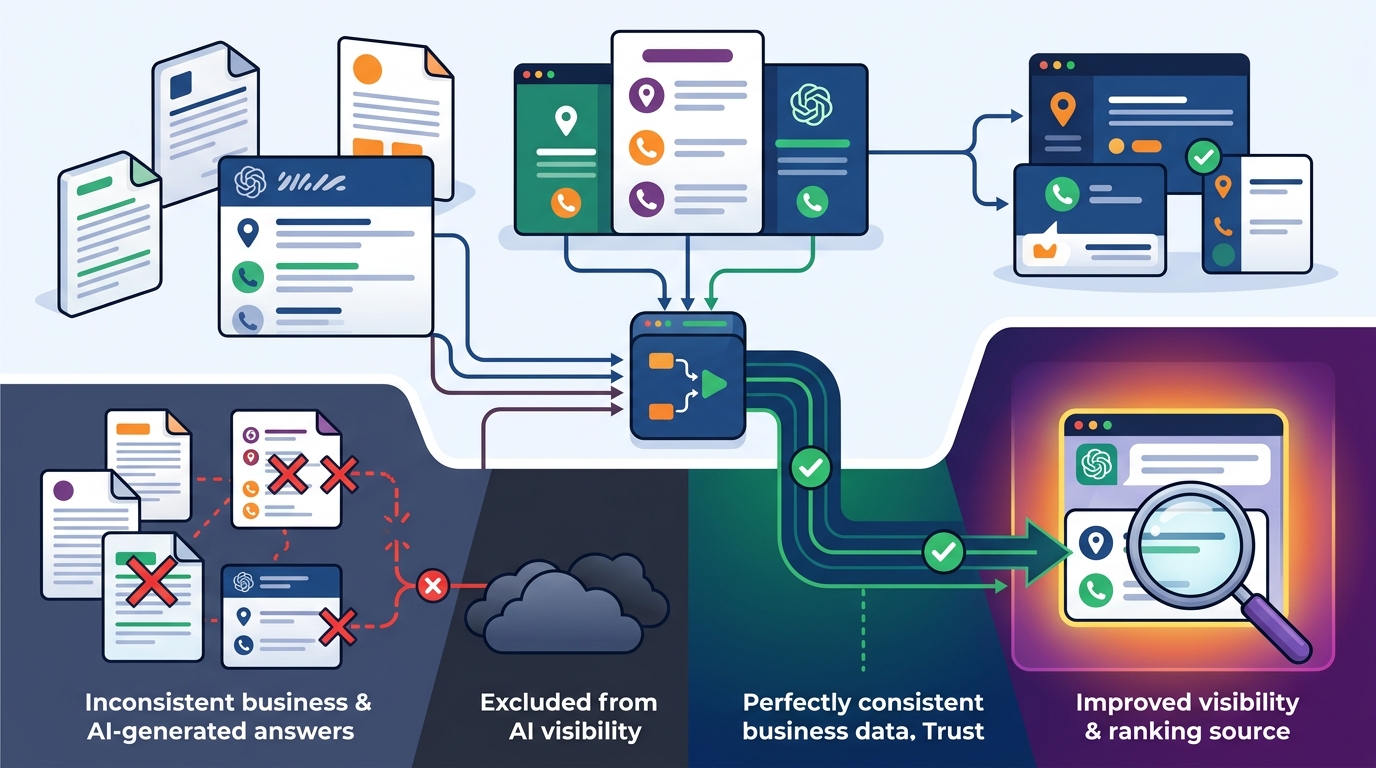
Consistent business data is the primary signal that tells AI models your information is reliable. When your name, address, and phone number match across the web, ChatGPT is more likely to trust and cite your business. Inconsistent data creates doubt, which leads to exclusion from AI-generated answers.
Why Consistency Matters for AI Trust
Large language models rely on pattern recognition to determine the truth. When a model encounters conflicting information about a business, it cannot easily verify which source is correct. This ambiguity reduces the model's confidence in citing that entity. Consistency is the foundation of digital trust. If your business profile on a directory says one thing and your website says another, the AI treats your data as low-quality. This is why Cytd emphasizes clean data as the first step in AI visibility. Without a unified digital footprint, no amount of content creation will secure a citation.
How LLMs Process Business Data
Language models do not browse the live web in real-time for every query. They rely on training data and retrieval-augmented generation to find current information. During retrieval, the system looks for corroborating sources. If multiple independent sources agree on your business details, the model assigns a higher probability to that data being accurate. Corroboration is key to citation. A single source is rarely enough. You need a network of consistent references. This process explains why local businesses often struggle with AI visibility. Their data is scattered across dozens of platforms with slight variations. The model sees noise instead of a clear signal.
Common Inconsistencies That Hurt Visibility
Small errors in business data can have a large impact on AI perception. These mismatches are common and often go unnoticed by business owners. Addressing them is a critical part of AI optimization. Here are the most frequent issues that prevent models from trusting your brand:
- Address Variations: Using "St." versus "Street" or omitting the unit number. These small differences create distinct data points for the AI.
- Phone Number Formats: Listing the same number with different area codes or extensions across platforms. The model may treat these as different businesses.
- Business Name Changes: Failing to update old directories after a rebrand. Old names linger in training data and create confusion.
- Category Mismatches: Listing your business under the wrong industry category. This prevents the model from associating you with relevant queries.
Each of these issues adds friction to the model's decision-making process. The more friction, the less likely you are to be recommended. Fixing these basics is often the fastest way to improve your standing in AI answers.
Fixing Data Mismatches
Correcting inconsistent data requires a systematic approach. You must audit every place your business information appears. This includes your website, social media profiles, and third-party directories. Start by creating a master record of your correct business details. Then, compare each live profile against this master record. Update any discrepancies immediately. Accuracy beats volume. It is better to have ten consistent profiles than fifty inconsistent ones. Focus on the platforms that AI models are most likely to scrape. These include major directories, review sites, and your own website. Ensuring these sources align is the highest-impact action you can take. This process is a core part of the content strategy that drives citations.
Monitoring Your AI Visibility
Once your data is consistent, you need to track how AI models respond. Visibility is not a one-time fix. It is an ongoing process that requires monitoring. You should regularly test how ChatGPT, Gemini, and other models answer questions about your category. Look for mentions of your business and note any missing details. This feedback loop helps you identify new inconsistencies as they arise. Tools like Cytd's free report can help you see your current standing. They show you where you are visible and where you are missing. This data-driven approach ensures you are not guessing. It allows you to make informed decisions about your digital presence. Consistency is the bridge between your business and the AI answer layer.
Key Takeaways
- Consistent business data is the primary signal for AI trust and citation.
- LLMs rely on corroboration from multiple sources to verify information.
- Small errors in addresses or phone numbers can create significant data noise.
- Corroborated data increases the probability of being featured in AI answers.
- Regular monitoring is essential to maintain consistency over time.
- Focus on high-impact platforms where AI models are likely to scrape data.
Frequently Asked Questions
Does fixing my data guarantee I will be cited by ChatGPT?
No, fixing your data does not guarantee citation. It removes a major barrier to trust. However, other factors like content quality and authority also play a role. Consistency is a necessary but not sufficient condition for visibility.
How long does it take for AI models to update my information?
There is no fixed timeline. Models update their knowledge through retraining and retrieval. It can take weeks or months for changes to fully propagate. Consistency helps accelerate this process by reducing ambiguity.
Which platforms are most important for AI visibility?
Major directories, review sites, and your own website are the most important. These are the sources AI models are most likely to scrape. Ensure your data is consistent across these key platforms first.
Can I control what ChatGPT says about my business?
No, you cannot directly control what AI models say. You can only influence the data they have access to. By providing consistent and accurate information, you increase the likelihood of positive mentions.
What is the difference between a mention and a citation?
A mention is when the AI refers to your business by name. A citation is when the AI links to your website or source. Citations are more valuable because they drive traffic. Mentions build brand awareness.
How often should I check my business data?
You should check your data at least quarterly. Directories and platforms can change or become outdated. Regular audits ensure your information remains consistent and accurate over time. Learn more: Cytd We make AI.