
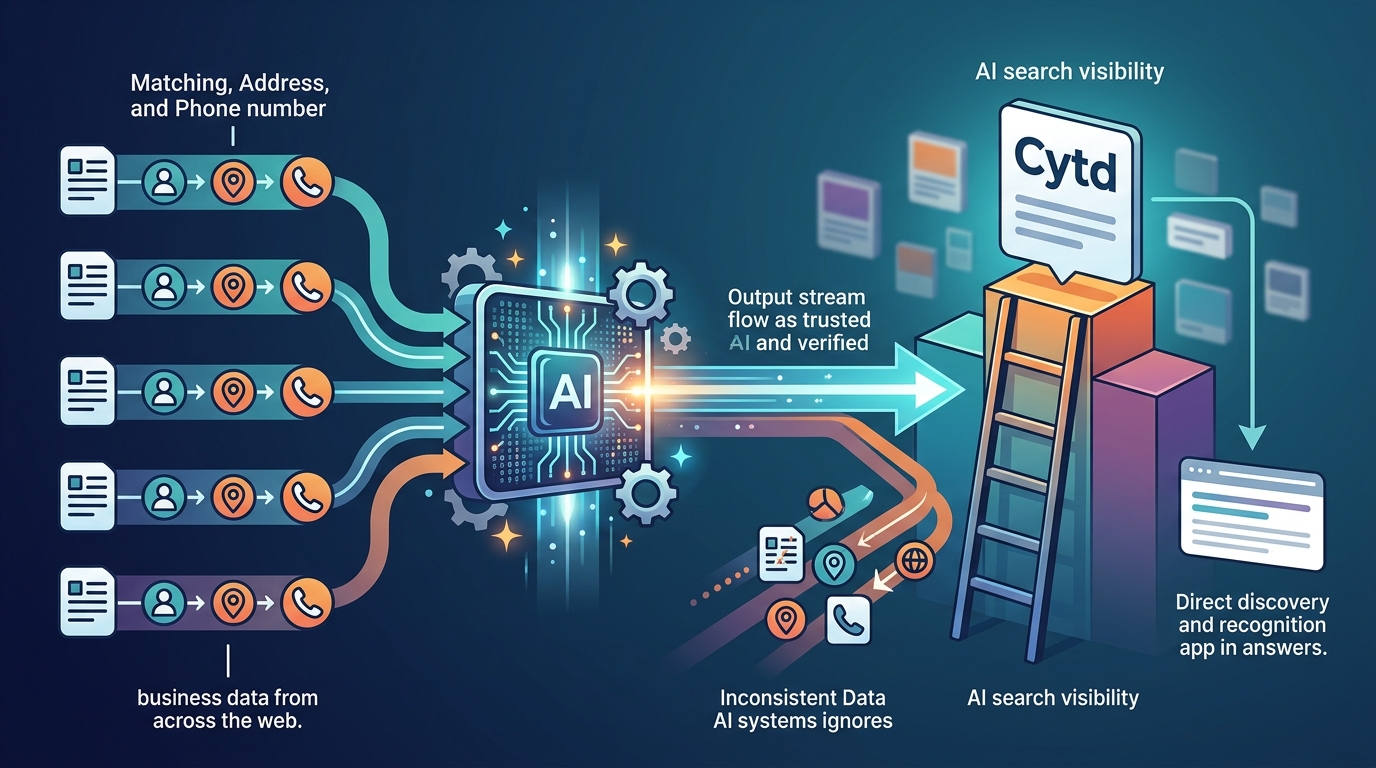
Consistent business data is the primary signal AI models use to verify a brand's legitimacy. When your name, address, and phone number (NAP) match across the web, AI engines trust your entity. This trust directly determines whether you appear in AI-generated answers. Inconsistent data creates ambiguity, causing AI systems to ignore or deprioritize your brand in search results. For additional details, contact our team.
Entity Verification and Trust Signals
AI search engines do not just read text; they map entities. Entity resolution is the process where AI systems identify and link a specific business to its verified data points across the internet. If your business profile on a directory lists a different phone number than your website, the AI model flags this as a data conflict. This conflict reduces the confidence score assigned to your entity. A low confidence score means the AI is less likely to recommend you when a user asks for a service in your category.
For local businesses, this verification is critical. AI models cross-reference your data against thousands of other sources. If your information is fragmented, the model cannot confirm your existence with high certainty. This lack of certainty pushes you out of the top recommendations in favor of competitors with cleaner, more consistent data profiles.
The Role of Structured Data in Consistency
Structured data acts as a bridge between your website and AI crawlers. Schema markup is a standardized format for providing information about a page and classifying the page's content. By implementing LocalBusiness schema, you explicitly tell AI engines your official name, address, and operating hours. This on-site data must match your off-site citations. If your schema says you are open until 5 PM, but a major directory says 6 PM, the AI detects a discrepancy. This mismatch can lead to your business being excluded from time-sensitive AI answers.
Cytd utilizes machine-readable markup to ensure your core site data is parsed correctly. We build dedicated subdomains and content structures that align with your primary entity data. This alignment ensures that when AI crawlers index your site, they find a single, authoritative source of truth that matches your broader web presence.
Citation Networks and Data Hygiene
Your business information exists in a vast network of citations. Citation consistency is the state where your core business details remain identical across all third-party directories, social profiles, and review sites. AI models aggregate these citations to build a profile of your brand. If 50% of your citations are accurate and 50% are outdated, the AI model averages the data or discards the entity entirely. This is why data hygiene is not just a local SEO task; it is a fundamental requirement for AI visibility.
Consider a dental practice in Laguna Beach. If their address is listed correctly on their website but incorrectly on three major health directories, AI models like ChatGPT or Gemini may hesitate to recommend them. The inconsistency creates noise. By auditing and correcting these citations, you reduce noise and increase the signal-to-noise ratio for AI crawlers. This clarity allows the AI to confidently place you in the answer.
How AI Crawlers Process Inconsistent Data
AI crawlers operate differently than traditional search bots. They prioritize semantic understanding over simple keyword matching. When an AI crawler encounters conflicting data about a business, it attempts to resolve the conflict using weighted sources. High-authority sources carry more weight. If your website is high-authority but your social profiles are inconsistent, the AI may prioritize the website data but flag the entity as unstable. This instability can limit your visibility in dynamic AI answers that require real-time accuracy.
Furthermore, AI models use social proof and community discussions to validate business data. If Reddit threads or forum discussions mention your business with outdated information, the AI may incorporate that noise into its knowledge base. Monitoring these community discussions is essential. By ensuring your data is consistent in these unstructured environments, you protect your entity from being polluted by outdated or incorrect user-generated content.
The Cytd Approach to Data Integrity
Cytd focuses on making AI recommend your business by ensuring your entity is robust and consistent. We do not just create content; we build a visibility infrastructure that prioritizes data integrity. Our platform includes discovery indexing and automated pings that alert search bots to updates. This ensures that when you correct a data point, the AI models are notified immediately. This rapid synchronization is crucial for maintaining a consistent entity profile in the eyes of AI engines.
Our dedicated account managers work with you to audit your existing data footprint. We identify inconsistencies across your digital presence and implement strategies to resolve them. By aligning your on-site schema, off-site citations, and social profiles, we create a unified entity that AI models can trust. This trust is the foundation of high AI visibility.
Key Takeaways
- AI models rely on consistent NAP data to verify business entities.
- Inconsistent data reduces the confidence score assigned to your brand.
- Schema markup must match off-site citations to avoid data conflicts.
- High-authority sources weigh more heavily in AI entity resolution.
- Data hygiene is a prerequisite for AI search visibility.
- Monitoring community discussions prevents outdated data from polluting your entity.
- Cytd helps align your digital footprint for maximum AI trust.
Frequently Asked Questions
Why do AI models care about data consistency?
AI models use consistency as a proxy for truth. If data is consistent across multiple independent sources, the model assumes it is accurate. Inconsistency signals error or fraud, leading the model to ignore the entity.
Does fixing old citations improve AI visibility?
Yes. Removing or correcting outdated citations reduces noise in the AI's data set. This allows the model to build a clearer, more confident profile of your business, which can improve your ranking in AI answers.
How often should I check my business data?
You should audit your data quarterly. AI models update their knowledge bases frequently. Regular audits ensure that any changes to your business information are reflected consistently across all platforms.
Can I control what AI models say about my business?
You cannot directly control the output, but you can influence the input. By providing consistent, high-quality data, you increase the likelihood that the AI will recommend you accurately.
What is the most important data point for AI visibility?
The Name, Address, and Phone number (NAP) are the most critical. These are the primary keys AI models use to identify and link business entities across the web.
How does Cytd help with data consistency?
Cytd audits your digital footprint and implements strategies to align your data across all platforms. We use machine-readable markup and automated indexing to ensure AI models see a consistent, trustworthy entity.
Conclusion
AI search visibility is not just about content; it is about data integrity. By ensuring your business information is consistent across all platforms, you build the trust that AI models require to recommend you. Cytd helps you achieve this alignment, ensuring your brand is the answer AI engines provide. To start improving your AI visibility, run your free AI report today. Learn more: Cytd We make AI.