
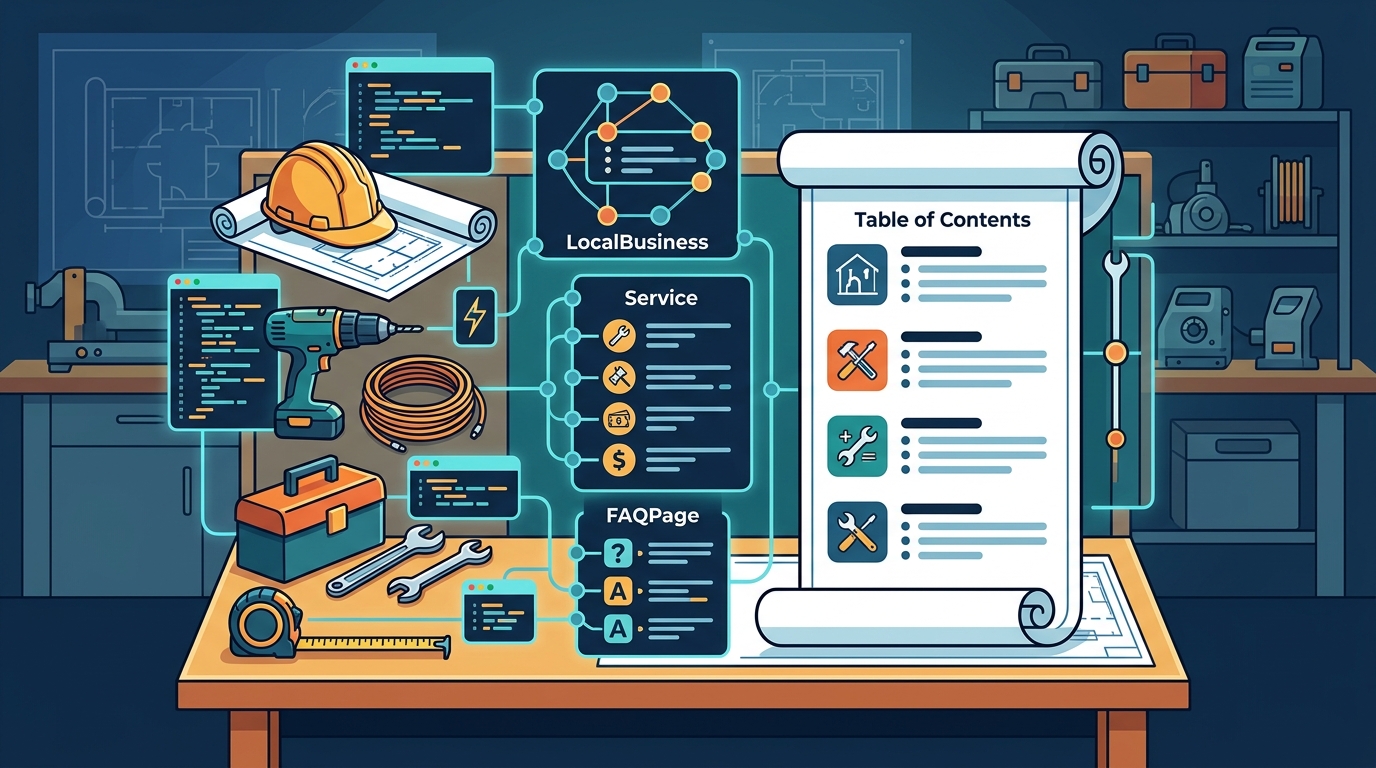
Home service contractors need LocalBusiness, Service, and FAQPage schema to rank in AI search. These markup types help large language models accurately extract your business details, service areas, and pricing. Proper implementation ensures your brand is cited as a trusted source when users ask for local recommendations.
Why AI Engines Require Structured Data
Traditional search engines rely heavily on text analysis, but AI answer engines depend on structured data to understand context. Structured data markup is a standardized format for providing information about a page and classifying the page's content. When an AI model processes a webpage, it looks for JSON-LD or Microdata to verify facts. Without this markup, the model may ignore your site or hallucinate incorrect details about your services. This distinction is critical for contractors who want to be recommended by platforms like ChatGPT or Gemini.
The shift from blue links to AI-generated answers means that visibility is no longer just about ranking position. It is about being the cited source. If your website lacks clear, machine-readable signals, you are invisible to the AI layer. This is why Cytd's research on AI search emphasizes that technical foundations must precede content strategy. You cannot optimize for AI if the AI cannot read your data.
Essential Schema Types for Contractors
Not all schema is created equal. For home service businesses, three specific types drive the most impact in AI citations. LocalBusiness schema is a markup type that defines your physical location, operating hours, and contact information. This is the baseline for any local service provider. It tells the AI where you are and when you are available. If this data is missing or inconsistent, the AI will likely recommend a competitor with clearer signals.
Next, you must implement Service schema, which is a markup type that describes the specific services you offer, including prices and areas served. A general contractor cannot just list "renovations." You need to break down services like kitchen remodeling or bathroom installation with specific details. This granularity allows AI models to match your business to specific user queries. Finally, FAQPage schema helps capture long-tail questions that users ask directly to AI assistants.
| Schema Type | Purpose | Key Fields |
|---|---|---|
| LocalBusiness | Establishes physical presence and trust | address, geo, openingHours, telephone |
| Service | Details specific offerings and pricing | name, description, provider, areaServed |
| FAQPage | Answers common user questions | question, acceptedAnswer |
Implementation Best Practices for Accuracy
Accuracy is the most important factor in AI citation. If your structured data contradicts your visible text, AI models may flag your site as unreliable. Consistency is a principle that ensures your structured data matches your visible content exactly. For example, if your schema lists your phone number as 555-0199 but your footer shows 555-0100, you create a trust deficit. AI engines cross-reference these signals. Discrepancies lead to exclusion from recommendations.
Use JSON-LD for implementation. It is the preferred format for Google and most AI crawlers because it is easy to parse and does not interfere with your HTML structure. Place the script in the head or body of your page. Ensure that every service you list in your schema has a corresponding page on your website. This creates a topical authority cluster that AI models can navigate. For a deeper look at how content and technical setup interact, review the Cytd platform overview which details how technical signals are monitored.
Common Mistakes That Hide You From AI
Many contractors make errors that inadvertently hide them from AI search. One major mistake is using generic descriptions. If your Service schema says "We do plumbing," you are competing with every plumber in the country. You need specific, intent-driven descriptions. Another error is neglecting the areaServed field. If you serve a specific metro area, list it explicitly. This helps AI models filter results by location, which is a primary user intent in local search.
Additionally, failing to update your schema is a silent killer. If you change your hours or add a new service, your structured data must reflect that change immediately. Outdated data leads to negative user experiences and reduced trust in the AI's recommendations. You can monitor your visibility and ensure your data is being read correctly by using Cytd's free AI visibility report. This tool helps you see how AI engines perceive your current setup.
Measuring the Impact of Your Markup
You cannot improve what you do not measure. Traditional SEO metrics like keyword rankings are less relevant in the AI era. Instead, you need to track citations and mentions. AI visibility score is a metric that quantifies how often your brand is cited by AI answer engines. This score helps you understand if your structured data is actually working. If your score is low, it indicates that your markup is either missing, incorrect, or insufficiently detailed.
Track your performance over time. Look for trends in how often you are mentioned in response to specific questions. Are you being cited for "best HVAC repair in Denver"? If not, adjust your Service schema to be more specific. Use tools that provide direct feedback on AI citations. The Cytd case studies show how businesses have improved their scores by focusing on technical accuracy and specific service definitions. This data-driven approach ensures your efforts are aligned with actual AI behavior.
Key Takeaways
- Structured data is the primary way AI engines verify your business details.
- Implement LocalBusiness, Service, and FAQPage schema for maximum coverage.
- Ensure your structured data matches your visible text to maintain trust.
- Use specific, intent-driven descriptions in your Service schema.
- Update your markup whenever your business details change.
- Monitor your AI visibility score to track citation frequency.
Frequently Asked Questions
What is the best format for structured data?
JSON-LD is the recommended format for most websites. It is easy to implement and does not interfere with your existing HTML structure. Most AI crawlers are optimized to parse JSON-LD efficiently.
Do I need schema for every page?
You should implement LocalBusiness schema on your homepage and Service schema on your service pages. You do not need to duplicate the same schema on every page, but each page should have relevant, specific markup.
How long does it take for AI to index my new schema?
Indexing times vary. Some AI engines may pick up changes within days, while others may take weeks. Consistent monitoring is the best way to track when your changes are reflected in AI answers.
Can I use structured data if I have a simple website?
Yes. Even simple websites can benefit from basic LocalBusiness and Service schema. The complexity of your website does not determine the value of structured data. Accuracy is more important than complexity.
Where can I test my structured data?
You can use Google's Rich Results Test to validate your markup. However, for AI-specific visibility, you need tools that monitor how AI engines actually cite your content, such as Cytd's support resources which guide you on monitoring your visibility.
Next Steps for Your Business
Implementing structured data is a technical task, but the strategy is simple. Start by auditing your current markup. Ensure your LocalBusiness and Service schema are accurate and specific. Then, monitor your visibility to see how AI engines respond to your changes. If you are unsure where to start, contact the Cytd team for a personalized assessment of your AI visibility. They can help you identify gaps in your markup and provide a roadmap for improvement.