

Home service contractors need LocalBusiness, Service, and FAQPage schema to get found by AI. These markup types provide the machine-readable facts that large language models require to verify your identity, services, and answers. Without them, AI engines cannot confidently cite your business in generated responses.
Why AI Engines Require Structured Data
Traditional search engines rank pages based on relevance and authority. AI answer engines operate differently. They retrieve specific passages of text to answer user questions. Structured data is the standardized format that tells machines exactly what a piece of content means. When a user asks an AI assistant for a plumber in their area, the system looks for verified facts about local businesses. If your website only describes your services in prose, the AI may struggle to extract the necessary details to recommend you.
According to Microsoft guidance on content for AI search, structure, schema markup, and block-level clarity are critical. Missing these elements is a common reason why content fails in AI-driven discovery. AI models prioritize current and contextually accurate data. They rely on citation networks and domain authority to determine trustworthy sources. By implementing structured data, you make your business machine-readable. This allows AI crawlers to parse your site without guesswork.
The Essential Schema Types for Contractors
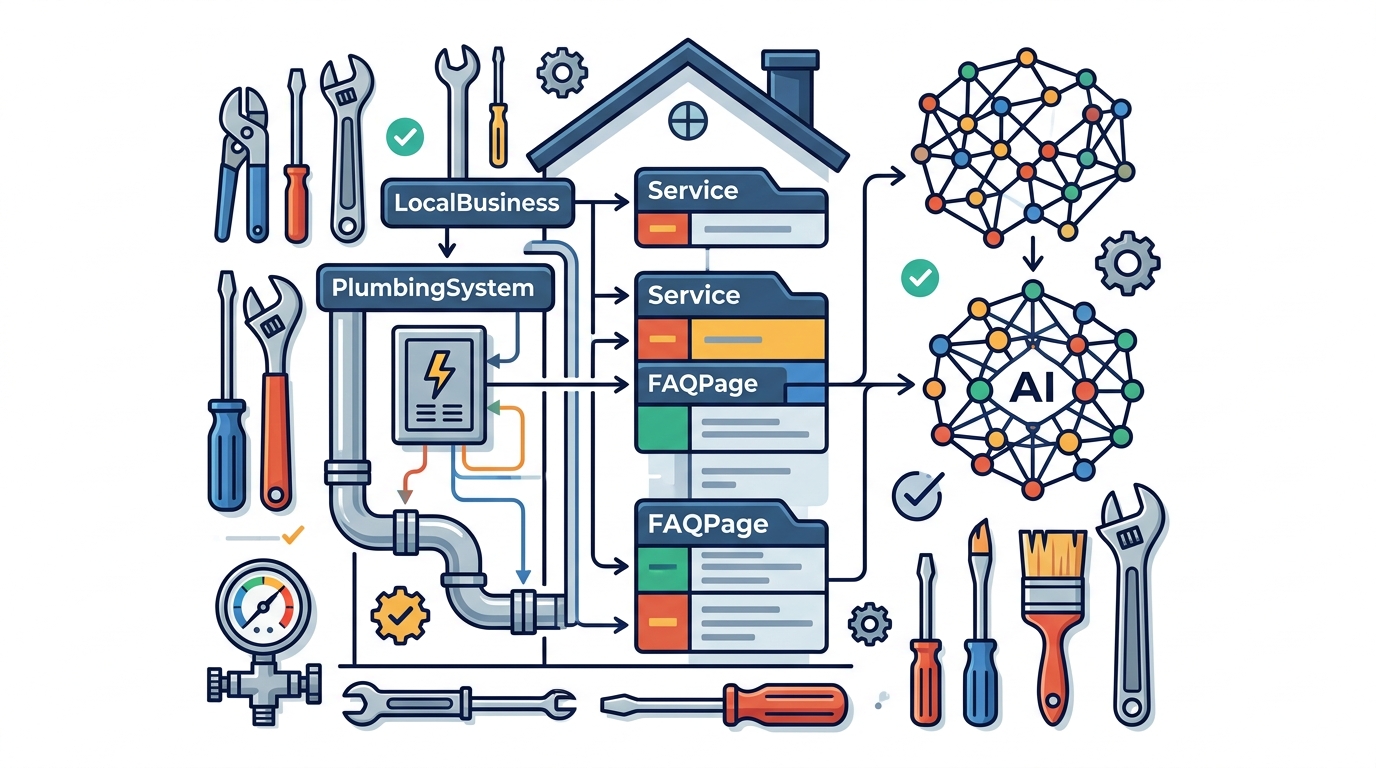
Not all schema is created equal. For home service businesses, three specific types form the foundation of AI visibility. LocalBusiness schema is the baseline for any service provider with a physical location. It defines your name, address, phone number, and operating hours. This data must be consistent across the web. AI systems cross-reference this information with directories and review sites to verify your existence.
Service schema is the specific markup that describes the work you do. It allows you to list individual services, such as HVAC repair or electrical installation, with their own descriptions and pricing models. This granularity helps AI engines match your specific capabilities to user queries. Finally, FAQPage schema is the format for answering common customer questions directly. It structures your Q&A content so that AI systems can lift the answer straight out of your page. This is crucial because AI citations are attached to passages, not whole pages.
Implementing Answer-First Content
Structured data works best when paired with clear, direct content. AI models look for structured, factual, and well-sourced information. You should use clear formatting and cite credible references. Answer-first formatting front-loads the direct answer before the supporting detail. This structure allows AI engines to extract and quote the answer instantly. For example, if a user asks about the cost of a furnace repair, your page should state the typical price range immediately. Then, you can provide the supporting details about factors that influence cost.
Cytd builds every client strategy around a foundation of tracked questions rather than a keyword list. Keywords were built for a search box, but AI answers come from questions. People are asking AI assistants "who is the best [service] near me" instead of Googling it. Whether your business shows up in that answer comes down to your target questions. You must identify the questions users are asking AI tools and structure your content to answer them. This approach ensures that your content is not just indexed, but actually cited.
Ensuring Machine Readability
Having the right schema is not enough if your content is not machine-readable. If important information is locked inside widgets, interactive elements, or PDFs, AI platforms may not see it. Ensure your core content is visible in raw HTML. Check that your key value propositions, summaries, and FAQs are part of the plain HTML. They should not be hidden behind JavaScript, widgets, or PDFs. Search Engine Land notes that if AI cannot read your website, it will not recommend it. This is a critical technical requirement for AI visibility.
You should also leverage structured data to improve how your content is interpreted by both traditional crawlers and AI scrapers. Metadata, schema markup, and well-organized HTML all help machines understand what your content means. Keep your content fresh and contextual. AI platforms prioritize current data. Regularly update your site with timely articles, product updates, and technical posts to maintain relevance in the AI ecosystem. This ongoing maintenance ensures that your structured data remains accurate and useful to AI systems.
Measuring Your AI Visibility
Once you have implemented structured data, you need to measure its impact. Traditional SEO metrics like rankings and traffic are no longer the only indicators of success. Citation visibility refers to how likely your content is to be referenced, summarized, or cited by AI platforms. Being cited by AI builds credibility and amplifies your brand's reach. When an AI references your domain as a trusted source, it reinforces your authority across the web. You need tools that track how your domain appears in AI-generated responses.
Cytd tracks citations across five major AI engines: ChatGPT, Perplexity, Gemini, Claude, and Grok. For each engine, it monitors how your domain appears in responses. This includes AI citations, visibility by engine, and comparative data. You can see exactly what AI assistants say and do not say about your business today. This data helps you identify gaps in your structured data and content strategy. By monitoring your AI visibility, you can make informed decisions about how to improve your presence in the AI search landscape.
Key Takeaways
- LocalBusiness schema is the foundation for verifying your business identity to AI engines.
- Service schema allows you to describe specific capabilities and match user queries.
- FAQPage schema structures your answers so AI systems can cite them directly.
- Answer-first formatting ensures that AI engines can extract the direct answer instantly.
- Machine readability requires that core content is visible in raw HTML, not hidden in widgets.
- Citation visibility is the new metric for success in AI-driven discovery.
- Continuous monitoring is essential to track how AI engines cite your business over time.
Frequently Asked Questions
What is the most important schema type for home service contractors?
LocalBusiness schema is the most important because it verifies your business identity, including name, address, and phone number. AI systems use this data to confirm that your business exists and is legitimate before recommending it to users.
How does structured data help with AI citations?
Structured data provides machine-readable facts that AI models can easily extract and cite. It reduces the ambiguity in your content, making it more likely that AI engines will reference your specific passages in their generated answers.
Do I need to implement all schema types at once?
No, you can start with LocalBusiness and Service schema. Then, add FAQPage schema as you develop more Q&A content. Prioritize the schema types that address the most common questions your customers ask AI assistants.
Can AI engines read content hidden in JavaScript widgets?
Often, no. If your core content is locked inside interactive elements or widgets that do not render easily to plain HTML, AI platforms may not see it. Ensure your key information is visible in raw HTML for maximum AI visibility.
How often should I update my structured data?
You should update your structured data whenever your business information changes, such as hours, services, or contact details. AI platforms prioritize current and contextually accurate data, so keeping your schema up to date is essential for maintaining relevance.
What is the difference between SEO and AI visibility?
SEO focuses on ranking pages in traditional search results, while AI visibility focuses on being cited in AI-generated answers. AI engines retrieve specific passages to answer questions, so your content must be structured to be easily extracted and cited by these systems.
Conclusion
Getting found by AI requires a shift from traditional SEO to structured, machine-readable content. Home service contractors must implement LocalBusiness, Service, and FAQPage schema to provide the facts that AI engines need. By using answer-first formatting and ensuring machine readability, you make your business a reliable source for AI citations. Cytd helps you track and improve your AI visibility across major platforms. Run your free AI report to see exactly what AI assistants say about your business today.