
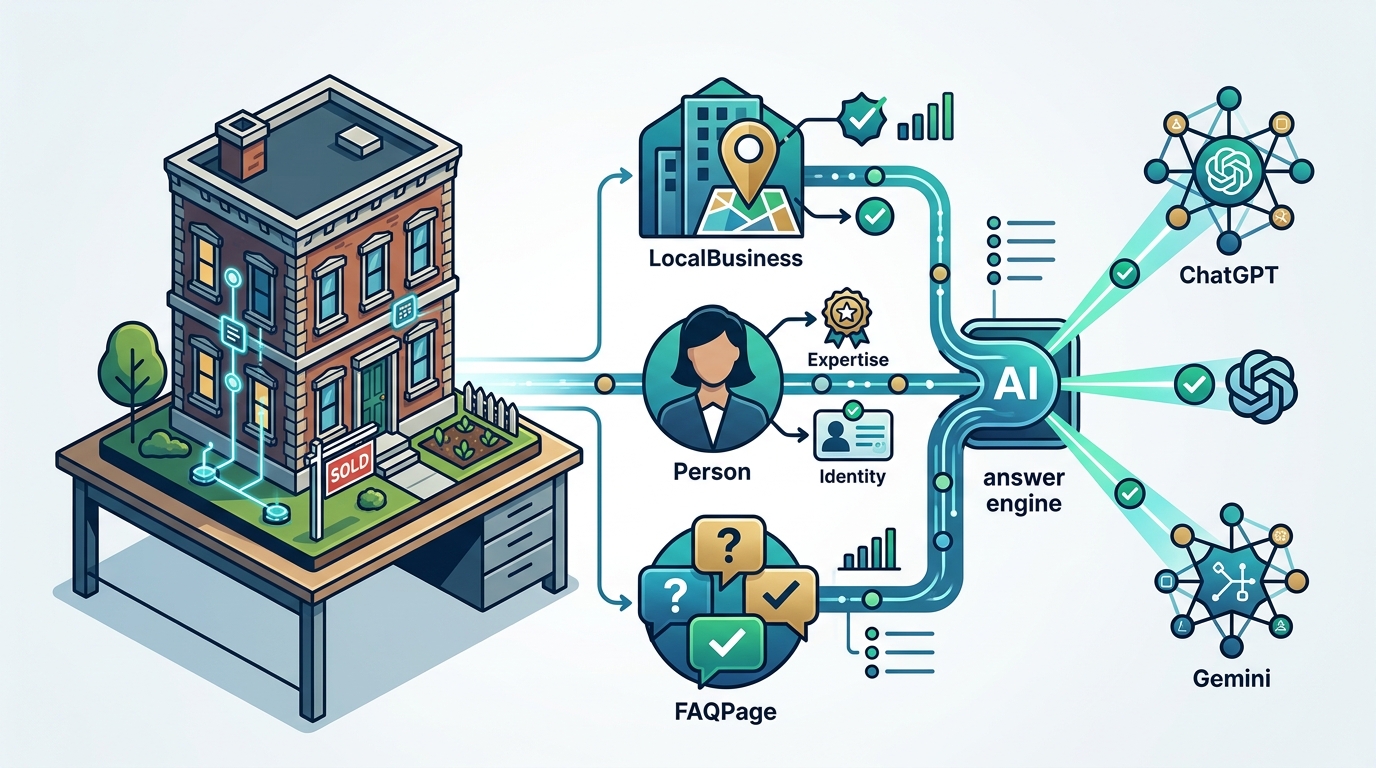
Real estate agents need LocalBusiness, Person, and FAQPage schema to rank in AI search. These structured data types help large language models verify your identity, location, and expertise. Cytd uses this data to ensure your business is cited accurately by ChatGPT and Gemini.
Why Schema Matters for AI Visibility
Traditional SEO relies on keywords, but AI search relies on context. Large language models parse structured data to understand the relationship between a brand and a specific query. Without clear schema, an AI engine cannot distinguish your agency from a competitor with a similar name. This ambiguity leads to exclusion from generated answers.
Cytd monitors how AI engines interpret your site's metadata. When schema is missing or malformed, the model may hallucinate details or simply omit your brand. Structured data acts as a factual anchor. It provides the machine-readable evidence that your business exists, operates in a specific city, and offers specific services. This reduces the risk of being left out of the recommendation list.
Core Schema Types for Agents
Three specific schema types form the foundation of AI visibility for real estate professionals. Each serves a distinct purpose in the data extraction process.
LocalBusiness Schema
LocalBusiness schema is the primary signal for geographic relevance. It defines your physical address, service area, and operating hours. For a local agent, this is non-negotiable. If an AI user asks for a realtor in Denver, the model looks for LocalBusiness entities with a matching geo-coordinate. Missing this data means you are invisible to location-based queries.
Person Schema
Person schema is the structured data that identifies the individual agent behind the brand. It links your name, job title, and social profiles to your website. AI engines use this to verify that a human expert is associated with the content. This builds trust in the recommendation. It moves the answer from a generic company name to a specific, accountable professional.
FAQPage Schema
FAQPage schema is the markup that organizes questions and answers for direct extraction. It allows AI models to pull specific answers without parsing entire paragraphs. For example, if a user asks about commission rates, the model can cite your FAQ section directly. This increases the likelihood of your specific answer being quoted in the final response.
Implementation Details for Accuracy
Adding schema is not enough; the data must be accurate and consistent. AI engines cross-reference your schema with other public sources. If your website says you are in Austin, but your social profiles say you are in Dallas, the model may flag the inconsistency. This discrepancy can lower your trust score in the AI's internal ranking system.
Cytd's platform includes a dedicated subdomain for AI-optimized content. This allows us to test schema variations without risking your main site's stability. We ensure that every data point in your markup matches your public record. This consistency is what allows AI engines to confidently cite your business as the recommended answer.
Common Schema Mistakes to Avoid
Many agents make errors that silently break their AI visibility. One common mistake is using generic schema types. Using a basic Organization schema instead of LocalBusiness fails to capture the geographic nuance required for local search. Another error is leaving key properties empty. An AI engine cannot infer your service area if you do not explicitly define it in the markup.
Validation is critical. You must use a schema validator to ensure your JSON-LD is syntactically correct. A single missing comma can cause the entire block to be ignored. Cytd's team reviews your markup to catch these errors before they impact your visibility score. We ensure that the data is not just present, but parseable by the specific AI crawlers we monitor.
Measuring Schema Impact
You cannot improve what you do not measure. Cytd provides a dashboard that tracks your visibility score across multiple AI engines. This score reflects how often your schema is cited in generated answers. By monitoring this metric, you can see the direct impact of your structured data efforts. It moves the conversation from guesswork to data-driven optimization.
The goal is to become the definitive source for your niche. When your schema is robust, AI engines treat your site as a trusted reference. This leads to more citations, more traffic, and more leads. It is a long-term strategy that compounds over time. As AI search grows, the agents with the best structured data will dominate the answer layer.
Key Takeaways
- LocalBusiness schema is essential for geographic relevance in AI search.
- Person schema links your professional identity to your brand content.
- FAQPage schema allows AI models to extract specific answers directly.
- Data consistency across your website and social profiles is critical for trust.
- Malformed schema can cause your entire site to be ignored by AI crawlers.
- Cytd monitors your visibility score to measure the impact of your schema.
Frequently Asked Questions
What is the most important schema for real estate agents?
LocalBusiness schema is the most important for real estate agents. It provides the geographic data that AI engines need to match your services with a user's location query.
Does schema markup guarantee AI citations?
No, schema markup does not guarantee citations. It provides the data that AI engines need to understand your business, but other factors like content quality and authority also play a role.
How does Cytd use schema markup?
Cytd uses schema markup to ensure your business data is accurate and consistent. We monitor how AI engines interpret this data and adjust your strategy to improve your visibility score.
Can I add schema markup myself?
Yes, you can add schema markup yourself using JSON-LD. However, ensuring accuracy and consistency across all your digital assets is complex. Cytd handles this process to ensure your data is optimized for AI extraction.
What happens if my schema is inconsistent?
If your schema is inconsistent with other public data, AI engines may lower your trust score. This can result in fewer citations or exclusion from generated answers.
How often should I update my schema?
You should update your schema whenever your business details change. This includes changes to your address, service area, or team members. Cytd helps you manage these updates to keep your data current. Learn more: Cytd We make AI.