
Does Updating Your Google Business Profile Help Insurance Agents Rank in AI Chatbots?
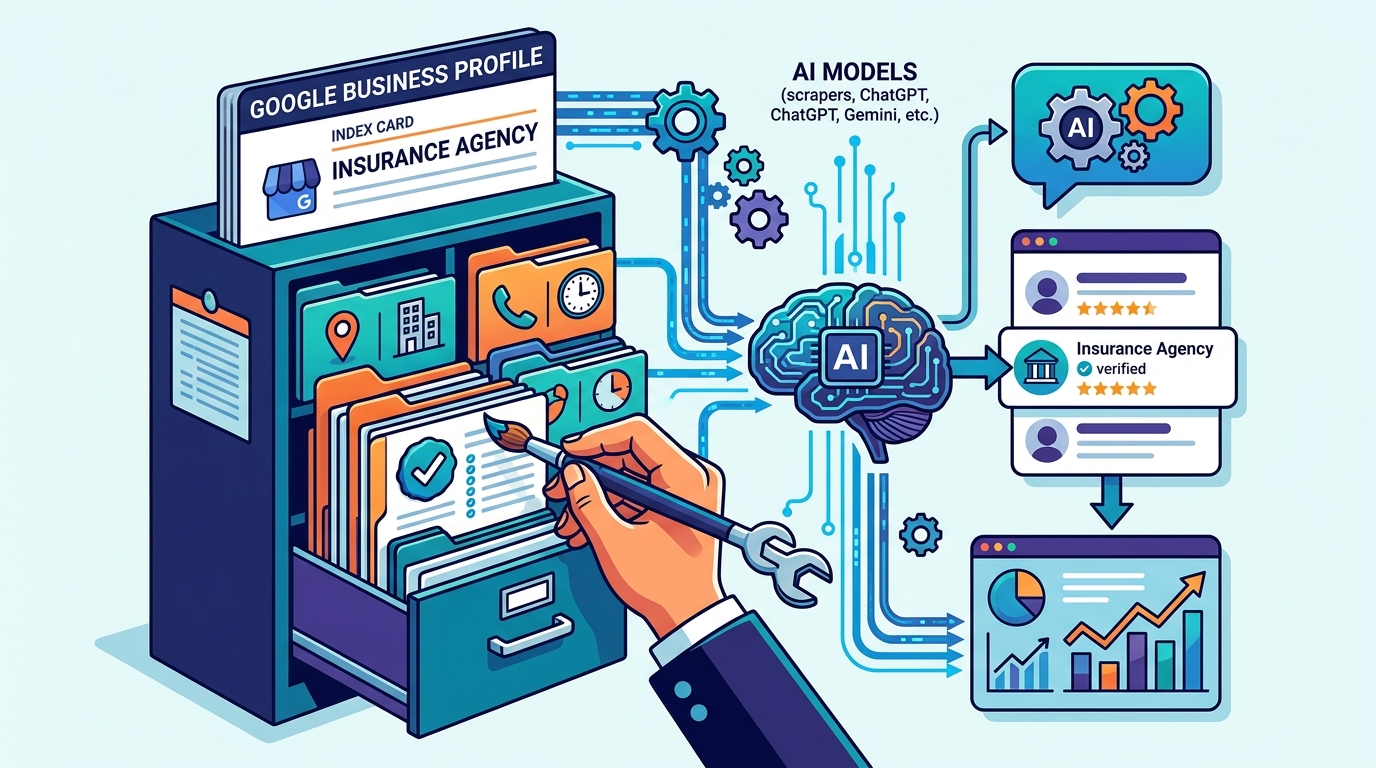
Yes, updating your Google Business Profile (GBP) directly influences how AI chatbots perceive and recommend your insurance agency. AI models scrape public web data to build their knowledge base, and your GBP serves as a primary, structured source of truth for your location, services, and contact details. When this data is accurate and current, it increases the likelihood that AI engines like ChatGPT or Gemini will cite your business when users ask for local insurance recommendations. Cytd helps brands monitor this visibility across multiple AI platforms to ensure their public data aligns with their actual services.
How AI Engines Consume Google Business Data
Large language models (LLMs) do not have a direct, real-time API connection to Google's local search index in the same way traditional search engines do. Instead, they rely on web crawlers that periodically scan public websites and structured data. Your Google Business Profile is one of the most frequently crawled sources for local business information because it is standardized and authoritative. When an AI model is asked, "Who is the best insurance agent in [City]?", it looks for entities that have a strong, consistent digital footprint. A stale or incomplete GBP creates a gap in this data, causing the AI to either ignore your business or provide outdated information. This is why AI visibility tracking is critical; it reveals whether the data AI sees matches the reality of your business operations.
Specific GBP Fields That Impact AI Citations
Not all fields on your profile carry equal weight for AI interpretation. The "Services" and "Description" fields are particularly important because they provide the semantic context needed for the AI to categorize your agency. For example, if you specialize in commercial liability insurance but your description only mentions "insurance services," the AI may not associate you with specific high-intent queries. Additionally, the "Attributes" section, which allows you to specify things like "Women-owned" or "LGBTQ+ friendly," helps AI models answer nuanced questions about diversity and inclusion in local services. Insurance agents should ensure these fields are populated with specific, keyword-rich language that reflects their actual niche. This specificity is what allows content optimization strategies to work effectively in the AI layer.
The Role of Data Consistency in AI Trust
AI models place a high premium on data consistency. If your Google Business Profile lists your phone number as 555-0101, but your website, LinkedIn, and Yelp listings show 555-0102, the AI may flag your business as low-trust or unreliable. This phenomenon, known as entity disambiguation, is a core function of modern AI search. When the AI cannot confidently link your various digital touchpoints to a single, verified entity, it is less likely to recommend you. Insurance agents should audit their NAP (Name, Address, Phone) data across all major directories to ensure perfect alignment. This consistency signals to the AI that your business is stable and legitimate, which is a key factor in improving citation frequency.
Leveraging Reviews for AI Sentiment Analysis
AI chatbots increasingly analyze the sentiment and content of customer reviews to determine the quality of a local service provider. A Google Business Profile with a high volume of recent, positive reviews that mention specific insurance terms (e.g., "fast claims processing," "helpful with auto insurance") provides rich semantic data for the AI to process. Conversely, a profile with few reviews or negative sentiment will be deprioritized. Insurance agents should actively encourage clients to leave detailed reviews that highlight specific services. This not only boosts your local SEO but also provides the AI with the specific language it needs to match your business to user queries. Monitoring this sentiment is a key part of AI search strategy.
Monitoring Your AI Visibility Score
Updating your GBP is a necessary step, but it is not sufficient on its own to guarantee AI recommendations. You need to know if the AI is actually seeing and citing your updated data. This is where a dedicated AI visibility tool becomes essential. By tracking your "Cytd Score" or similar metrics, you can see exactly which AI platforms are recommending you and for which specific questions. This data allows you to identify gaps in your public information and adjust your strategy accordingly. For instance, if you are being cited for "auto insurance" but not "home insurance," you know you need to update your service descriptions to better reflect your full portfolio. This proactive approach ensures that your digital presence evolves in lockstep with the changing landscape of AI search.
Key Takeaways
- Google Business Profile data is a primary source for AI models to build their knowledge of local businesses.
- Specific fields like "Services" and "Description" must be populated with niche-specific keywords to improve AI matching.
- Data consistency across all online directories is critical for building AI trust and entity disambiguation.
- Customer reviews provide semantic data that AI models use for sentiment analysis and quality assessment.
- Updating your GBP is a foundational step, but monitoring your AI visibility score is required to verify results.
- AI models do not have real-time access to all data, so periodic updates and monitoring are essential.
Frequently Asked Questions
Does Google Business Profile data update in real-time for AI chatbots?
No, AI models do not have real-time access to Google Business Profile updates. They rely on periodic web crawls, which means there can be a delay between when you update your profile and when the AI model incorporates that new data into its responses.
Which specific GBP fields are most important for AI citations?
The "Services," "Description," and "Attributes" fields are the most important. These fields provide the semantic context that AI models need to categorize your business and match it to specific user queries.
How does data inconsistency affect my AI ranking?
Data inconsistency, such as mismatched phone numbers or addresses across different platforms, can cause AI models to flag your business as low-trust. This reduces the likelihood of your business being recommended in AI-generated answers.
Can I control which AI chatbots recommend my business?
You cannot directly control which AI chatbots recommend your business. However, you can influence the likelihood of recommendation by ensuring your public data is accurate, consistent, and rich with relevant semantic information.
How often should I update my Google Business Profile?
You should update your Google Business Profile whenever there is a change in your business information, such as new services, hours, or contact details. Additionally, periodic reviews of your profile to ensure data consistency are recommended.
What is the difference between SEO and AI visibility?
SEO focuses on ranking in traditional search engine results pages (SERPs), while AI visibility focuses on being cited and recommended by AI chatbots and answer engines. The two are related but require different optimization strategies. Learn more: Cytd We make AI.