
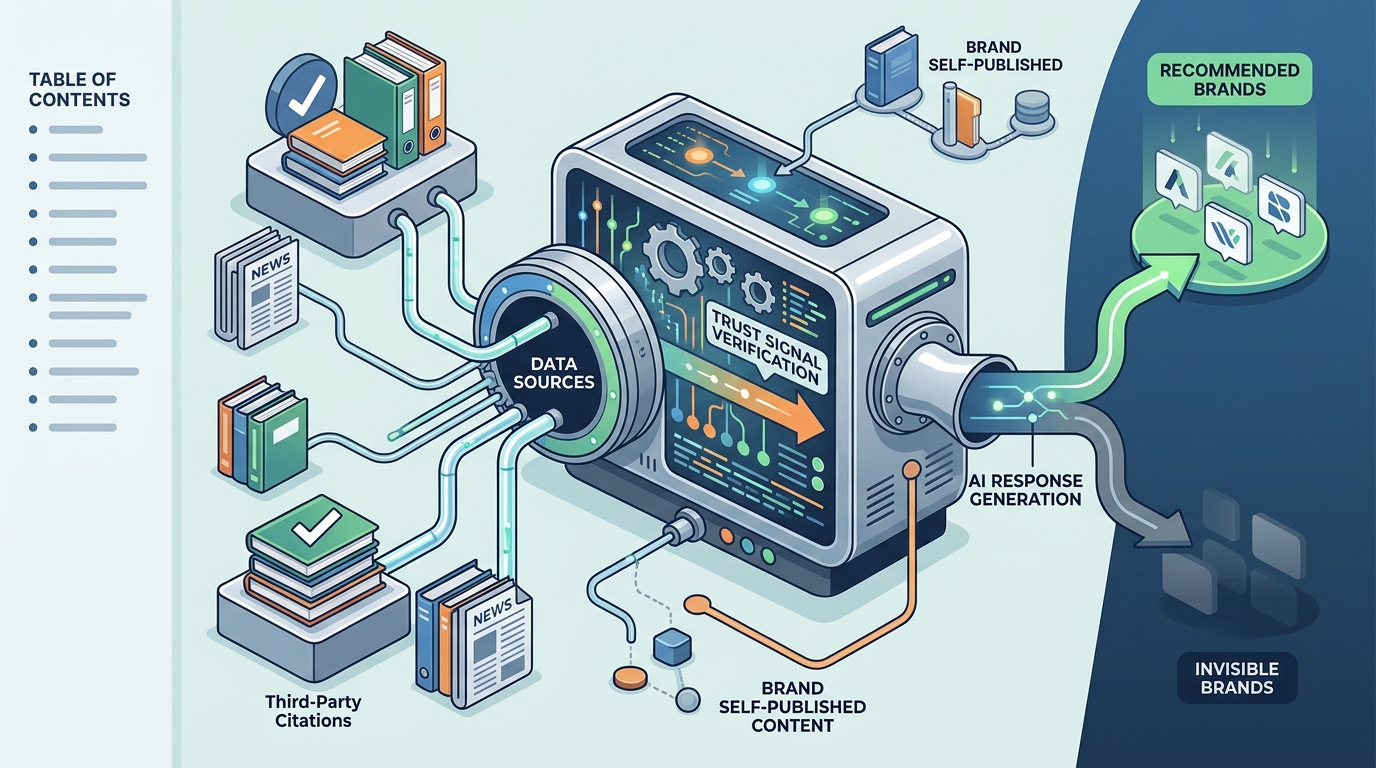
Third-party citations act as the primary trust signals that determine whether ChatGPT recommends a specific brand. When large language models scan the web to generate answers, they prioritize information found on independent, authoritative sources over self-published content. This external validation is the critical factor that separates brands that appear in AI answers from those that remain invisible.
The Mechanics of External Trust Signals
ChatGPT and other generative AI models do not simply read a company's website to form an opinion. They aggregate data from the broader web to build a consensus. Third-party citation is the process where independent websites, news outlets, or industry directories mention and link to a brand. When multiple unrelated sources reference the same entity, the AI model interprets this as a signal of legitimacy and relevance.
This mechanism mirrors how traditional search engines used backlinks, but with a crucial difference. In AI search, the context of the citation matters more than the raw volume. A mention in a specialized industry report carries more weight than a generic directory listing. The model looks for semantic alignment between the user's query and the context in which the brand is discussed.
Why Self-Published Content Falls Short
Many businesses assume that having a well-optimized website is enough to be recommended by AI. However, AI models are trained to be skeptical of self-serving content. If a brand only exists on its own domain, the model lacks the external corroboration needed to confidently include it in a recommendation. This is why a company might rank highly on Google but remain absent from ChatGPT answers.
The implication is clear: visibility in AI search requires a strategy that extends beyond the brand's own digital footprint. You must build a presence in the third-party ecosystem. This includes industry publications, review platforms, and professional networks where your peers and customers discuss your services. The more independent voices that validate your expertise, the higher the likelihood of AI citation.
The Role of Semantic Context in Citations
Not all citations are created equal. The specific language used in third-party mentions directly influences how the AI categorizes your brand. If a tech publication describes your software as a "leading solution for enterprise data security," that semantic tag becomes part of the model's understanding of your brand. When a user asks for "enterprise data security tools," the model is more likely to recall your brand because the context matches the query.
This is where Generative Engine Optimization (GEO) comes into play. GEO is the practice of structuring content and building citations to align with the way AI models process and retrieve information. It involves ensuring that third-party mentions use the specific terminology and phrasing that potential customers are likely to use in their prompts. By aligning your external narrative with user intent, you increase the probability of being the recommended answer.
Building a Citation Strategy for AI Visibility
Developing a robust citation strategy requires a shift in how you approach digital marketing. Instead of focusing solely on traffic to your own site, you must focus on earning mentions in high-authority external sources. This involves proactive outreach to industry influencers, contributing to relevant podcasts, and ensuring your brand is accurately represented in professional directories.
At Cytd, we help brands navigate this complex landscape. Our platform analyzes your current visibility across major AI engines and identifies gaps in your third-party citation profile. By understanding where you are missing from the AI's knowledge base, you can target specific external sources to build the trust signals needed for recommendation. This approach ensures that your brand is not just present on the web, but actively recommended by the AI tools your customers use.
Key Takeaways
- Third-party citations are the primary trust signals that drive AI brand recommendations.
- AI models prioritize independent validation over self-published content.
- The semantic context of a citation matters more than the volume of mentions.
- Generative Engine Optimization (GEO) aligns external narratives with user intent.
- A robust citation strategy requires proactive engagement with industry authorities.
- Monitoring your AI visibility score helps identify gaps in your external presence.
Frequently Asked Questions
Do backlinks still matter for AI search?
Yes, but their role has evolved. While backlinks still contribute to domain authority, AI models place greater emphasis on the context and quality of the citing source. A single mention in a highly relevant, authoritative publication can be more impactful for AI recommendations than dozens of low-quality directory links.
How long does it take for new citations to affect AI recommendations?
The timeline varies depending on how frequently the AI model updates its training data and retrieval index. Generally, it can take several weeks to months for new third-party citations to be fully integrated into the model's knowledge base. Consistent, high-quality citation building is more effective than sporadic bursts of activity.
Can I control which third-party sites cite my brand?
You cannot directly control which sites choose to cite you, but you can influence the likelihood of citations through strategic outreach and content creation. By providing valuable resources, data, or expert commentary to journalists and industry leaders, you increase the chances that they will reference your brand in their work.
What is the difference between SEO and GEO?
SEO (Search Engine Optimization) focuses on ranking in traditional search engine results pages (SERPs). GEO (Generative Engine Optimization) focuses on being cited and recommended by AI-powered answer engines. While there is overlap, GEO places a heavier emphasis on semantic context, third-party validation, and structured data that AI models can easily parse.
How does Cytd help with third-party citations?
Cytd provides a comprehensive analysis of your brand's visibility across major AI platforms. We identify where you are currently cited and where you are missing. This data allows you to target specific external sources and build the third-party trust signals necessary to improve your AI recommendation potential. Learn more: Cytd We make AI.