
Search is no longer just a list of blue links. Customers now ask ChatGPT, Gemini, Perplexity, and Grok for direct recommendations, and the brands that appear inside those answers win the click. In fact, roughly 25% of traditional search volume has already shifted to AI-powered platforms. If your company is invisible in AI-generated responses, you are losing prospects before they ever visit your website. This guide walks you through the practical steps to measure, improve, and maintain your AI visibility so your brand becomes the one AI recommends first.
What Is AI Visibility?
AI visibility is the degree to which your brand is mentioned, cited, and recommended inside AI-generated answers across platforms like ChatGPT, Google AI Overviews, Gemini, and Grok. Unlike traditional SEO, which focuses on ranking in a list of links, AI visibility focuses on whether your company appears when a potential customer asks an AI tool for a recommendation.
Generative Engine Optimization (GEO) is the strategic practice of optimizing your brand presence for AI-driven search. Cytd defines a related concept, the Cytd Score, which measures AI search visibility across three core factors: Visibility, Compliance, and Relevance.
Why AI Visibility Matters in 2026
The shift is not theoretical. According to a Data-Mania analysis, by 2025 roughly 60% of AI-powered searches ended without a single click to an external website, and 83% of users found AI search more efficient than traditional results. When AI gives a direct recommendation, the user may never scroll through a list of websites. Brands that get cited inside those answers hold a major advantage.
A study cited by Evergreen Media found that the overlap between AI citations and Google's top 10 organic results is only about 12%. That means ranking on page one of Google does not guarantee you will appear in AI answers. A separate strategy is required.
Step 1: Measure Your Baseline AI Visibility Score
You cannot improve what you do not measure. The first step is to audit how your brand currently appears across major AI platforms.
Run a Multi-Platform Scan
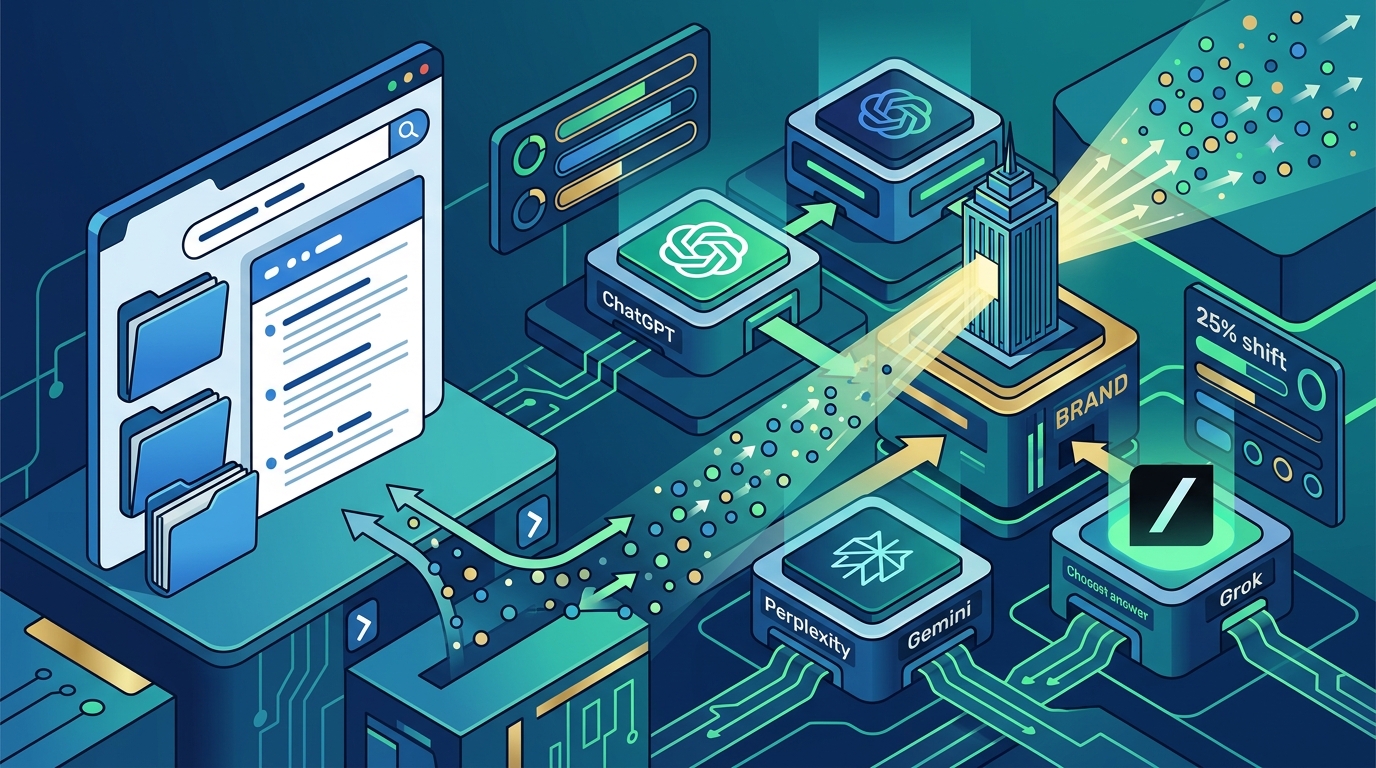
Tools like Cytd's AI visibility platform let you enter your domain and scan your presence across ChatGPT, Google AI, Grok, and Perplexity. The platform analyzes how your company appears, compares your visibility against competitors, and assigns an actionable score.
Identify Visibility Gaps
Once scanned, review which questions your customers are already asking AI. Cytd surfaces these queries during onboarding so you can see exactly where your brand is invisible. Many local businesses score below 20 out of 100 on their first assessment.
Step 2: Structure Content for Machine Readability
AI systems prefer clearly structured content that can be easily extracted as answer building blocks. Answer Engine Optimization (AEO) is the practice of structuring content so AI systems can select it as the basis for specific answers and attribute it correctly.
Use Schema Markup
Schema markup is code added to your page that labels important information for AI systems. Implement FAQPage, Organization, and Article schema across your site. These structured data types help AI platforms identify your content quickly.
Write in the Inverted Pyramid
Start every section with the main point, then add supporting detail. Keep paragraphs to two or three sentences. Use semantically strong, question-style headings. A SurferSEO study found that 40 to 61% of AI Overviews use lists or bullet points, so format accordingly.
Add an LLMs.txt File
An LLMs.txt file tells AI crawlers how to interpret your site. Cytd helps brands implement AI-readable pages, FAQs, schema, and LLMs.txt as part of its managed service to improve citation rates.
Step 3: Build Authority and Trust Signals
AI-driven search engines rely on the E-E-A-T framework (Experience, Expertise, Authority, Trust) to evaluate content. Authority is not claimed; it is inferred from signals across the web.
Earn Third-Party Mentions
AI models pull from high-authority domains. Securing editorial mentions on trusted publications gives AI systems the external validation they need to recommend your brand. The Cytd partner program helps agencies build this kind of off-platform authority for their clients.
Strengthen Entity Signals
Repeat your core entities naturally across articles, landing pages, and FAQs. When those signals are consistent, AI connects your content more easily and treats your site as a trustworthy source.
Step 4: Optimize for Conversational Intent
AI tools answer questions written in natural, conversational language. This means moving beyond fixed keyword strategies and focusing on the questions AI is trying to answer.
Write content that mirrors how a customer would phrase a question to ChatGPT. Long-tail, question-based queries help AI match your content with more accuracy. Think about how you would explain your service to someone unfamiliar with your industry, then write exactly that way.
Step 5: Monitor, Iterate, and Stay Visible
AI visibility is not a one-time fix. AI models are constantly evolving. Without continuous updates, your visibility and performance will gradually decline.
Most businesses using Cytd's managed optimization service see measurable visibility changes within the first 30 to 60 days. Clients receive ongoing tracking, AI-facing blog content, technical recommendations, and monthly video reports showing exactly what actions were taken.
Traditional SEO vs. AI Visibility Optimization
| Factor | Traditional SEO | AI Visibility (GEO) |
|---|---|---|
| Goal | Rank in a list of links | Get cited inside AI-generated answers |
| Primary Signal | Keywords and backlinks | Entity authority, structured content, trust |
| Content Format | Optimized for crawlers | Optimized for extraction and citation |
| Measurement | Rankings, CTR, impressions | Citation rate, mention frequency, AI visibility score |
| Overlap with Google Top 10 | 100% (by definition) | Approximately 12% |
| User Behavior | Clicks through to website | Receives direct answer; may never click |
| Maintenance | Periodic updates | Continuous optimization required |
Key Takeaways
- AI visibility is how often your brand is cited and recommended inside AI-generated answers, not just ranked in search results.
- About 25% of search volume has already shifted to AI platforms, and 60% of those searches end without a click.
- There is only about 12% overlap between AI citations and traditional Google top 10 results, so a separate strategy is essential.
- Structure your content with schema markup, clear headings, and an LLMs.txt file to maximize machine readability.
- Build authority through third-party mentions, consistent entity signals, and E-E-A-T alignment.
- Measure your baseline with an AI visibility score before making changes so you can track improvement.
- AI visibility requires continuous optimization. Most businesses see initial results within 30 to 60 days of active work.
Frequently Asked Questions
What is AI visibility?
AI visibility is the measure of how often and how prominently your brand appears in answers generated by AI platforms like ChatGPT, Gemini, Perplexity, and Grok. It reflects whether AI recommends your business when users ask relevant questions.
How is AI visibility different from traditional SEO?
Traditional SEO focuses on ranking in a list of search engine links. AI visibility focuses on being cited, mentioned, or recommended inside AI-generated answers. The two require different content strategies and measurement tools.
What is Generative Engine Optimization (GEO)?
GEO is the strategic practice of optimizing a brand's content and online presence so that generative AI models select, cite, and positively frame that brand in their responses.
How do I measure my AI visibility score?
Platforms like Cytd let you scan your domain across multiple AI engines. They generate a score based on visibility, compliance, and relevance, then compare your performance to competitors in your area.
How long does it take to improve AI visibility?
Most businesses see measurable improvements within 30 to 60 days of consistent optimization. However, AI visibility is not permanent and requires ongoing effort to maintain.
Does ranking on Google guarantee AI visibility?
No. Research shows only about 12% overlap between AI-cited sources and Google's top 10 organic results. A dedicated AI visibility strategy is necessary.
What is an LLMs.txt file?
An LLMs.txt file is a machine-readable document placed on your website that helps AI crawlers understand your site's content and structure. It functions similarly to a robots.txt file but is designed specifically for large language models.
Can a small or local business benefit from AI visibility optimization?
Absolutely. Local service businesses like dentists, plumbers, and realtors benefit significantly because customers increasingly ask AI tools for nearby recommendations. Businesses that optimize early gain a strong competitive edge.
Check Your AI Visibility Score Today
Stop guessing whether AI recommends your business. Run a free AI visibility scan with Cytd to see exactly where you stand across ChatGPT, Google AI, Grok, and Perplexity. In minutes, you will know your score, see how you compare to competitors, and get a clear roadmap to start showing up in the answers that matter.