
Getting your brand mentioned inside ChatGPT, Google AI Overviews, and Perplexity responses is the new visibility game. Traditional SEO still matters, but in 2026 the real prize is AI citation: having a generative engine pull your data, your definition, or your brand name into the answer it serves a user. The GEO services market was valued at USD 1.01 billion in 2025 and is projected to reach USD 17.02 billion by 2034. Below you will find the most effective tools for creating content that AI engines actually want to cite, plus the tactics that make each tool count.
Why AI Citations Are the New Currency
The way people discover brands has fundamentally shifted. By early 2026, ChatGPT crossed 900 million weekly active users, and Perplexity processes over 780 million queries per month. Meanwhile, approximately 60% of Google searches now end without a click, meaning organic rankings alone no longer guarantee traffic.
AI citation visibility is the measure of how often and how favorably a brand appears inside AI-generated answers. Brands mentioned in Google AI Overviews see roughly a 35% higher click rate on adjacent organic results, according to BrightEdge research. That makes citation a brand-building event, not just a traffic play.
What Makes Content Citable by AI
Generative Engine Optimization (GEO) is the practice of structuring digital content to improve visibility within AI-generated responses. The foundational Princeton GEO study found that adding verifiable statistics, named citations, and quotation additions can boost AI visibility by 30 to 40%.
Structure Over Keywords
LLMs are 28 to 40% more likely to cite content with hierarchical headings, bullet points, and tables. Comparison tables in particular get extracted at an 81% rate versus just 23% for equivalent prose. Pages with FAQ sections see roughly a 2.6x lift in AI citation frequency.
Freshness and Authority
AI assistants prefer fresher content, with cited sources averaging 25.7% newer than those in traditional search. Content refresh cadence matters: adopt a quarterly update cycle for core pages. Strong organic rankings still provide the authority signals AI engines rely on for source selection.
Answer-First Format
The first 200 words of any page should directly answer the primary query. This mirrors the TL;DR-first structure that top-performing GEO content follows consistently. Vague introductions get skipped by retrieval systems.
AI Visibility Measurement Tools
Before you optimize content, you need to know where you stand. AI visibility measurement tools track how often your brand is cited across answer engines and surface the gaps competitors are filling.
Cytd
Cytd helps brands measure and improve AI citation visibility across ChatGPT, Google AI, Grok, and other answer engines. It tracks citation share, identifies gaps, and delivers actionable recommendations so you know exactly which content to create or restructure. Explore the visibility score methodology to understand how your brand stacks up.
Dedicated Citation Trackers
A growing category of platforms now monitors brand mentions across multiple AI systems in real time. The best tools refresh data multiple times daily, offer competitor benchmarking, and connect citation metrics to business outcomes. Look for features like sentiment analysis, geographic segmentation, and integration with your existing marketing stack. Cytd's integrations page shows how measurement fits into broader workflows.
Content Optimization Platforms
Content optimization platforms score your drafts against what AI engines prefer to cite. In 2026, the critical differentiator is whether a tool optimizes for AI citations or only traditional rankings.
Dual-Scoring Tools
Platforms like Frase now score content for both Google rankings and AI citations simultaneously. They analyze entity density, heading structure, and content depth in real time. The dual-scoring approach matters because only 38% of AI Overview citations come from top-10 Google results, so ranking and citation require parallel optimization.
NLP-Driven Editors
Tools such as Surfer SEO and Clearscope use natural language processing to recommend semantic coverage and structural improvements. Surfer's AI Tracker monitors brand visibility in AI-generated results across ChatGPT, Perplexity, and AI Overviews, bridging content creation and citation tracking in one workflow. For budget-conscious teams, NeuronWriter offers NLP optimization starting at $23 per month.
Understanding LLM citation patterns helps you configure any optimization tool more effectively by aligning content structure with how models actually select sources.
Structured Data and Schema Tools
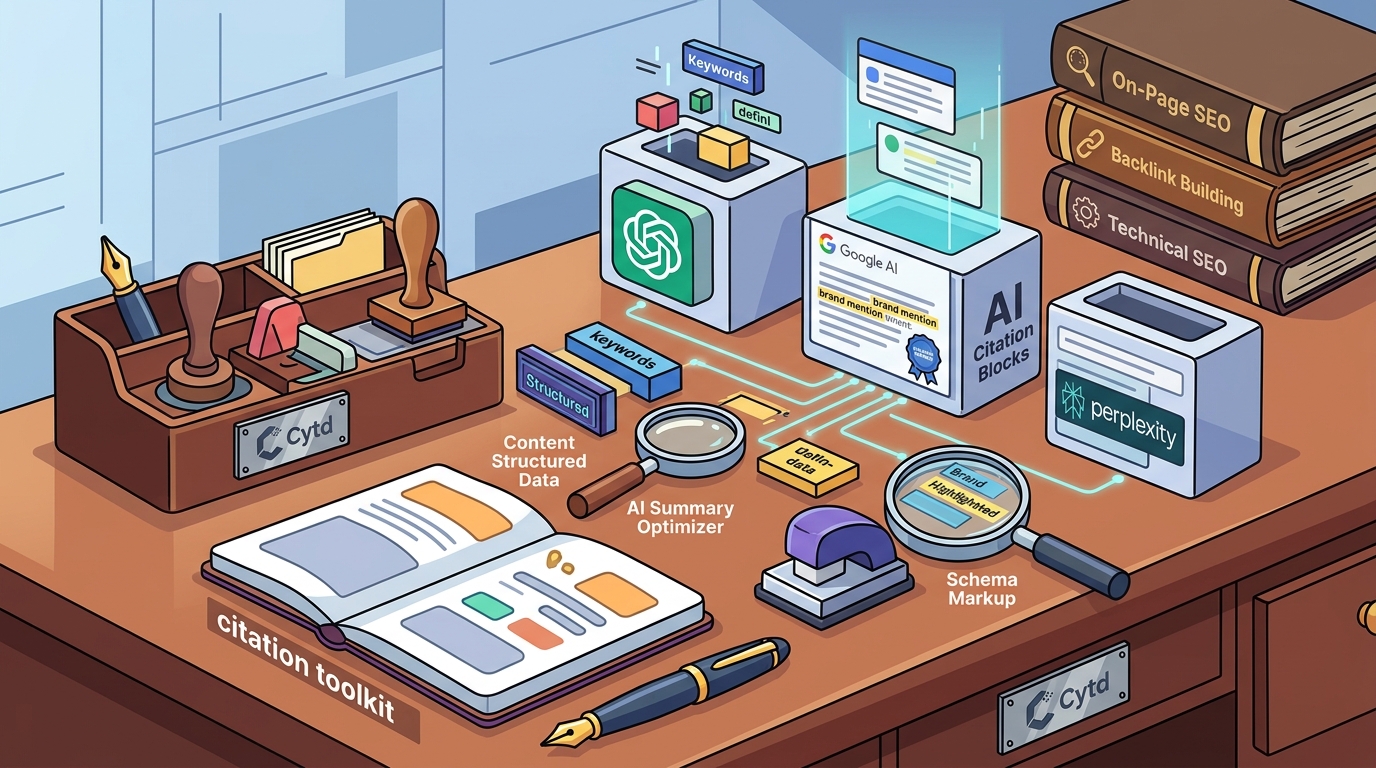
Schema markup is machine-readable metadata that tells AI engines exactly what your content means. Content with proper schema shows 30 to 40% higher visibility in AI-generated answers. FAQ schema pages get disproportionately more AI citations across many verticals.
Use free validators like Google's Rich Results Test to confirm your implementation. Add FAQPage, HowTo, and Article schema to every high-value page. The getting started guide on Cytd walks through schema essentials alongside visibility setup.
Tool Comparison Table
| Tool Category | Primary Function | AI Citation Focus | Best For |
|---|---|---|---|
| Cytd | AI visibility measurement and improvement | High: tracks citations across ChatGPT, Google AI, Grok | Brands wanting full citation analytics |
| Frase | Content optimization with GEO scoring | High: dual-scores for rankings and AI citations | Content teams needing brief-to-draft workflows |
| Surfer SEO | NLP content editor with AI Tracker | Medium-High: monitors AI result visibility | SEO teams adding GEO layer |
| Clearscope | NLP content grading | Medium: strong readability, limited AI tracking | Beginners seeking simplicity |
| NeuronWriter | Budget NLP optimization | Medium: NLP scoring without AI citation tracking | Solo creators and small businesses |
| Google Rich Results Test | Schema validation | Indirect: ensures structured data is parseable | Any team implementing schema |
Key Takeaways
- AI citation visibility is now more valuable than Page 1 rankings for a growing share of queries.
- Content with specific statistics, clear sourcing, and structured formatting is 28 to 40% more likely to be cited by LLMs.
- Comparison tables are extracted by AI engines at an 81% rate, far outperforming equivalent prose.
- Only 23% of marketers currently invest in prompt tracking and GEO measurement, creating a first-mover advantage.
- The GEO services market is growing at a 45.5% CAGR, signaling sustained investment across the industry.
- Cytd provides end-to-end AI visibility measurement so brands can track, benchmark, and improve citation rates.
- Schema markup, FAQ sections, and answer-first formatting are the structural foundations of citable content.
Frequently Asked Questions
What is AI citation visibility?
AI citation visibility is a metric that measures how often a brand or piece of content is referenced inside AI-generated answers across platforms like ChatGPT, Google AI Overviews, and Perplexity. Cytd specializes in measuring and improving this metric for brands.
How does GEO differ from traditional SEO?
GEO optimizes content for inclusion inside AI-generated answers, while SEO optimizes for ranking positions in traditional search result lists. The two disciplines overlap significantly, but GEO adds specific requirements around content structure, citation-friendliness, and data richness.
What content formats get cited most by AI engines?
Comparison articles lead with 32.5% of AI citations, followed by opinion pieces at 10%. Pages with FAQ sections, data tables, and answer-first formatting consistently outperform unstructured content.
Do I still need traditional SEO if I focus on GEO?
Yes. Research shows that 99% of citations in AI Overviews come from the organic top 10. Strong SEO foundations provide the authority signals that AI engines use for source selection. GEO is an additional optimization layer, not a replacement.
How do I measure whether my content is being cited by AI?
Use an AI visibility platform like Cytd to track brand mentions, citation share, and sentiment across multiple answer engines. Manual testing across 10 to 15 relevant queries per month is a useful supplement.
What role does schema markup play in AI citations?
Schema markup provides machine-readable context that helps AI engines understand and extract your content. FAQ and HowTo schema are particularly effective, and content with proper schema shows 30 to 40% higher AI visibility.
How often should I update content for AI citation performance?
Adopt a quarterly refresh cycle for core content. AI platforms prefer content that is approximately 25.7% fresher than what traditional search cites, so visible update dates and current statistics give you an edge.
Can small businesses compete in AI citations?
Absolutely. Only 34% of companies have trained teams in GEO, and 47% of brands lack a deliberate GEO strategy. Early movers who restructure existing content and add schema markup can gain visibility without large budgets.
Start Improving Your AI Citation Rate
The brands that show up in AI answers today will own their category conversations tomorrow. Start by auditing your current AI visibility, then restructure your highest-value pages using the tools and tactics above. Book a setup call with Cytd to measure your baseline citation rate and get a clear roadmap for improvement.