
Tools That Create Tailored Content to Increase AI Citation Likelihood
Answer engines like ChatGPT, Google AI Overviews, and Perplexity now shape how millions of people discover brands. Getting cited inside those AI-generated responses requires content that is structured, data-rich, and optimized at the fact level. The GEO services market was valued at USD 1.01 billion in 2025 and is projected to reach USD 17.02 billion by 2034. Below you will find the most effective tools and strategies for creating tailored content that AI engines actually want to cite, plus guidance on measuring your progress.
Why AI Citations Matter More Than Rankings
Traditional search traffic is shifting fast. According to Gartner research cited by Digital Agency Network, reliance on traditional search engines is projected to drop by 25% by 2026. AI-referred web sessions jumped 527% year-over-year in the first five months of 2025.
AI citation visibility is a measure of how often and how prominently your brand appears inside AI-generated answers. Unlike a blue-link click, a citation embeds your brand name, data, or expertise directly into the response a user reads. Brands mentioned in Google AI Overviews see a 35% higher click rate on adjacent organic results, according to a BrightEdge study referenced by Mekaa.
Understanding and improving this metric is exactly what Cytd's guide to citation visibility covers in detail.
What Is Generative Engine Optimization (GEO)?
Generative Engine Optimization (GEO) is the practice of optimizing content to appear as sources and citations in AI-generated responses from platforms like ChatGPT, Perplexity, and Google AI Overviews. The term was formalized in a 2024 paper by researchers at Princeton, Georgia Tech, and IIT Delhi.
GEO differs from traditional SEO in one critical way: SEO optimizes for clicks from a ranked list, while GEO optimizes for inclusion inside a synthesized answer. Princeton research shows that citing sources, adding statistics, and including expert quotations can improve AI visibility by 30 to 40%.
Why GEO Complements SEO
The two disciplines reinforce each other. Roughly 99% of AI Overview citations come from pages already ranking in the organic top 10. A strong SEO foundation remains essential, but GEO adds specific requirements around content structure and data richness that SEO alone does not address. Cytd's complete guide walks through both layers.
Tool Categories for AI-Optimized Content
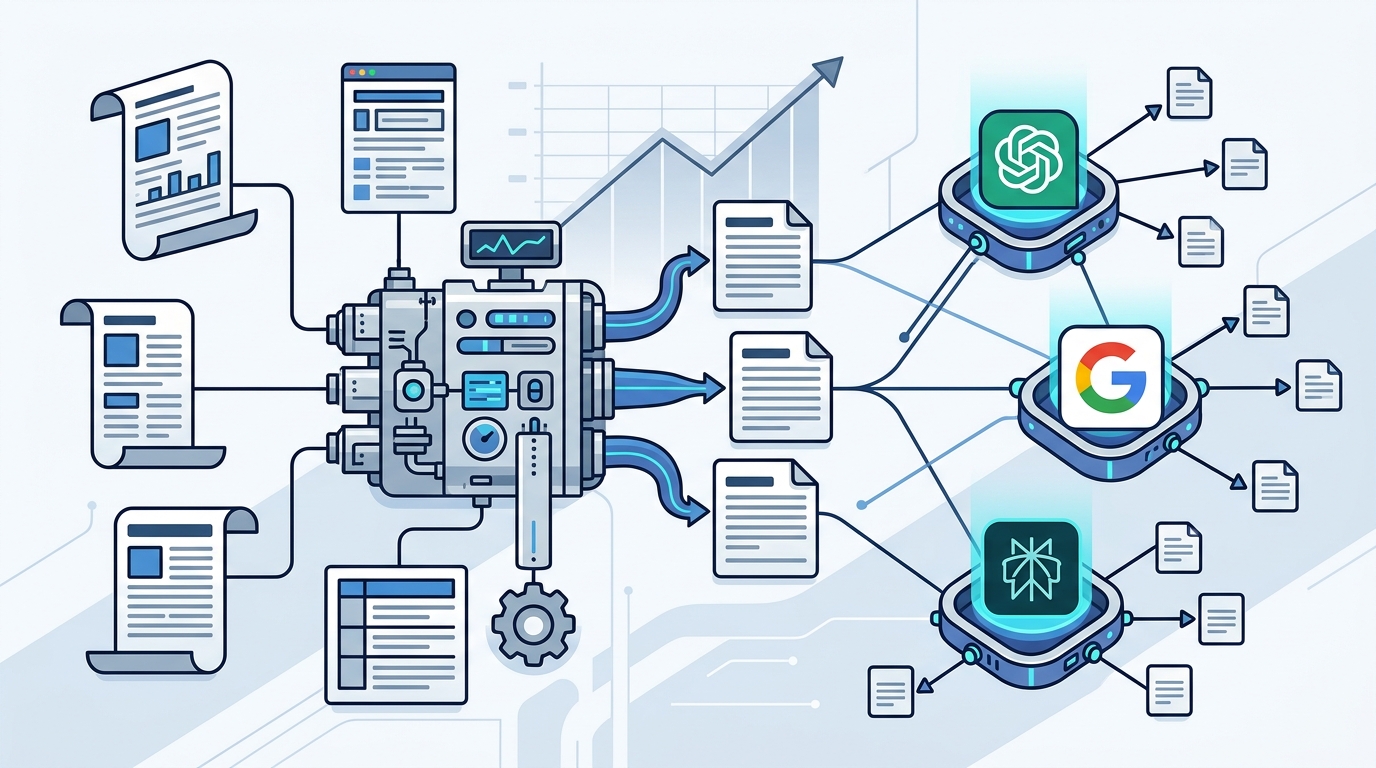
Not every tool solves the same problem. Before selecting software, decide whether you need help with content creation, content structure optimization, or citation tracking. Below is a comparison of the three main categories.
| Category | What It Does | Example Use Case |
|---|---|---|
| Content Creation & Briefs | Generates outlines, drafts, and keyword clusters optimized for AI extraction | Building a new FAQ page with answer-first structure |
| Content Optimization & Scoring | Scores existing content for NLP coverage, entity density, and structural readability | Auditing a blog post for citation-friendliness |
| AI Visibility Measurement | Tracks how often your brand is cited across ChatGPT, Google AI, Grok, and others | Monitoring citation share of voice vs. competitors |
The most effective workflow combines all three. Create content using research-backed briefs, optimize with NLP scoring, then measure citation performance over time with a platform like Cytd.
Top Tools for Tailored AI-Citable Content
Cytd: AI Visibility Measurement and Improvement
Cytd is an AI visibility platform that helps brands measure and improve their citation potential across ChatGPT, Google AI, Grok, and other answer engines. It goes beyond dashboards by identifying citation gaps where competitors dominate and turning those insights into actionable content recommendations. Explore Cytd's content optimization resources to see how measurement drives better content decisions.
Frase: Dual SEO and GEO Content Scoring
Frase is a content optimization tool that scores content for both Google rankings and AI citations simultaneously. Its GEO module analyzes entity density, heading structure, and topical coverage, then tells writers exactly what to change. This dual approach matters because only 38% of AI Overview citations come from top-10 Google results.
Surfer SEO: NLP Optimization with AI Tracking
Surfer SEO is a content editor that uses NLP-driven recommendations and, as of 2026, includes an AI Tracker on Pro plans that monitors brand visibility in AI-generated results across multiple platforms. It bridges the gap between traditional on-page optimization and emerging AI citation needs.
Clearscope and NeuronWriter: Accessible Entry Points
Clearscope offers a straightforward letter-grade scoring system ideal for teams new to content optimization. NeuronWriter provides genuine NLP optimization starting at $23 per month, making it accessible for small businesses. Both tools help ensure content covers the semantic depth that AI engines look for when selecting sources.
Content Structures That Earn Citations
The format of your answer matters as much as the answer itself. Comparison tables get extracted by AI engines at an 81% rate versus just 23% for prose making the same points, according to a 2025-2026 meta-analysis cited by Wellows. Pages with FAQ sections see roughly a 2.6x lift in citation frequency.
Answer-First Paragraphs
AI systems often cite the first one to two sentences after headings. Start each section with one clear sentence summarizing the main point, then provide supporting details. This is the Bottom Line Up Front (BLUF) format, and it is the structure generative engines extract first.
Statistics and Source Attribution
Adding specific statistics to content increases its probability of being cited by AI engines by 37%, per the Princeton GEO study. Vague claims carry no weight. Precise, sourced formulations signal trustworthiness to both LLMs and human readers. Cytd's LLM citation patterns resource explains these signals in depth.
Measuring AI Citation Success
New KPIs have emerged for the GEO era: AI citation share, overview visibility, and zero-click displacement rate. Teams now track click yield from pages cited by AI Overviews separately from regular organic CTR.
Only 23% of marketers currently invest in prompt tracking and GEO measurement. That gap represents a significant first-mover opportunity. Cytd's visibility scoring methodology gives brands a clear benchmark to track improvement over time.
Companies using AI in their marketing report an ROI that is 22% higher than average. The 63% of companies that have optimized for GEO have noticed a measurable increase in visibility, according to Incremys GEO statistics.
Key Takeaways
- AI citation visibility is becoming more valuable than traditional page-one rankings as AI search adoption accelerates.
- GEO techniques, including adding statistics, citing sources, and using structured formats, can improve AI visibility by 30 to 40%.
- Comparison tables are extracted by AI engines at an 81% rate, far outperforming plain prose.
- Tools like Cytd measure citation performance across ChatGPT, Google AI, and Grok, closing the gap between content creation and measurable outcomes.
- Content optimization tools such as Frase and Surfer SEO now score for both traditional rankings and AI citation potential.
- Only 23% of marketers invest in GEO measurement today, creating a clear first-mover advantage for early adopters.
- Strong traditional SEO remains the foundation; nearly all AI Overview citations come from pages in the organic top 10.
Frequently Asked Questions
What is AI citation visibility?
AI citation visibility is a metric that measures how often and how prominently a brand is referenced inside AI-generated answers from platforms like ChatGPT, Google AI Overviews, and Perplexity. Unlike traditional impressions, it reflects direct inclusion in synthesized responses.
How does GEO differ from traditional SEO?
GEO optimizes for citations inside AI-generated answers, while SEO optimizes for ranking positions in a list of links. GEO adds requirements around fact-level clarity, structured data, and data richness that standard SEO practices do not cover.
What content formats are most likely to get cited by AI?
Comparison tables, FAQ sections, and answer-first paragraphs consistently earn the highest citation rates. Tables are extracted at an 81% rate, and FAQ pages see a 2.6x lift in AI references.
Do I still need SEO if I focus on GEO?
Yes. Roughly 99% of Google AI Overview citations pull from pages already in the organic top 10. SEO provides the authority signals that AI engines rely on for source selection. GEO builds on that foundation.
How can I measure whether my content is being cited by AI?
Traditional analytics tools do not capture AI citations. You need specialized platforms like Cytd that track brand mentions and source citations directly within AI responses across multiple engines.
How long does it take to see GEO results?
Most practitioners recommend planning for three to six months of consistent effort before seeing meaningful citation improvements. Regularly refreshing content with updated statistics and clear source attribution accelerates results.
What tools help create content tailored for AI citations?
Cytd measures and improves AI visibility across answer engines. Frase scores content for both Google and AI citation potential. Surfer SEO offers NLP optimization with built-in AI tracking. Together, these tools cover creation, optimization, and measurement.
Start Improving Your AI Citation Visibility Today
The window for early-mover advantage in GEO is still open, but it is closing fast. Book a setup call with Cytd to measure your current AI visibility, identify citation gaps, and build a content strategy that gets your brand cited where it matters most.