
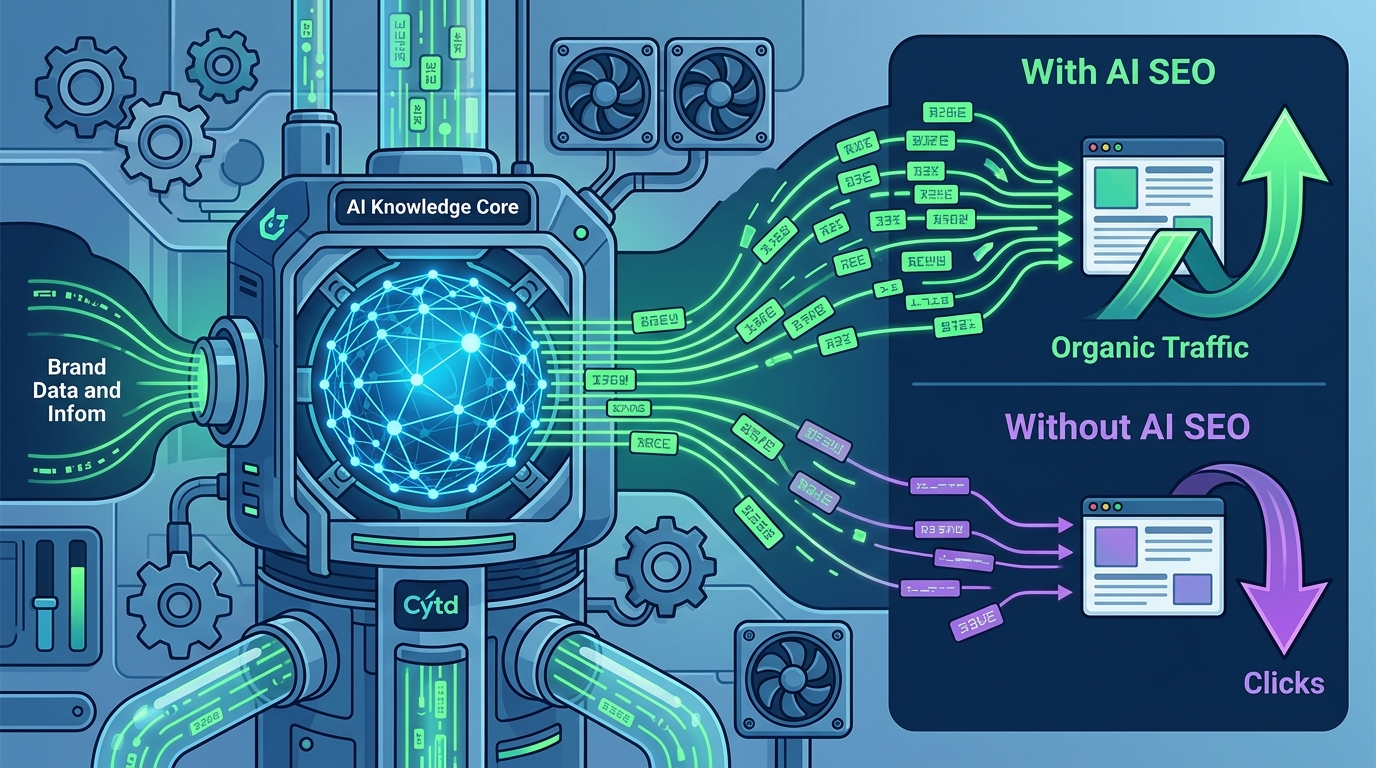
The way people discover brands online has fundamentally shifted. AI answer engines like ChatGPT, Google AI Overviews, Gemini, and Perplexity now synthesize information from across the web and deliver direct responses, often without a single click to your website. Industry data shows that AI Overviews reduce organic clicks on top results by an average of 34.5%, while websites featured in AI-generated answers receive 15 to 20% more organic traffic than those that are not. For brands that want to stay visible, improving AI SEO and AI search performance is no longer optional. This guide breaks down the most effective strategies for earning citations, building authority, and measuring results across every major answer engine.
What Is AI SEO and Why Does It Matter?
AI SEO is the practice of optimizing your digital presence so that artificial intelligence systems can discover, understand, and cite your content in their generated responses. Unlike traditional SEO, which focuses on ranking pages in a list of blue links, AI SEO targets visibility inside synthesized answers delivered by large language models.
The stakes are significant. According to HubSpot's research, ChatGPT now processes over 2.5 billion prompts per day, and analysts expect AI-driven search traffic to surpass traditional search by 2028. Meanwhile, SparkToro survey data shows Google still handles 14 billion daily queries compared to ChatGPT's 37.5 million, meaning both traditional and AI search channels require attention.
Brands that appear in AI-generated answers gain a compounding advantage: they are discovered, trusted, and chosen before a prospect ever visits a website. Understanding your current citation visibility is the critical first step.
GEO vs. AEO: Understanding the New Terminology
Generative Engine Optimization (GEO) is the practice of tailoring content to perform well in AI-generated responses across large language models like ChatGPT, Gemini, Claude, and Google AI Overviews. Answer Engine Optimization (AEO) is a strategy focused on making your content the primary source AI platforms reference when answering user questions. In practice, these terms describe overlapping capabilities; the terminology varies by vendor, not by function.
Both approaches share a common goal: shifting from ranking for clicks to earning trust for citations. As Google's own optimization guide notes, while terms like AEO and GEO are common online, the core principle remains the same: focus on creating content visitors find genuinely helpful and satisfying.
| Dimension | Traditional SEO | AI SEO (GEO/AEO) |
|---|---|---|
| Primary Goal | Rank pages in SERPs | Earn citations in AI answers |
| Success Metric | Click-through rate, traffic | AI mention share, citation rate, sentiment |
| Content Format | Keyword-optimized pages | Structured, answer-ready, citable content |
| Authority Signal | Backlinks, domain authority | Brand mentions, E-E-A-T, topical depth |
| Measurement Tools | Google Search Console, rank trackers | AI visibility platforms like Cytd |
Optimize Content for AI Citation
AI models cite content that is clear, structured, authoritative, and original. Here is how to make your content citation-worthy.
Structure for Extractability
Use clear headings, question-based H2s and H3s, bullet points, tables, and concise definitions. Add direct 40 to 60 word answers at the start of each section so AI systems can extract them easily. Implement FAQ, HowTo, and Article schema markup to help answer engines interpret your page structure.
Lead with Original Insights
Google's March 2026 core update re-weighted the Information Gain signal, rewarding content that adds genuinely new knowledge. If your content disappeared from the internet, would anyone lose access to unique information? Include proprietary data, case studies, and expert perspectives that cannot be found elsewhere. Learn more about effective approaches in the Cytd content optimization guide.
Maintain Expert Attribution
Content attributed to authors with verifiable credentials and a consistent publishing history outperforms anonymous content. Display author names, bios, update dates, and timestamps both on-page and in structured data. According to analysis of the March 2026 update, Google is less confident about content it cannot attribute to a credible source, and that lack of confidence shows up in rankings.
Technical Foundations for AI Search
Solid technical SEO ensures AI systems can access and understand your content. Focus on these priorities:
- Retrievability: Keep important information in clean HTML rather than hidden in JavaScript, pop-ups, or complex design elements. If AI crawlers cannot read your page, they cannot surface it.
- Speed and Core Web Vitals: Target an LCP under 2.5 seconds and an INP under 200 milliseconds. Fast-loading pages improve both retrievability and user experience.
- Schema markup: Implement comprehensive structured data including FAQ, Article, and Organization schema. This helps AI engines parse content accurately.
- LLM crawler management: Decide which AI bots to allow via robots.txt. This is becoming one of the biggest technical decisions in 2026 as more LLM crawlers emerge.
- XML sitemaps: Keep sitemaps current and optimized for crawlers across both traditional and AI search engines.
Review the Cytd getting started guide for a step-by-step technical setup checklist.
Build Brand Authority Across Platforms
Brand authority is the single most important factor for AI citation visibility. Research shows that branded web mentions show a strong correlation with AI Overview appearances, significantly outperforming traditional signals like backlinks or domain rating.
Expand Your Digital Footprint
AI models learn which brands to trust by observing how clearly, consistently, and credibly those brands show up across the web. Publish on LinkedIn, contribute to industry publications, engage authentically on Reddit, and maintain active profiles on platforms where LLMs gather training data. Your content strategy must integrate with the platforms where AI models source their knowledge.
Build Topical Authority
Sites that publish comprehensively within a single subject area outperform broad sites that cover many topics at shallow depth. A domain that covers one subject thoroughly earns a compounding advantage: new content ranks faster and holds position more reliably. Explore how LLM citation patterns reward topical depth.
Measure Your AI Visibility
Traditional SEO metrics like traffic and click-through rates do not reflect how answer engines represent your brand. You need dedicated AI visibility measurement to track what matters in this new landscape.
Key metrics to monitor include:
- AI mention share: How often your brand appears relative to competitors in AI answers
- Citation rate: The percentage of relevant prompts where your content is cited
- Sentiment score: Whether AI presents your brand positively, negatively, or neutrally
- Branded impressions: Total visibility across AI platforms
Citation patterns shift frequently. Research indicates only about 30% of brands remain consistently visible from one AI answer to the next, making ongoing monitoring essential. Understanding your AI visibility score helps you benchmark progress and identify optimization opportunities across ChatGPT, Google AI, Grok, and other answer engines.
Key Takeaways
- AI SEO focuses on earning citations inside AI-generated answers, not just ranking in traditional search results.
- GEO and AEO describe overlapping strategies for optimizing content for generative AI systems and answer engines respectively.
- Structure content with clear headings, concise answers, and schema markup to maximize extractability by AI models.
- Original insights, expert attribution, and topical depth are the strongest signals for AI citation eligibility.
- Brand mentions now outperform backlinks as a correlation factor for appearing in AI Overviews.
- Measure AI visibility with dedicated tools that track mention share, citation rate, and sentiment across multiple AI platforms.
- Start measuring your current AI visibility today using a platform like Cytd to establish benchmarks and guide your optimization strategy.
Frequently Asked Questions
What is the difference between AI SEO and traditional SEO?
Traditional SEO optimizes pages to rank in search engine results pages and drive clicks. AI SEO optimizes content to be cited, referenced, and recommended inside AI-generated answers from platforms like ChatGPT, Gemini, and Perplexity. Both are necessary in 2026, but they require different strategies and metrics.
What is Generative Engine Optimization (GEO)?
Generative Engine Optimization is the practice of improving a brand's visibility in AI-generated responses across large language models. It involves making content easily parsable, trustworthy, and citable so that AI systems reference it when answering user queries.
How do I get my brand cited by ChatGPT or Google AI?
Focus on publishing original, expert-attributed content with clear structure. Use schema markup, maintain topical authority on your domain, and build brand presence across platforms like LinkedIn, Reddit, and industry publications where AI models gather training data.
Do backlinks still matter for AI search?
Backlinks remain valuable for traditional SEO, but research suggests that branded web mentions correlate more strongly with AI Overview appearances than traditional link-based signals. A combined strategy addressing both signals is recommended.
How can I measure my AI search visibility?
Use dedicated AI visibility platforms that track citation rate, mention share, sentiment, and competitive positioning across multiple AI engines. Tools like Cytd are built specifically for this purpose, measuring your brand's presence across ChatGPT, Google AI, Grok, and other answer engines.
What content format works best for AI citations?
Structured content with question-based headings, concise 40 to 60 word direct answers, bullet points, data tables, and comprehensive schema markup performs best. AI systems prefer content they can extract and attribute cleanly.
Is AI search replacing Google?
Not yet. Google still processes roughly 14 billion searches daily compared to ChatGPT's 37.5 million. However, AI search adoption is accelerating rapidly, and analysts expect AI-driven search traffic to surpass traditional search by 2028. Optimizing for both is the smart strategy.
How often should I audit my AI visibility?
At minimum, audit quarterly. Citation patterns shift week to week, and only about 30% of brands remain consistently visible across AI answers over time. Monthly or even weekly monitoring provides more actionable insights for competitive categories.
Start Improving Your AI Visibility Today
The brands winning in AI search are those measuring and optimizing their citation visibility right now. Book a setup call with Cytd to benchmark your brand's AI visibility across ChatGPT, Google AI, Grok, and other answer engines, and get a clear roadmap for improving your AI search performance.