
How to Boost Your AI Visibility in Search Engine Optimization
Search has changed. In 2026, consumers increasingly receive direct, synthesized answers from AI platforms like ChatGPT, Google AI Overviews, and Perplexity instead of clicking through traditional blue links. For brands, this means appearing in AI-generated responses is now as important as ranking on page one of Google. Generative Engine Optimization (GEO) is the discipline that makes this possible. This guide walks you through the practical steps a company can take to measure, improve, and sustain its AI visibility across the answer engines that matter most.
What Is AI Visibility and Why It Matters
AI visibility is how often and how prominently your brand or content appears in AI-generated responses from platforms such as ChatGPT, Google AI Overviews, and Perplexity. Unlike traditional search rankings, these mentions often occur without a user clicking any link at all.
According to EMARKETER, nearly 31.3% of the U.S. population will use generative AI search in 2026. Meanwhile, Gartner predicts traditional search engine volume will drop 25% by 2026 due to AI platform usage. Brands that fail to appear in these AI answers risk becoming invisible to a growing share of their audience.
Understanding your citation visibility score is the first step toward closing this gap.
GEO vs. Traditional SEO: Key Differences
Generative Engine Optimization (GEO) is the practice of structuring content and digital presence so that AI-powered platforms cite, recommend, or mention a brand when users ask questions. Traditional SEO focuses on ranking pages for clicks; GEO focuses on being selected as a source in synthesized answers.
| Dimension | Traditional SEO | GEO / AI Visibility |
|---|---|---|
| Primary goal | Rank in search results | Get cited in AI responses |
| Success metric | Click-through rate, traffic | Citation frequency, brand mention rate |
| Content format | Keyword-optimized pages | Modular answer blocks, structured data |
| Trust signals | Backlinks, domain authority | Cross-source consistency, entity verification |
| User behavior | Clicks to website | Zero-click consumption |
The overlap between the two is significant. As SEO expert Lily Ray noted, the practices are "very, very strong" in their shared foundations. The difference lies in why the work matters. Learn more in the complete guide to AI visibility on Cytd.
Step 1: Audit Your Current AI Presence
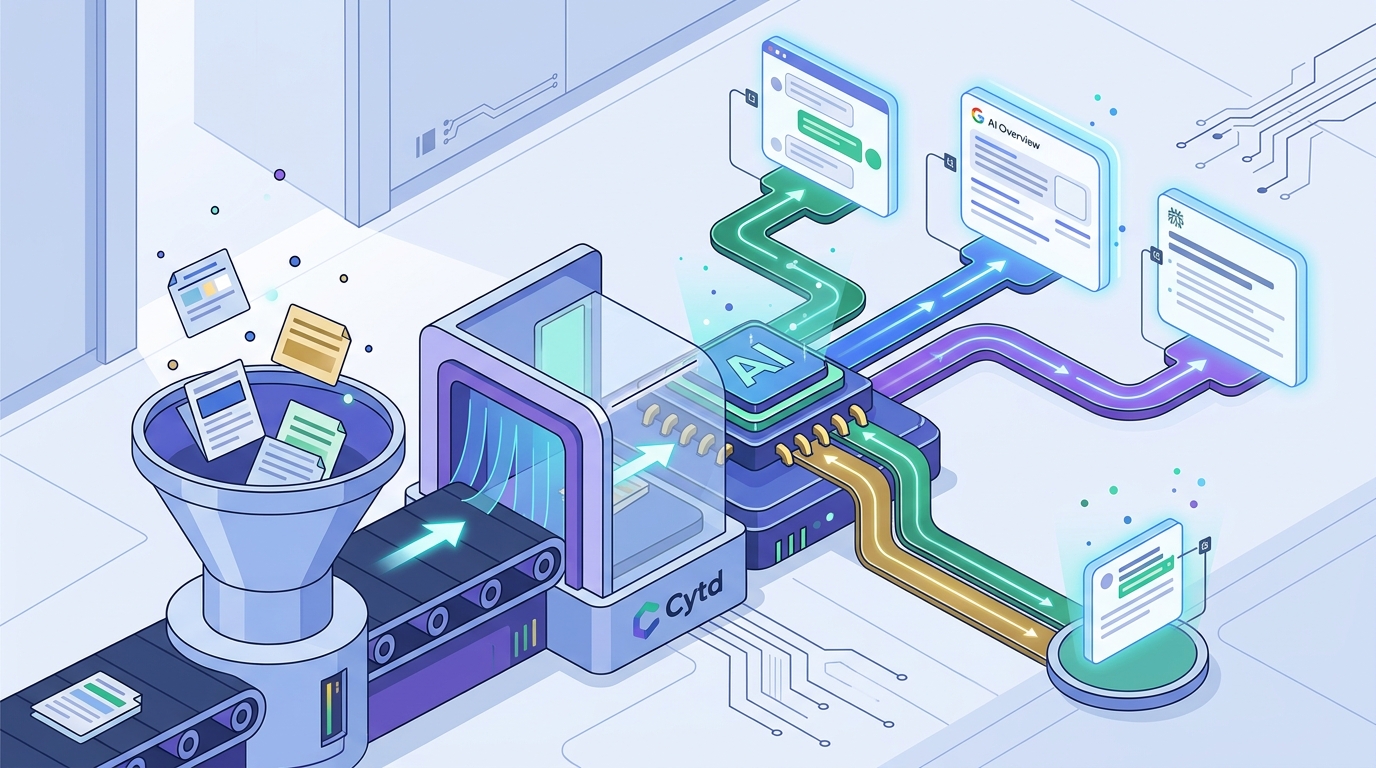
Before optimizing, you need a baseline. Query ChatGPT, Gemini, and Perplexity with the prompts your customers actually use. Note which brands appear, which sources get cited, and where your brand is absent.
Manual Prompt Testing
Ask questions like "What is the best [your category] tool?" or "How do I solve [pain point]?" across at least three AI platforms. Document the results in a spreadsheet noting brand presence, sentiment, and source URLs.
Automated Tracking
Manual audits are useful but do not scale. Platforms like Cytd automate this process by tracking your brand's AI citation visibility across ChatGPT, Google AI, Grok, and other answer engines over time. This gives you a continuous measurement baseline rather than a one-time snapshot.
For a deeper understanding of how scoring works, review understanding your AI visibility score.
Step 2: Structure Content for AI Extraction
AI models do not read pages the way humans do. They extract discrete facts and reassemble them. Your content must be easy to scan, easy to extract, and easy to trust.
Use Answer Blocks
An answer block is a concise, 40-to-60-word paragraph placed directly under each H2 heading that provides a clear, direct response to a specific question. This gives AI systems a ready-made excerpt to cite without rewriting. Place supporting evidence, data, and examples below the answer block.
Implement Structured Data
JSON-LD schema markup helps AI crawlers categorize your products and services instantly. Use Organization, FAQPage, HowTo, and Product schemas where appropriate. Without structured data, AI agents must guess at your intent, and they often guess wrong.
Optimize for Conversational Queries
AI users ask complex, natural-language questions. Structure your pages around question-based headings and provide the direct answer first, followed by supporting detail. Explore content optimization strategies for practical templates.
Step 3: Build Off-Site Authority and Trust Signals
AI engines verify your claims by checking what the rest of the web says about you. This distributed trust model means on-site optimization alone is insufficient. You need consistent, high-quality mentions across authoritative third-party sources.
According to Roketto's 2026 analysis, a single citation in a peer-reviewed paper or major news publication carries more weight than a thousand low-tier backlinks. LLMs prioritize sources frequently cited across high-authority domains.
Practical actions include publishing original research, securing mentions in industry reports, maintaining active profiles on Reddit and LinkedIn (which AI models heavily cite), and ensuring your business information is consistent across all directories and platforms.
Step 4: Measure and Iterate With AI Visibility Tools
AI visibility is not a set-it-and-forget-it effort. AI models update frequently, and competitor content shifts the landscape daily. Continuous measurement is essential.
Cytd's measurement platform tracks how often your brand is cited by major answer engines and provides actionable insights to improve your ranking potential. By monitoring citation frequency over time, you can identify which content changes drive results and which fall flat.
Review the state of AI search report for current benchmarks and trends. You can also explore LLM citation patterns to understand how different AI models select their sources.
Key Takeaways
- AI visibility is how prominently your brand appears in AI-generated answers, and it is now a critical marketing metric.
- GEO is the practice of optimizing content so AI platforms cite your brand in synthesized responses.
- Start with a manual audit of your presence across ChatGPT, Gemini, and Perplexity, then automate tracking with a dedicated tool.
- Structure content using answer blocks, JSON-LD schema, and question-based headings for maximum AI extractability.
- Build off-site trust through digital PR, original research, and consistent brand mentions on high-authority platforms.
- AI models update constantly; continuous measurement and iteration are required to maintain visibility.
- Traditional SEO fundamentals remain the foundation; GEO layers on top rather than replacing them.
Frequently Asked Questions
What is AI visibility?
AI visibility refers to how often and how prominently your brand appears in AI-generated responses from platforms like ChatGPT, Google AI Overviews, Gemini, and Perplexity. It measures whether AI models cite your content when users ask relevant questions.
What is Generative Engine Optimization (GEO)?
Generative Engine Optimization (GEO) is the practice of structuring your content and digital presence so that AI-powered platforms cite, recommend, or mention your brand in their synthesized answers. It builds on traditional SEO but targets AI citation rather than click-through.
How is GEO different from traditional SEO?
Traditional SEO focuses on ranking pages in search results to drive website clicks. GEO focuses on being selected as a trusted source in AI-generated answers. The core skills overlap, but the success metrics and content formats differ significantly.
Why does AI visibility matter in 2026?
Nearly a third of U.S. consumers now use generative AI search, and traditional search volume is declining. If your brand is not visible in AI responses, you risk losing awareness, leads, and revenue from this growing audience segment.
How do I check my brand's current AI visibility?
Start by querying major AI platforms with prompts your customers would use. For ongoing tracking, use a dedicated AI visibility measurement tool like Cytd that monitors citation frequency and sentiment across multiple answer engines automatically.
What content formats work best for AI citation?
Modular answer blocks of 40 to 60 words, structured data via JSON-LD, question-based H2 headings, and clear definitional sentences all increase your likelihood of being cited. AI models favor content that is easy to extract and verify.
Do backlinks still matter for AI visibility?
Yes, but quality matters far more than quantity. AI models prioritize brands that are consistently cited across high-authority sources like news outlets, industry reports, and academic publications rather than brands with large volumes of low-quality links.
How long does it take to improve AI visibility?
Results vary by industry and starting position. Some brands see measurable citation improvements within weeks of structured optimization, while broader authority-building efforts may take several months to influence AI model outputs.
Start Improving Your AI Visibility Today
Your competitors are already showing up in AI answers. Every day you wait is a day your brand stays invisible to a growing segment of your audience. Book a setup call with Cytd to measure your current AI citation visibility and get a clear roadmap for improvement across ChatGPT, Google AI, Grok, and every answer engine that matters.