
Generative Engine Optimization (GEO) is the strategic practice of structuring digital content to be selected, cited, and recommended by large language models and AI answer engines. This discipline has replaced traditional search engine optimization as the primary driver of digital discovery. The landscape has shifted dramatically, with thirty-seven percent of consumers now starting their journey with AI instead of traditional search engines. This massive migration means that visibility in AI-generated results is no longer optional. It is the new baseline for business survival. (Cytd We make AI)
Why Traditional SEO Is No Longer Enough
The era of the ten blue links is officially over. In the past, ranking number one on Google was the ultimate goal for digital marketers. However, that ranking no longer guarantees visibility in the modern consumer journey. Data shows that clicks drop by fifty-eight percent when an AI Overview appears on a search results page. This statistic highlights a critical disconnect between traditional search performance and actual business outcomes.
Forty-five percent of consumers now use AI to find local businesses. Yet, ChatGPT recommends just one point two percent of them. This gap represents a massive opportunity for brands that adapt quickly. If your business does not appear in AI recommendations, you are effectively invisible to a growing segment of high-intent buyers. Traditional SEO focuses on keywords. GEO focuses on questions and authoritative context.
Understanding your target questions is the first step in this transition. People are asking AI assistants "who is the best [service] near me" instead of Googling it. Whether your business shows up in that answer comes down to one thing: your target question alignment. You must build content around the specific queries users pose to AI, not the terms they type into a search box.
How LLMs Rank and Cite Brands
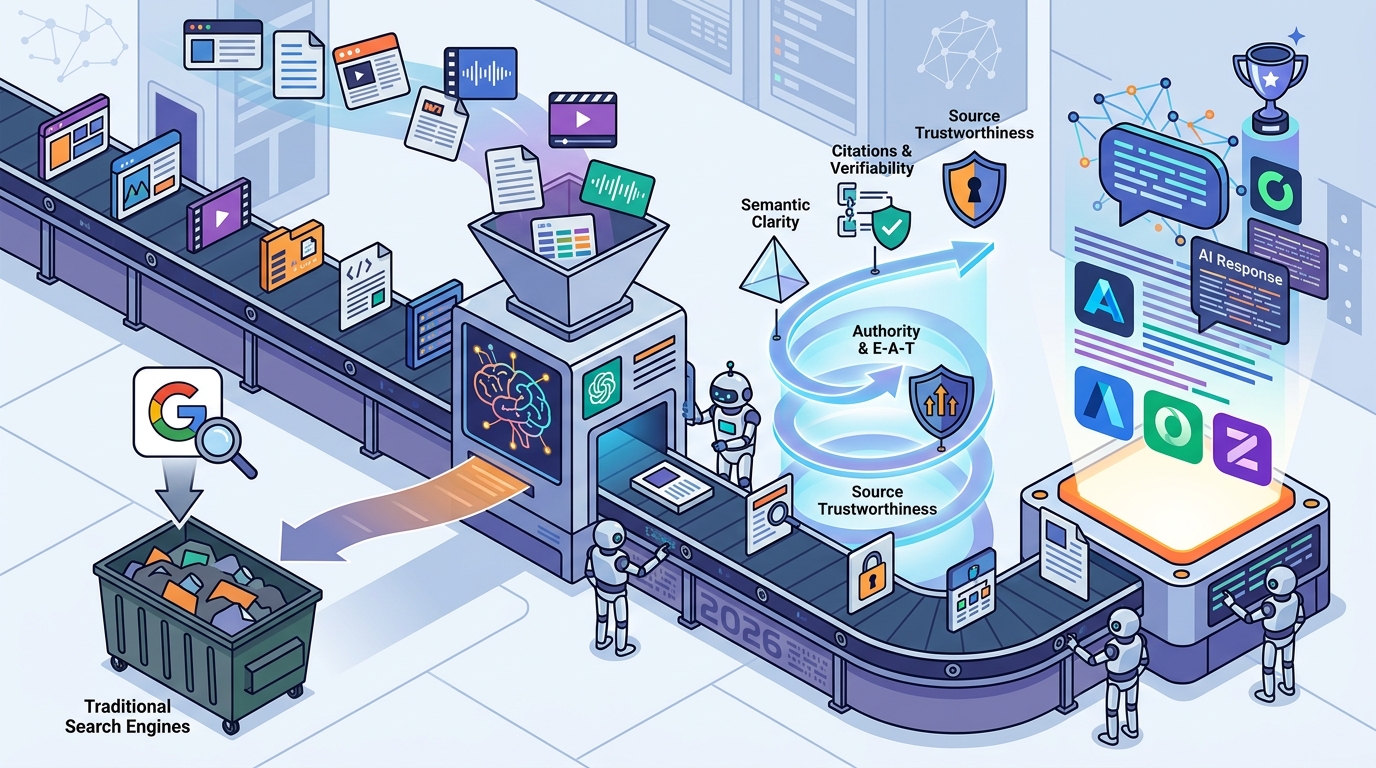
Large language models do not rank content based on backlinks alone. They rank based on trust, authority, and the clarity of the information provided. GEO separates market dominators from digitally erased brands in the era of AI search. The algorithm prioritizes content that is easy to parse and verify. This requires a fundamental shift in how we write and structure digital assets.
Answer-first formatting is critical for this process. You must front-load the direct answer before the supporting detail. This allows AI engines to extract and quote your content instantly. If the answer is buried in paragraphs of fluff, the model will likely skip it in favor of a clearer source. Clarity is the new currency of search.
Machine-readable markup is another non-negotiable requirement. Clean semantic HTML, proper headers, tables, and schema markup that AI crawlers can parse without guesswork are essential. When you use structured data, you reduce the cognitive load on the AI. You are essentially handing it the answer on a silver platter. This increases the likelihood of citation significantly.
Understanding the Cytd Score
Your Cytd Score is a number from zero to one hundred that shows how likely AI systems are to cite your business when someone asks about what you do. This metric is not a vanity number. It is a composite measure of your visibility, authority, and topic coverage across the AI web. A low score indicates that AI models do not yet trust your domain as a definitive source.
The score is influenced by several factors. First, it looks at your citation tracking. This involves real-time logging of the exact instances, locations, and contexts where your material gets cited. Second, it analyzes your mention tracking across major platforms like Claude, ChatGPT, Gemini, Grok, and Perplexity. Third, it evaluates your competitor benchmarking. This head-to-head comparison shows exactly how your brand stacks up against market rivals in AI answers.
Improving your Cytd Score requires a holistic approach. It is not enough to just publish content. You must ensure that content is indexed, distributed, and reinforced by a structured backlink registry. The Spotlight feature in Cytd provides a deliberate linking ecosystem that funnels domain authority to your priority assets. More linked sources means higher authority in the eyes of the AI.
Content Strategy for AI Consumption
As digital discovery evolves, simply writing good content is not enough. The way content is surfaced by AI platforms requires a specific architectural approach. You must cover a subject in depth across linked pages instead of a single standalone post. This builds topical authority. Topical authority is the signal that tells AI models your domain is an expert in a specific niche.
Generative Engine Optimization requires you to think like an AI. What questions does your ideal customer ask? What data do they need? What comparisons are they making? Your content must answer these questions with precision. This involves creating AI-optimized articles that are specifically designed for AI consumption. These articles use clear headings, concise paragraphs, and direct answers.
Video content is also becoming a critical component of GEO. AI doesn't just read articles. It looks at a vast array of social content too. AI-optimized videos are scripted and framed specifically to capture modern multimedia search algorithms. YouTube and Instagram are key platforms for this distribution. Strategic video distribution captures high-intent search traffic on the world's second-largest search engine. This expands your brand footprint across modern discovery feeds.
Technical Infrastructure and Indexing
Even the best content is useless if AI cannot find it. Discovery indexing is the immediate indexing of your domain so it can actually be seen. This involves automated ping networks that alert major search bots the moment a page updates. IndexNow is a protocol that facilitates this rapid discovery process.
Direct pipeline sync with Bing's webmaster ecosystem is crucial for feeding OpenAI web search and Copilot indices. Google Search Console also plays a role in accelerated crawl submission. This ensures Google's AI Overviews register your authority without standard crawling delays. These technical steps ensure that your content is available to AI models the moment it is published.
A dedicated subdomain built specifically for AI content allows you to recursively test and iterate without touching your core site. This separation is vital for experimentation. You can try new formats, structures, and topics without risking the SEO health of your main website. This dedicated environment also serves as a GPT Reference Listing. It is essentially a Wikipedia built for AI that consolidates all your optimized assets.
Real-World GEO Case Studies
Theoretical knowledge is important, but real-world results prove the efficacy of GEO. Five accounts across five industries demonstrate the power of this approach. These businesses went from being absent from AI answers to being the primary recommendation. The average account achieves three times the citations and mentions in its first three months. They also see a forty-five percent increase in their AI visibility score.
| Industry | Starting Score | Ending Score | Key Outcome |
|---|---|---|---|
| Real Estate Lending | 32 | 92 | 2 to 42 citations via ChatGPT |
| Fitness Coaching | 18 | 95 | 3 to 33 citations via Claude |
| Supplement Science | 20 | 78 | 2 to 24 citations via ChatGPT |
| Sports Medicine | 21 | 77 | 3 to 26 citations via Grok |
| Management Consulting | 25 | 75 | 6 to 31 citations via Grok |
Consider the case of a real estate lending marketplace. They operated since 2016 with a full content library but were still absent from AI answers. Nine out of ten of their AI visitors had never touched the site before. By optimizing for the question "What is the best platform to match my commercial loan scenario with hundreds of lenders?" they increased their citations from two to forty-two. Their Cytd Score jumped from thirty-two to ninety-two.
Another example is a fitness gym in Denver. They never tried to win the broad term "best gyms in Denver." Instead, they owned the niche question: "Is there a gym near me in Denver that offers Hyrox prep and small-group coaching?" This specific focus allowed them to climb from a score of eighteen to ninety-five. They became the definitive answer for a high-intent local audience.
Key Takeaways
- AI Search Dominance: Thirty-seven percent of consumers now start with AI instead of Google, fundamentally changing discovery habits.
- Click Drop-off: Clicks drop by fifty-eight percent when an AI Overview appears, making direct citation vital for traffic.
- Citation Gap: Forty-five percent of consumers use AI for local business, yet only one point two percent of businesses are recommended.
- Cytd Score Impact: A high Cytd Score correlates directly with increased citations and mentions across major AI engines.
- Content Structure: Answer-first formatting and machine-readable markup are essential for AI extraction and quoting.
- Indexing Speed: Automated ping networks and IndexNow ensure AI models see your content immediately upon publication.
- Topical Authority: Covering subjects in depth across linked pages builds the trust required for AI recommendation.
Frequently Asked Questions
What is the difference between SEO and GEO?
SEO focuses on ranking for keywords in traditional search engines. GEO focuses on answering questions in a way that AI models can easily extract and cite. GEO prioritizes clarity, structure, and authority over keyword density.
How does the Cytd Score work?
Your Cytd Score is a number from zero to one hundred that shows how likely AI systems are to cite your business when someone asks about what you do. It measures visibility, authority, and topic coverage.
Why is answer-first formatting important?
Answer-first formatting is important because it allows AI engines to extract and quote your content instantly. By front-loading the direct answer, you reduce the cognitive load on the model and increase the chance of citation.
What is the role of backlinks in GEO?
Backlinks still matter in GEO. They reinforce your brand as the definitive factual source on key topics. A structured backlink registry funnels domain authority to your priority assets, increasing your trust score.
How long does it take to see results from GEO?
The first 90 days are critical. Month one involves baseline establishment and initial indexing. Month two sees citations and mentions start appearing. Month three and beyond bring the best results as momentum builds and site visits increase.
Can video content be optimized for AI?
Yes. AI doesn't just read articles. It looks at a vast array of social content too. AI-optimized videos are scripted and framed specifically to capture modern multimedia search algorithms on platforms like YouTube and Instagram.
What is a dedicated subdomain for AI?
A dedicated subdomain for AI is a separate subdomain built specifically for AI content. This allows you to recursively test and iterate without touching your core site. It also serves as a centralized reference library for AI models.
How do I track my AI visibility?
You can track your AI visibility through prompt tracking, citation tracking, and mention tracking. These tools monitor the exact prompts and queries driving visibility to your domain and log where your brand is mentioned.
Start Your GEO Journey
The window to dominate AI search is open, but it is closing. Businesses that adapt now will capture the majority of future digital discovery. Those that wait will be left behind in the shadows of traditional search. Cytd provides the full platform to make AI recommend your business. From AI-optimized articles to dedicated subdomains and comprehensive tracking, we handle the entire process.
Do not let your competitors own the AI answers in your industry. Visit the Cytd platform to see exactly what is included. Review our case studies to see real results. Then, subscribe to Cytd today and start building your AI authority. Your business deserves to be the answer.