
Restaurants, real estate agents, and insurance brokers show up in AI search by optimizing structured data, local reviews, and conversational content. This guide explains the technical and strategic steps required to become a recommended answer in ChatGPT, Gemini, and other AI engines. It covers the specific signals these models use to select local businesses.
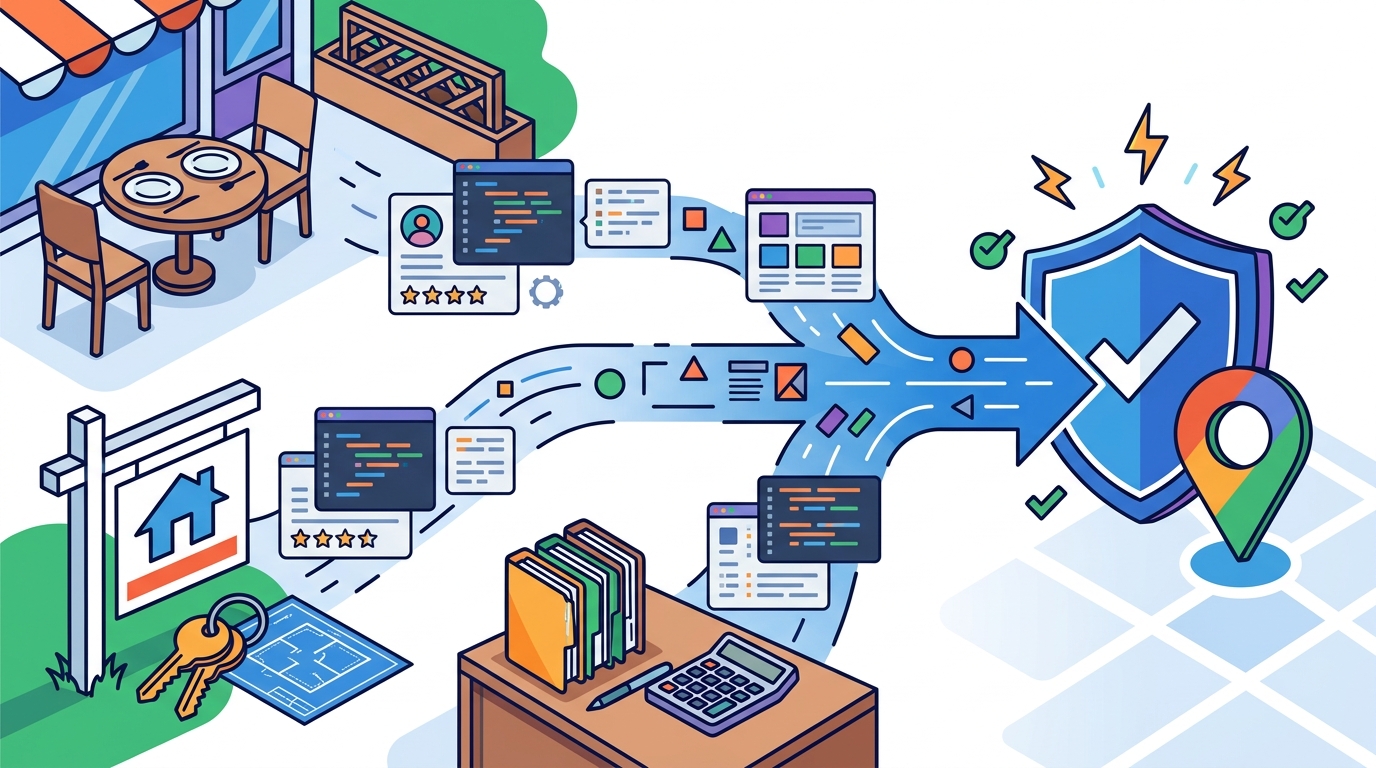
Structured Data and Schema Markup
Structured data is a standardized format for providing information about a page and classifying the page content. For local businesses, this markup is the primary way AI engines understand what you sell, where you are located, and what your hours are. Without it, the model must guess, which often leads to exclusion from the final answer.
Implementing LocalBusiness Schema
Every local business should implement the LocalBusiness schema type. This includes specific subtypes such as Restaurant, RealEstateAgent, or InsuranceAgency. You must include your name, address, phone number, and geographic coordinates. This data helps the AI map your physical location to user queries like "best pizza near me."
Adding Service and Offer Schema
For service-based businesses, adding Service or Offer schema clarifies your specific capabilities. A real estate agent might list "Buyer Representation" or "Commercial Leasing." An insurance broker might list "Auto Insurance" or "Life Insurance." This granularity allows the AI to match specific user needs to your specific services rather than just your general category.
Machine-Readable Formatting
AI engines prefer clean, semantic HTML. Use proper header tags (H1, H2, H3) to structure your content. Avoid heavy JavaScript rendering for critical information. The content should be visible in the raw HTML source. This ensures that when the AI crawler visits your site, it can extract the data without executing complex scripts.
Local Review Signals
Local review signals are the aggregate ratings and written feedback from customers on platforms like Google, Yelp, and industry-specific sites. AI models analyze these reviews to determine trustworthiness and quality. They do not just look at the star rating; they analyze the text for sentiment, specific keywords, and recurring themes.
Keyword Density in Reviews
When customers mention specific services in their reviews, it reinforces your relevance. If a restaurant receives reviews mentioning "great vegan options" or "family-friendly atmosphere," the AI associates those attributes with your brand. Encourage customers to mention the specific service they used. This creates a semantic link between your business and specific user intents.
Response Strategy
Responding to reviews is a signal of active management. AI engines may analyze the tone and content of your responses. A professional, helpful response to a negative review demonstrates customer service quality. It also provides additional text for the AI to analyze. Keep responses concise, factual, and solution-oriented.
Platform Diversity
Do not rely on a single platform. A diverse profile across multiple review sites increases your credibility. If you only have reviews on one site, the AI may view your data as incomplete. Aim for a consistent presence on the top three platforms relevant to your industry. This redundancy helps ensure that your reputation is visible regardless of which data source the AI prioritizes.
NAP Consistency
NAP consistency refers to the uniformity of your Name, Address, and Phone number across the entire web. AI engines cross-reference your information against multiple directories and data providers. If your NAP data conflicts, the model may discard your entry as unreliable. Consistency is a foundational trust signal for local AI search.
Auditing Your Citations
Start by listing every place your business information appears. This includes your website, social media profiles, local directories, and industry-specific listings. Check for typos, outdated phone numbers, or incorrect addresses. Even a small discrepancy, like a missing suite number, can cause a mismatch. Use a spreadsheet to track each citation and its current status.
Canonical Source
Designate your website as the canonical source for your NAP data. All other citations should link back to your website or mirror its data exactly. When you update your phone number or move locations, update your website first, then propagate the change to all directories. This creates a clear hierarchy of truth for the AI crawlers.
Handling Multiple Locations
If you operate multiple locations, each must have its own unique NAP profile. Do not reuse the same phone number for different physical addresses unless it is a central switchboard. Each location needs its own dedicated page on your website with unique content and schema. This prevents the AI from confusing your locations and diluting your local relevance.
Conversational Content Strategy
Conversational content is written in a natural, question-and-answer format that mirrors how users speak to AI assistants. Traditional SEO focused on keywords; AI search focuses on intent and context. You must write content that directly answers the specific questions your customers ask. This shifts your content from being a brochure to being a helpful resource.
Question-First Formatting
Structure your pages around specific questions. Use H2 and H3 headers that are phrased as questions. For example, instead of "Our Services," use "What types of insurance do you offer?" Follow the question with a direct, concise answer in the first two sentences. Then provide supporting details. This format makes it easy for the AI to extract a snippet and cite it as the answer.
Addressing Long-Tail Queries
AI users often ask complex, multi-part questions. A real estate agent might be asked, "What is the best neighborhood for young families in Denver with good schools?" Your content should address these nuanced queries. Create dedicated pages or sections that answer specific, long-tail questions. This positions you as an authority on specific topics rather than just a general provider.
Monitoring AI Visibility
You need to know if your content is actually being cited. Tools like Cytd's free AI visibility report can show you how you appear across different AI engines. This data helps you identify gaps in your content. If you are not being recommended for a specific question, you need to create content that answers it. Regular monitoring ensures your strategy stays aligned with how AI models are evolving.
Key Takeaways
- Structured data is the primary way AI engines understand your business type and location.
- Local reviews provide the social proof and semantic context that AI models analyze for trust.
- NAP consistency across the web is a critical trust signal; conflicts can lead to exclusion.
- Conversational content should be written in a question-and-answer format to match user intent.
- AI search is different from traditional SEO; it prioritizes direct answers over keyword density.
- Monitoring your AI visibility is essential to understand which questions you are winning.
- Consistency and clarity are more important than volume in AI search optimization.
- Use tools to track your performance across ChatGPT, Gemini, and other answer engines.
Frequently Asked Questions
How does AI search differ from traditional Google search?
Traditional search returns a list of links for the user to click. AI search synthesizes information from multiple sources to provide a direct answer. It may cite specific websites, but the user often stays within the AI interface. This means your content must be extractable and authoritative to be included in the final answer.
Do I need to change my website for AI search?
You may need to adjust your content structure and add structured data. If your site is already well-optimized for traditional SEO, you have a strong foundation. The main change is shifting from keyword-stuffed pages to clear, question-answering content. Ensure your site is mobile-friendly and loads quickly, as these are still important signals.
Which AI engines should I focus on?
Focus on the engines your customers actually use. For many local businesses, ChatGPT and Google AI Overviews are the primary sources. However, you should monitor a range of engines, including Gemini and Perplexity. Different models may prioritize different signals. A broad strategy ensures you are visible regardless of which tool your customer chooses.
How long does it take to see results in AI search?
Results vary, but most businesses see initial changes within 30 to 90 days. AI models update their training data and index new content regularly. Consistency is key. You need to maintain your NAP data and publish new content regularly. Patience is required, as the AI ecosystem is still evolving rapidly.
Can I control what the AI says about my business?
You cannot directly control the AI's output, but you can influence the data it uses. By providing accurate, consistent, and high-quality information, you increase the likelihood that the AI will cite you positively. You cannot force a specific phrasing, but you can ensure the underlying facts are correct and favorable.
Is AI search only for large brands?
No, AI search is particularly beneficial for local businesses. Large brands often dominate traditional search, but AI search levels the playing field by focusing on relevance and specific intent. A small local business that answers a specific question well can be recommended over a larger competitor that is less specific.
What is the role of a dedicated subdomain in AI optimization?
A dedicated subdomain can be used to host AI-optimized content separately from your main site. This allows you to test different formats and structures without affecting your core website. It provides a clean environment for the AI to crawl and extract data. This strategy is used by some advanced optimization services to iterate quickly.
Conclusion
Showing up in AI search requires a shift from traditional SEO tactics to a focus on clarity, consistency, and conversational relevance. By implementing structured data, maintaining NAP consistency, and writing question-first content, you position your business as a trusted source for AI engines. Cytd helps businesses monitor and improve their visibility across these new answer engines. Start by auditing your current presence and identifying the questions your customers ask. Then, build the content and data structures that allow AI to recommend you.