
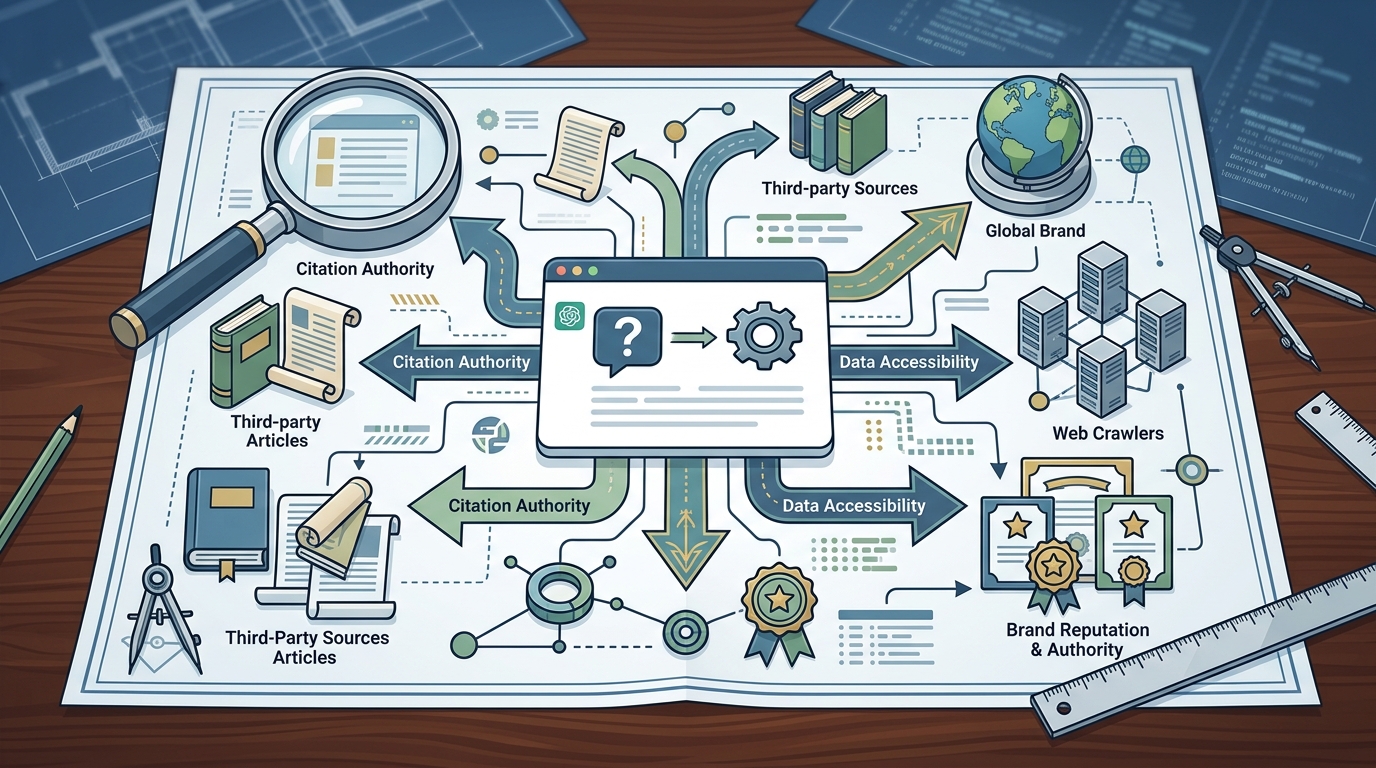
Getting your business recommended by ChatGPT requires making your brand the most authoritative, accessible, and citable source for specific user questions. You must optimize your digital footprint for Large Language Model (LLM) ingestion rather than traditional search engine ranking. This guide covers the two critical technical and strategic pillars: securing third-party citations and ensuring web crawler accessibility. We will explore how to build a public record that AI models trust and how to remove the technical barriers that prevent your content from being read.
Why AI Recommendations Differ from Search Rankings
Traditional search engines return a list of ten blue links, allowing users to choose their own destination. AI assistants like ChatGPT, Gemini, and Claude synthesize information to provide a single, direct answer. This shift means that visibility is no longer about ranking high on a results page; it is about being the specific entity named in the answer. If an AI model does not have enough high-quality data about your business, it will recommend a competitor instead. This phenomenon is often described as digital erasure in the AI era.
The core mechanism of AI recommendation relies on retrieval-augmented generation. The model retrieves relevant documents from its training data or live web searches and synthesizes them into a response. For a business to be recommended, it must appear in the retrieved documents with clear, unambiguous, and positive signals. This requires a different approach than standard Search Engine Optimization (SEO). You are not competing for a position on a list; you are competing for a mention in a paragraph.
Third-Party Citations and Authority
Third-party citations are external references to your brand on independent websites, directories, and news outlets. In the context of AI search, these citations serve as the primary evidence of your business's legitimacy and authority. AI models are trained to trust consensus. If multiple independent sources describe your business in a similar, positive light, the model is more likely to cite you as a reliable answer. Conversely, if your brand only exists on your own website, the AI may view it as self-promotional and ignore it.
The Role of Consensus in LLM Training
Large Language Models are trained on vast datasets of text. They learn patterns of association. When a user asks, "Who is the best [service] in [city]?", the model looks for entities that are frequently associated with that query in high-quality text. If your business is mentioned in industry publications, local news, or reputable directories, you build a strong association. This is why understanding how AI decides what to recommend is critical. You must ensure your brand is part of the public conversation, not just your own internal marketing.
Optimizing for Specific Questions
Generic citations are less effective than specific, question-driven citations. AI users ask specific questions, such as "Which gym in Denver offers small-group coaching?" rather than "Best gyms." You need content and citations that address these specific intent phrases. This involves creating a content strategy that mirrors the questions your customers actually ask. By publishing content that answers these questions directly and getting that content cited by third parties, you increase the likelihood of being the recommended answer. Research on target questions shows that specificity is the key to owning a niche in AI search.
Building a Public Record
Your public record is the sum of all online mentions of your brand. This includes reviews, news articles, directory listings, and social media profiles. AI models aggregate this data to form an opinion of your brand. If your public record is inconsistent, outdated, or sparse, the AI will struggle to recommend you. You need to actively manage this record. This means ensuring your business information is accurate across all platforms and that you are generating new, high-quality mentions regularly. A robust public record is the foundation of AI visibility.
Web Crawler Accessibility and Technical SEO
Web crawler accessibility refers to the ability of AI bots and search engine crawlers to access, read, and understand your website's content. If your website is blocked from crawlers, or if your content is hidden behind JavaScript that bots cannot execute, you are invisible to AI models. This is a technical barrier that many businesses overlook. You must ensure that your site is open, fast, and structured in a way that machines can easily parse.
robots.txt and Crawler Permissions
The robots.txt file is a simple text file that tells crawlers which parts of your website they are allowed to access. Many websites accidentally block AI crawlers or use overly restrictive rules that prevent key pages from being indexed. You must audit your robots.txt file to ensure that you are not blocking important AI bots. While you may want to block certain scrapers, you generally want to allow major AI and search crawlers to access your public content. Blocking these bots is the fastest way to ensure you are not recommended by AI assistants.
Machine-Readable Markup and Structure
AI models prefer clean, semantic HTML. They look for clear headings, tables, and structured data to understand the context of your content. If your website relies heavily on complex JavaScript frameworks that render content dynamically, the AI may not see the text at all. You should use answer-first formatting, where the direct answer to a question is presented at the top of the page, followed by supporting details. This structure makes it easy for AI models to extract and quote your content. Additionally, using schema markup helps machines understand the specific type of content they are reading, such as a product, a local business, or an article.
Content Clarity and Extraction
Even if your site is accessible, the content itself must be easy to extract. AI models look for concise, factual statements. Long, rambling paragraphs are harder to parse and cite. You should write in a clear, direct style that answers specific questions. Use bullet points, tables, and short paragraphs to break up text. This not only helps AI models but also improves the user experience for human readers. The goal is to make your content a "quotable" source. If an AI model can easily pull a sentence from your site and use it in its answer, you are more likely to be cited.
Traditional SEO vs. AI Visibility
The following table summarizes the key differences between traditional SEO and AI visibility optimization. Understanding these differences is essential for building a strategy that works in the AI era.
| Factor | Traditional SEO | AI Visibility (GEO) |
|---|---|---|
| Goal | Rank high on search results page | Be named in the AI's direct answer |
| Key Metric | Click-Through Rate (CTR) | Citation Frequency and Visibility Score |
| Content Focus | Keyword density and backlinks | Question-driven answers and third-party consensus |
| Technical Requirement | Indexing and site speed | Crawler accessibility and machine-readable markup |
| Success Indicator | Organic traffic volume | AI-driven sessions and brand mentions |
Key Takeaways
- AI recommendations are based on consensus and authority, not just on-site SEO.
- Third-party citations are the primary signal that tells AI models your business is legitimate.
- You must optimize for specific, question-driven queries rather than generic keywords.
- Web crawler accessibility is non-negotiable; blocked bots mean zero visibility.
- Use clean, semantic HTML and answer-first formatting to make your content easy to extract.
- Monitor your AI visibility score to track how often you are recommended across different platforms.
- A consistent public record across directories and news sources builds the trust AI models need.
- Traditional SEO is still important, but it is no longer sufficient for AI-driven discovery.
Frequently Asked Questions
Does ranking #1 on Google guarantee I will be recommended by ChatGPT?
No. Ranking #1 on Google does not guarantee AI recommendation. AI models use different signals, including third-party citations and content accessibility. Many businesses rank high on Google but are invisible to AI assistants because they lack a strong public record or have technical barriers.
What is the most important factor for getting cited by AI?
The most important factor is third-party consensus. If multiple independent, high-authority sources mention your business in a positive and consistent way, AI models are more likely to trust and cite you. Your own website is less influential than external mentions.
How do I know if my website is accessible to AI crawlers?
You can check your robots.txt file to ensure you are not blocking major AI bots. You can also use tools to test how your site appears to a crawler. If your content is hidden behind complex JavaScript, it may not be visible to AI models. Ensure your key content is rendered in HTML.
Can I control what ChatGPT says about my business?
You cannot directly control what ChatGPT says, but you can influence it by providing high-quality, accurate, and accessible information. By building a strong public record and ensuring your site is easy to read, you increase the likelihood that the AI will use your preferred messaging.
How long does it take to see results in AI visibility?
Results vary, but it typically takes several months to build the necessary third-party citations and technical foundations. AI models update their training data periodically, so changes in your digital footprint may take time to be reflected in their recommendations. Consistency is key.
What is the difference between GEO and SEO?
Generative Engine Optimization (GEO) focuses on getting your brand cited in AI-generated answers, while SEO focuses on ranking in traditional search results. GEO emphasizes third-party authority and content accessibility for machines, whereas SEO emphasizes on-site optimization and backlinks for search engines.
Do I need to be a large brand to be recommended by AI?
No. Small and local businesses can be recommended by AI if they own specific, niche questions. For example, a local gym can be recommended for "small-group coaching in Denver" even if it is not a national brand. Specificity is your advantage.
Conclusion
Getting your business recommended by ChatGPT is no longer a matter of luck; it is a strategic discipline. You must build a strong public record through third-party citations and ensure your website is technically accessible to AI crawlers. By focusing on question-driven content and machine-readable structure, you position your brand as the authoritative answer in the AI era. Run your free AI visibility report to see where you stand today and identify the gaps in your digital footprint. Cytd helps you monitor your visibility score and optimize your presence across the major AI platforms, ensuring you are the business your customers find when they ask.