
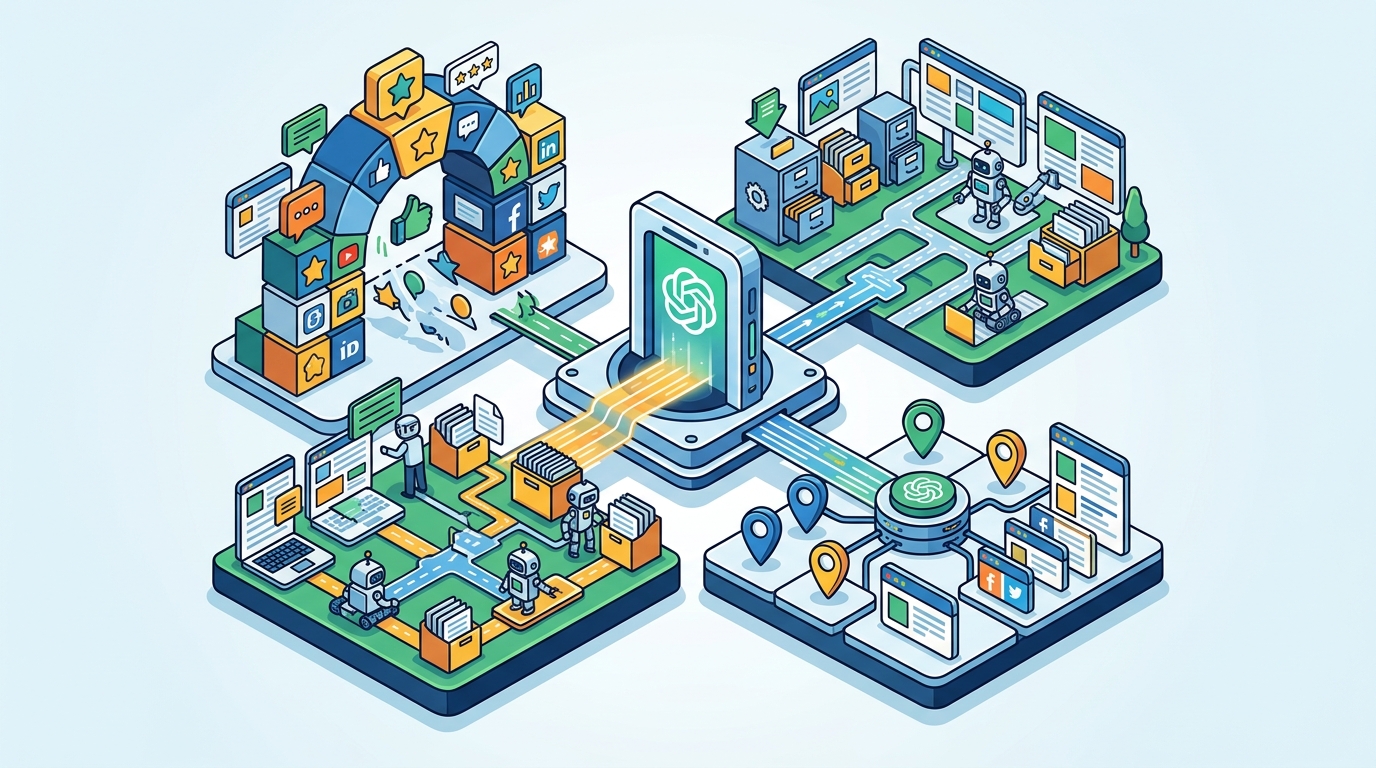
Getting your business recommended by ChatGPT requires building a clear, accessible, and consistent digital footprint that large language models can easily parse and trust. This guide covers the three critical pillars of AI visibility: securing third-party citations, ensuring web crawler accessibility, and maintaining business information consistency. We will explore how to structure your content for answer engines and how to monitor your progress effectively.
Third-Party Citations
Third-party citations are external references to your business on independent websites, directories, and news outlets. Large language models like ChatGPT rely heavily on these external signals to validate the existence and reputation of a brand. If a model cannot find your business mentioned on reputable third-party sites, it is unlikely to recommend you in a conversational answer.
The Role of Authority in AI Answers
AI models prioritize sources that demonstrate authority and trustworthiness. When a user asks for a recommendation, the model looks for entities that are frequently cited by high-quality domains. This is similar to how traditional search engines use backlinks, but the context is different. In AI search, the model is generating a natural language response, so it needs to be confident that the entity it mentions is real and well-regarded.
Building these citations involves getting your business listed on relevant industry directories, local business platforms, and news sites. You should aim for a diverse set of citations that cover different aspects of your business. For example, a dental practice might want citations on health directories, local news sites, and professional association pages. This diversity helps the AI model build a comprehensive understanding of your brand.
Quality Over Quantity
While having many citations is helpful, quality is more important. A citation from a highly authoritative source, such as a major news outlet or a well-known industry publication, carries more weight than a citation from a low-quality directory. Focus on earning mentions in contexts that are relevant to your services. If you are a fitness coach, getting featured in a health and wellness magazine is more valuable than being listed on a generic business directory.
Web Crawler Accessibility
Web crawler accessibility is the ability of AI systems and search engine bots to access, read, and understand the content on your website. If your website is blocked from crawlers or if your content is not structured in a way that machines can easily parse, you will not appear in AI-generated answers. This is a technical but critical component of AI visibility.
Ensuring Crawlability
First, you must ensure that your website is not blocking AI crawlers. Check your robots.txt file to make sure it does not disallow access to key pages. Additionally, your website should load quickly and be mobile-friendly, as these factors influence how easily crawlers can process your content. If your site is slow or difficult to navigate, crawlers may skip it or fail to index it properly.
Structured Data and Semantic HTML
Using structured data, such as schema markup, helps AI models understand the context of your content. For example, marking up your business as a LocalBusiness entity with specific details like address, phone number, and service area helps the model associate your brand with local queries. Semantic HTML, which uses tags like
, , and
in a logical hierarchy, also aids in content parsing. This structure allows the AI to extract key information more accurately.
Business Information Consistency
Business information consistency is the practice of ensuring that your name, address, phone number, and other key details are identical across all online platforms. Inconsistencies can confuse AI models and reduce their confidence in recommending your business. When a model sees conflicting information about a business, it may choose a competitor with more consistent data.
The Importance of NAP Consistency
NAP stands for Name, Address, and Phone number. These three elements are the foundation of local business visibility. If your NAP information varies between your website, Google Business Profile, and third-party directories, it creates a signal of uncertainty. AI models use this consistency as a trust signal. By keeping your NAP information identical everywhere, you help the model verify your business's legitimacy.
Managing Multiple Locations
If you operate multiple locations, consistency becomes even more critical. Each location should have its own unique NAP information, and this information should be consistent across all platforms for that specific location. Avoid using the same phone number for multiple locations unless it is a central office number that is clearly labeled. This clarity helps AI models distinguish between your different branches and recommend the correct one based on the user's location.
Monitoring Your AI Visibility
Monitoring your AI visibility involves tracking how often and in what context your business is mentioned by AI models. This is different from traditional SEO metrics, which focus on rankings and clicks. AI visibility metrics focus on citations, mentions, and the sentiment of the AI's response. Tools like Cytd can help you monitor your visibility score across various AI platforms, including ChatGPT, Gemini, and Perplexity.
By regularly monitoring your AI visibility, you can identify gaps in your strategy. For example, if you notice that you are not being mentioned in certain categories or regions, you can adjust your citation and content strategy to address those gaps. This ongoing monitoring ensures that your AI visibility remains strong as the landscape evolves.
Key Takeaways
- Third-party citations are essential for building trust with AI models.
- Ensure your website is accessible to AI crawlers by checking your robots.txt file.
- Use structured data and semantic HTML to help AI models parse your content.
- Maintain consistent NAP information across all online platforms.
- Monitor your AI visibility regularly to identify and address gaps.
- Focus on quality citations from authoritative sources rather than just quantity.
- Keep your business information up-to-date and accurate to avoid confusion.
Frequently Asked Questions
How long does it take to get recommended by ChatGPT?
It can take several weeks to months for changes in your digital footprint to be reflected in AI recommendations. This depends on how frequently the AI model updates its training data and how quickly it indexes your new content.
Do I need to be on Google to be recommended by ChatGPT?
While being on Google is helpful, it is not the only factor. ChatGPT uses a variety of sources, including third-party citations and your own website. However, a strong presence on Google can indirectly support your AI visibility.
What is the best way to get cited by third-party sites?
The best way is to provide valuable content or insights that other sites want to reference. This can include publishing research, offering expert commentary, or creating unique resources that are relevant to your industry.
How does Cytd help with AI visibility?
Cytd helps you monitor your visibility score across various AI platforms and provides insights into how to improve your citations and content strategy. It allows you to track your progress and make data-driven decisions.
Is it possible to control what ChatGPT says about my business?
You cannot directly control what ChatGPT says, but you can influence it by providing accurate, consistent, and high-quality information about your business. The more reliable your data, the more likely the model is to recommend you positively.
What should I do if my business is not being mentioned?
If your business is not being mentioned, start by auditing your third-party citations and ensuring your website is accessible to crawlers. You may also need to improve the consistency of your business information across different platforms.