
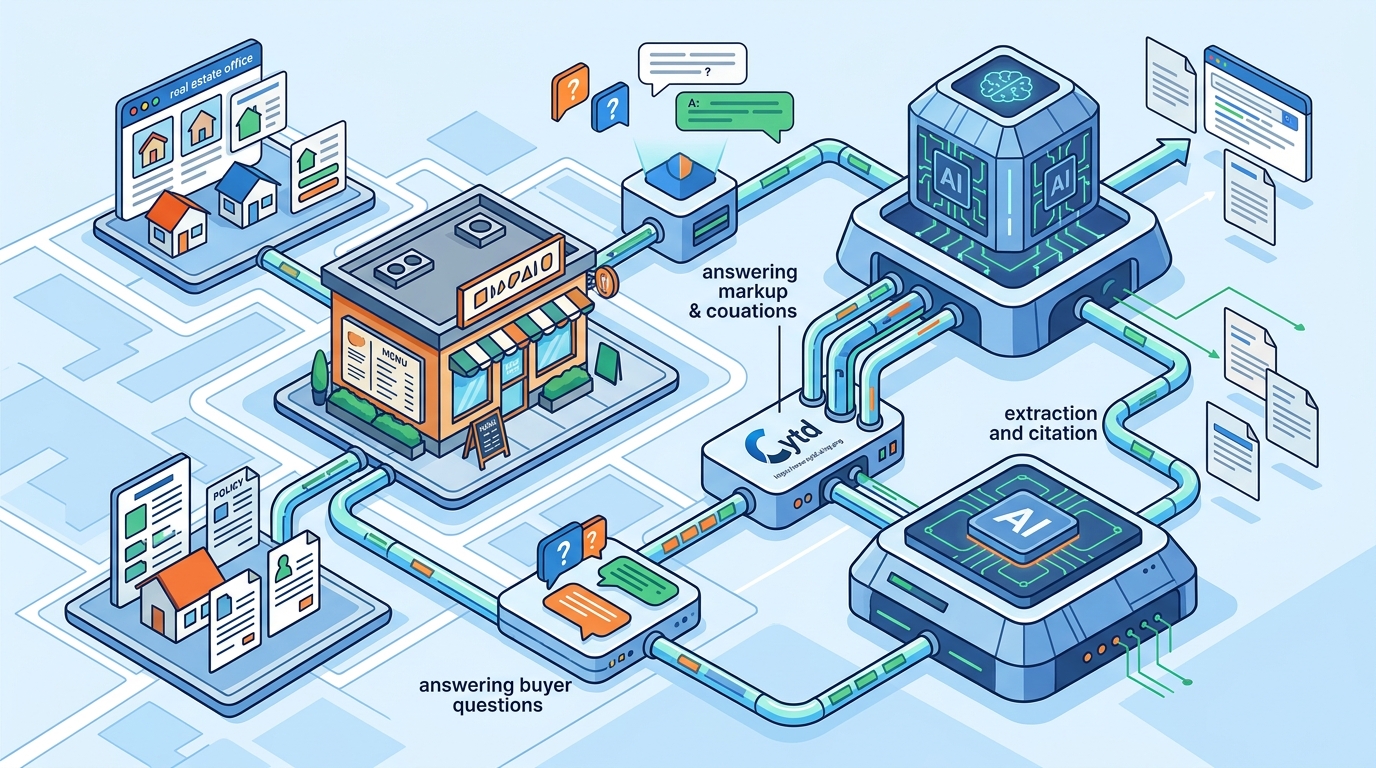
Restaurants, real estate agents, and insurance brokers show up in AI search by structuring their web content for machine readability and answering specific buyer questions. AI engines like ChatGPT and Gemini do not rank pages; they extract and cite sources. This guide explains how to build a digital footprint that AI systems trust and recommend.
How to Choose an AI Visibility Provider
Choosing the right partner for AI search visibility requires looking beyond generic SEO promises. A good provider focuses on how large language models (LLMs) parse and cite information. They should demonstrate an understanding of the difference between traditional search engine optimization and answer engine optimization. Look for teams that build content specifically for AI consumption, such as answer-first formatting and machine-readable markup. A bad option relies on outdated keyword stuffing or black-box tactics that do not address how AI engines actually retrieve data. The provider should offer transparency into how they measure success, such as tracking citations and mentions across multiple AI platforms.
What to Ask Before Committing
Before signing a contract, you must ask specific questions about the provider's methodology. Ask how they monitor your visibility across different AI models like ChatGPT, Gemini, and Perplexity. Inquire about the frequency of their reporting and what metrics they track. You should ask if they publish content on your domain or a subdomain, and how that affects your site's authority. Ask about the human element of the service. Do you work with a dedicated strategist, or is it fully automated? Understanding the level of human interaction helps set realistic expectations for the speed and quality of the work.
How to Verify Claims and Credentials
Verifying a provider's claims is critical in a rapidly evolving market. Check if the company has a track record of working with businesses in your specific industry. Look for case studies that show before and after metrics, such as citation counts or AI-driven traffic. Verify that the team has technical expertise in semantic HTML and schema markup. You can also test their understanding by asking them to explain how AI engines differ from traditional search engines. If a provider cannot clearly articulate the mechanics of AI citation, their service may be superficial. Trust is built on transparency and technical accuracy.
How AI Visibility Optimization Works
AI visibility optimization is a structured process that begins with an audit of your current digital footprint. The first step is to identify the specific questions your customers ask AI assistants. The provider then creates or optimizes content to answer those questions directly. This content is structured with clear headers, tables, and schema markup to make it easy for AI systems to extract. The process involves publishing this content on your website or a dedicated subdomain. Over time, the provider monitors how AI engines cite this content and iterates on the strategy. It is a continuous cycle of creation, monitoring, and refinement.
What It Costs and What Drives Price
The cost of AI visibility services varies based on the scope of work and the complexity of the industry. Prices are often driven by the number of questions being targeted and the level of content creation required. A basic monitoring service costs less than a full managed service that includes content writing and technical implementation. Factors that drive the price up include the need for custom technical development, such as building a dedicated subdomain for AI content. The price may also reflect the seniority of the team members involved in your account. It is important to understand what is included in the monthly fee to avoid unexpected costs.
Common Mistakes and How to Avoid Them
One common mistake is expecting immediate results. AI models update their training data and retrieval indexes on their own schedules, so visibility changes can take weeks or months. Another mistake is ignoring the quality of the underlying content. AI engines prioritize authoritative and helpful sources. If your website has thin content or poor user experience, AI systems are less likely to cite it. Avoid providers who promise guaranteed rankings or control over what the AI says. You cannot control the model, but you can control the quality and structure of the data you provide to it.
AI Visibility vs. Traditional SEO
Traditional SEO and AI visibility optimization share some foundations but have different goals. Traditional SEO aims to rank high in search engine results pages (SERPs) to earn clicks. AI visibility aims to be cited in the direct answer provided by an AI assistant. The table below highlights the key differences between these two approaches.
| Feature | Traditional SEO | AI Visibility Optimization |
|---|---|---|
| Primary Goal | Rank in SERPs | Be cited in AI answers |
| User Interaction | User clicks a link | User reads AI-generated summary |
| Content Structure | Keyword-rich, long-form | Answer-first, machine-readable |
| Success Metric | Organic traffic and clicks | Citations and mentions |
Strategies for Specific Local Situations
Local businesses like restaurants and real estate agents face unique challenges in AI search. For a restaurant, the key is to be the recommended answer for specific dining queries, such as "best place for vegan food in [City]." This requires having clear, structured information about menu items, dietary options, and location. For real estate agents, the focus is on local market expertise. AI engines look for agents who provide specific, data-backed insights about neighborhoods. Insurance brokers need to demonstrate trust and clarity in explaining complex policies. Each of these sectors requires a tailored approach to content and technical setup.
Rules, Rights, and Consumer Protections
When engaging with AI visibility providers, it is important to understand your rights and the rules that apply. Review the terms of service carefully to understand what you are agreeing to. Ensure that you retain ownership of the content created for your website. Check if the provider uses your data for other purposes. Consumer protection laws vary by state, but generally, you have the right to clear and honest representations of services. Be wary of contracts that lock you in for long periods without a clear exit strategy. Transparency in billing and service delivery is a key protection for your business.
Local Specifics for US Markets
AI search behavior can vary by region due to differences in local data availability. In the US, major AI models have extensive training data on popular cities and well-known brands. However, smaller towns or niche local businesses may have less data, making it harder for AI to form a confident recommendation. This is where structured local data becomes crucial. Providing accurate and consistent information about your business location, hours, and services helps AI engines build a reliable profile of your brand. Local specificity is a competitive advantage in AI search.
When to Act and How Timing Changes Outcomes
Measurable Outcomes and Long-Term Expectations
Measuring success in AI search requires tracking specific metrics. Key performance indicators include the number of citations and mentions across different AI platforms. You should also track AI-driven traffic to your website. This is the number of users who arrive at your site after interacting with an AI assistant. Over time, you should see an increase in these metrics as your content becomes more authoritative. Long-term success is built on consistency and continuous improvement. It is not a one-time fix but an ongoing strategy that evolves with the technology.
Key Takeaways
- AI visibility is distinct from traditional SEO and requires a focus on machine-readable content.
- Choose providers who offer transparency and technical expertise in AI optimization.
- Verify claims by looking for case studies and understanding the provider's methodology.
- The process involves auditing, creating answer-first content, and continuous monitoring.
- Costs are driven by the scope of work and the complexity of the industry.
- Avoid common mistakes like expecting immediate results or ignoring content quality.
- Local businesses must tailor their strategies to their specific industry and region.
- Acting early provides a competitive advantage in the rapidly evolving AI search landscape.
Frequently Asked Questions
What is AI visibility?
AI visibility is the measure of how often and how prominently a business is cited or recommended by AI answer engines like ChatGPT or Gemini.
How is AI search different from Google search?
AI search provides direct answers generated by large language models, whereas Google search provides a list of links for the user to click. AI search relies on citation and extraction rather than ranking.
Can I control what AI models say about my business?
No, you cannot directly control what AI models say. However, you can influence the outcome by providing high-quality, structured, and authoritative content that AI systems are likely to cite.
How long does it take to see results in AI search?
Results can take several weeks to months, depending on how quickly AI models update their indexes and how competitive your industry is.
Do I need to change my website for AI visibility?
Yes, your website should be optimized for machine readability. This includes using semantic HTML, proper headers, and schema markup to help AI engines understand your content.
Is AI visibility only for large brands?
No, local businesses of all sizes can benefit from AI visibility. In fact, local businesses often have less competition in AI search, making it easier to be recommended.
Conclusion
Showing up in AI search is a critical strategy for restaurants, real estate agents, and insurance brokers in 2026. By understanding the mechanics of AI citation and working with a knowledgeable partner, you can ensure your business is the recommended answer. Run your free AI report with Cytd to see where you stand today and start building your visibility in the AI answer layer.