
5 Critical Mistakes Local Businesses Make With AI Search Visibility
Local businesses are failing to appear in AI answers because they treat AI search like traditional SEO. They ignore question-based intent, lack structured data, and fail to build topical authority. Cytd helps brands fix these gaps by optimizing for how large language models actually retrieve and cite information.
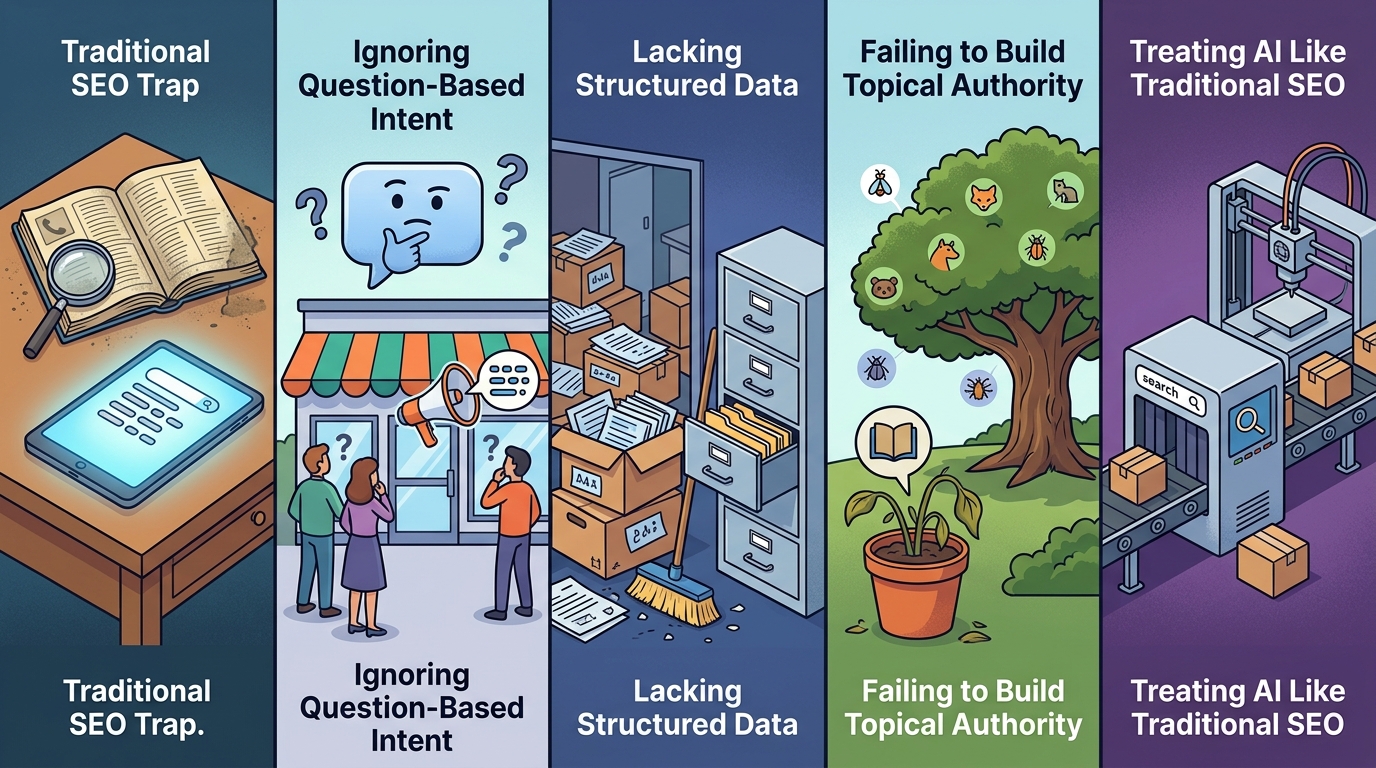
Mistake 1: Ignoring Question-Based Intent
Traditional SEO relies on keywords, but AI engines respond to natural language questions. When a user asks, "Who is the best plumber in Austin?" the AI looks for a direct answer, not a keyword-stuffed page. Businesses that only optimize for "plumber Austin" miss the conversational query entirely. This disconnect means their content is invisible to the AI layer.
For example, a dental practice in Laguna Beach might rank for "dentist" but fail to answer "Who is the best family dentist in Laguna Beach?" The AI needs a clear, concise statement that positions the business as the recommended solution. Without this, the model defaults to competitors who have structured their content to answer specific questions.
Mistake 2: Lacking Machine-Readable Markup
AI crawlers parse HTML differently than human readers. If your website lacks semantic structure, the AI cannot extract your value proposition. Clean semantic HTML, proper headers, and schema markup are essential for AI engines to understand your content. Without this, your site is just a wall of text to the model.
Cytd uses machine-readable markup to ensure AI crawlers can parse content without guesswork. This includes clean semantic HTML, proper headers, tables, and schema markup. For instance, a real estate agent in Sarasota needs their bio and specialties clearly marked so the AI can cite them for luxury waterfront properties. If the data is buried in unstructured text, the AI ignores it.
Mistake 3: Failing to Build Topical Authority
AI models favor sources that demonstrate deep expertise on a subject. A single blog post is rarely enough to establish authority. You need a network of linked pages that cover a topic in depth. This is known as topical authority. Without it, the AI views your site as a shallow source and looks elsewhere for more comprehensive information.
Consider a fitness studio in Denver. If they only have one page about "gyms in Denver," they are competing with hundreds of others. By creating a dedicated subdomain or section for "Hyrox prep" and "small-group coaching," they build a cluster of authority. This allows the AI to cite them for specific, high-intent queries rather than generic ones.
Mistake 4: Neglecting Social and Video Signals
AI engines do not just read articles. They analyze social content, videos, and community discussions. Many local businesses ignore these channels, assuming that their website is the only source of truth. However, AI models look at a vast array of social content to verify brand reputation and relevance. If your brand is absent from social platforms or video sites, you are missing a significant portion of the AI's data sources.
For example, a supplement company might have great articles but no video presence. By creating AI-optimized videos and distributing them on YouTube, they capture high-intent search traffic and provide the AI with multimedia signals. This helps the model understand the brand's credibility and reach.
Mistake 5: Not Monitoring AI Visibility
You cannot improve what you do not measure. Most local businesses have no idea if they are being cited by AI engines. They assume that if they rank on Google, they are visible everywhere. This is a dangerous assumption. AI visibility is a separate metric that requires dedicated tracking. Without monitoring, you are flying blind.
Cytd provides a visibility score that tracks your presence across multiple AI sources. This allows you to see exactly where you are being cited and where you are missing. For a lending marketplace, this might mean tracking mentions in ChatGPT versus Gemini. By monitoring these metrics, you can adjust your strategy to fill in the gaps.
Key Takeaways
- AI search relies on question-based intent, not just keywords.
- Machine-readable markup is essential for AI crawlers to parse your content.
- Topical authority requires a network of linked pages, not just single posts.
- Social and video signals are critical for AI verification and citation.
- Monitoring AI visibility is necessary to track your performance across different engines.
- Cytd helps brands optimize for these specific AI search requirements.
Frequently Asked Questions
Why doesn't my business show up in ChatGPT?
Your business likely lacks the structured data and question-based content that AI engines require. You need to optimize for natural language queries and ensure your site is machine-readable.
Is AI search different from Google SEO?
Yes. AI search focuses on answering specific questions and citing authoritative sources. Traditional SEO focuses on ranking for keywords. The strategies are distinct and require different approaches.
How does Cytd help with AI visibility?
Cytd provides a managed service that optimizes your content for AI consumption. This includes creating AI-optimized articles, adding machine-readable markup, and monitoring your visibility score across multiple AI engines.
Do I need to be on YouTube for AI search?
While not strictly required, video content provides additional signals for AI engines. It helps verify your brand's credibility and reach, which can improve your chances of being cited.
How long does it take to see results in AI search?
Results vary by industry and competition. However, consistent optimization and monitoring can lead to improved visibility within a few months. Cytd's case studies show significant improvements in the first 90 days.