
Search behavior has fundamentally changed. In 2026, a growing share of product discovery queries now start in AI interfaces like ChatGPT, Perplexity, and Google AI Overviews. Traditional SEO metrics like click-through rate and impressions no longer tell the full story because zero-click AI answers bypass your website entirely. If your brand is not being cited in AI-generated responses, you are invisible to a rapidly growing segment of buyers. This guide walks you through exactly how a company can boost its AI visibility, from content structure and entity authority to measurement and continuous optimization. Whether you are a founder, marketer, or agency leader, these strategies will help you get cited, recommended, and chosen.
What Is AI Visibility?
AI visibility is a measure of how often, how accurately, and how favorably your brand appears in AI-generated answers across platforms like ChatGPT, Google AI Overviews, Perplexity, Gemini, Grok, and Claude. Unlike traditional search rankings, AI visibility focuses on whether your brand is cited inside synthesized answers rather than whether it appears on a results page.
AI visibility metrics measure how accurately and frequently a brand is cited within generative AI answers, whereas traditional SEO metrics track rank positions and organic clicks. Understanding this distinction is the first step toward building a strategy that works in the new search landscape. You can learn more about the fundamentals in Cytd's guide on what citation visibility means for brands.
Why AI Visibility Matters More Than Ever
The data is clear. According to Onely's 2026 analysis, organic click-through rates for queries with Google AI Overviews have fallen 61% since mid-2024, dropping from 1.76% to 0.61%. Roughly 60% of all searches now end without a click to any destination site.
Meanwhile, the traffic that does arrive through AI answers converts at dramatically higher rates. VentureBeat reported that LLM-referred traffic converts at 30-40%, significantly higher than traditional organic search. These visitors are not browsing. They are buying.
The Zero-Click Reality
Bain & Company found that about 80% of consumers rely on zero-click results for at least 40% of their searches. By 2026, projections suggest 65% of global searches will be zero-click. If your brand is not inside the AI-generated answer, it is functionally invisible to this audience. The state of AI search is evolving fast, and brands must adapt accordingly.
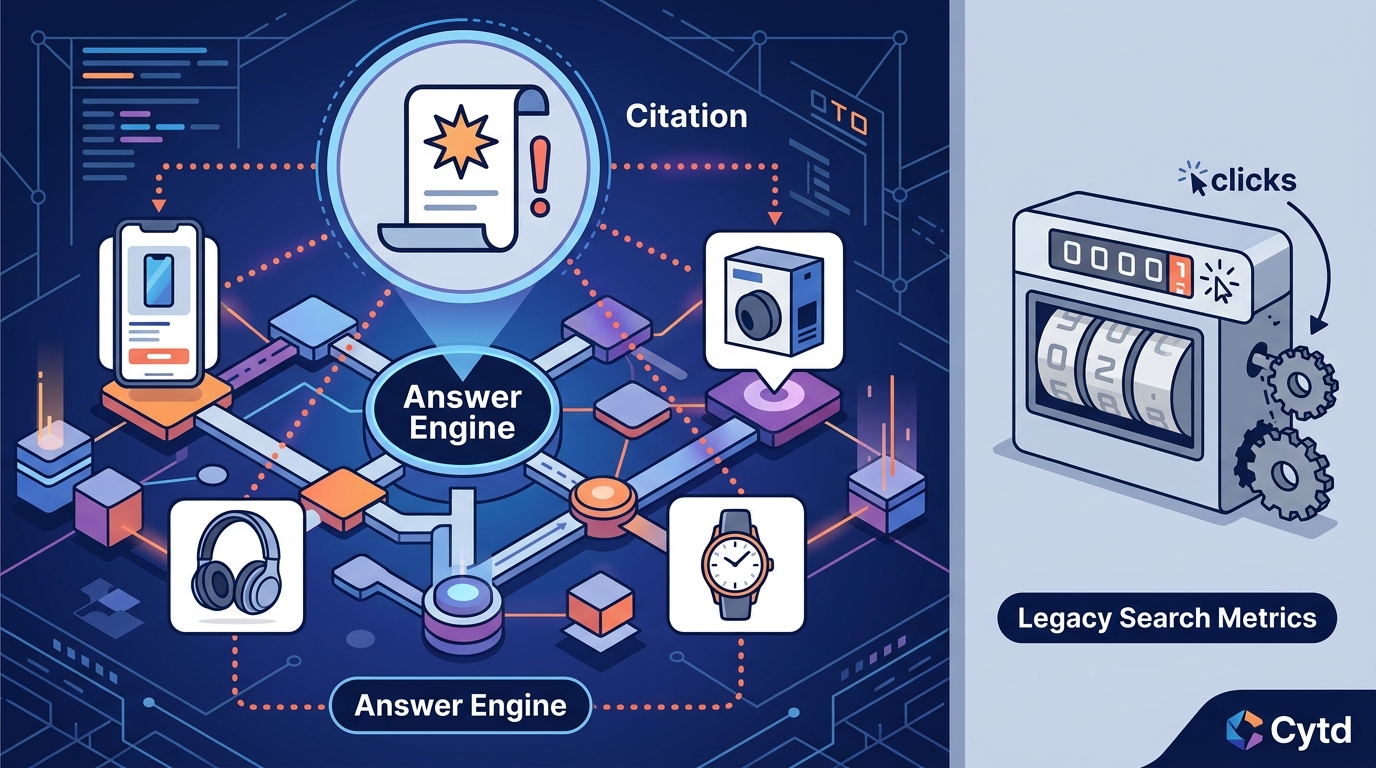
Traditional SEO vs. Generative Engine Optimization
Generative Engine Optimization (GEO) is the practice of structuring content so that AI models can easily parse, extract, and reference it. While traditional SEO optimizes for search engine crawlers and ranking algorithms, GEO optimizes for AI models that synthesize information and deliver direct answers.
| Dimension | Traditional SEO | Generative Engine Optimization (GEO) |
|---|---|---|
| Primary goal | Rank on results page | Get cited inside AI answers |
| Key metrics | Rankings, CTR, impressions | Citation rate, mention frequency, sentiment |
| Content format | Keyword-optimized pages | Structured, extractable, answer-ready content |
| Authority signals | Backlinks, domain authority | Entity authority, third-party mentions, schema |
| Update frequency | Periodic refreshes | Quarterly minimum to maintain citations |
| Measurement tools | Google Analytics, Search Console | AI visibility platforms |
Google's own May 2026 optimization guide confirms that AI features are rooted in core search ranking and quality systems, but the mechanism has shifted from clicks and links to citations and source selection. Both disciplines now work together, and Cytd's complete guide to AI visibility explains how to unify them.
Six Factors That Determine AI Citation
According to research from Onely, six interconnected factors determine whether AI systems cite your brand: retrieval-ready content structure, platform-specific optimization, entity signal strength, technical infrastructure performance, third-party citation presence, and measurement infrastructure.
Third-Party Credibility Is Essential
About 85% of brand mentions in AI answers originate from third-party pages rather than owned domains, according to the AirOps 2026 State of AI Search report. Community platforms like Reddit and YouTube account for roughly 48% of citations. This means building off-site credibility through PR, reviews, community engagement, and earned media is not optional.
Freshness and Structured Data
Pages not updated quarterly are 3x more likely to lose citations. Sequential headings and rich schema correlate with 2.8x higher citation rates. Brands earning both mentions and citations show a 40% higher likelihood of reappearing across consecutive AI answers. You can explore how LLM citation patterns work to understand what drives these signals.
How to Optimize Content for AI Engines
Content optimized for answer engines earns significantly more AI citations than traditional SEO content. Here is what works:
Structure for Extraction
Write direct answers near the top of each section. Use descriptive headings that mirror how users phrase questions. Implement structured data markup where applicable. Make factual claims that AI models can confidently attribute to your brand. Cytd's content optimization resource provides a detailed framework.
Build Entity Authority
Entity authority is the strength and consistency of signals that help AI models recognize your brand as a distinct, credible entity. Entity-optimized brands see up to 70% more accurate AI-generated descriptions. Without clear entity signals, AI systems may confuse similar brand names or fail to recognize your brand as relevant.
Optimize Per Platform
Each AI engine evaluates content differently. Perplexity favors fresh content and always provides inline citations. ChatGPT holds dominant market share but cites inconsistently. Google AI Overviews weight semantic completeness heavily. Tailoring your approach to each platform maximizes your total citation surface area.
Measuring and Tracking AI Visibility
AI citation visibility is the frequency and accuracy with which AI models reference your brand in their generated responses. You cannot improve what you do not measure. Traditional analytics tools were not designed for zero-click environments, so purpose-built AI visibility platforms are essential.
Key capabilities to look for include citation tracking across multiple AI models, prompt-level insights showing which queries trigger your brand mentions, source attribution connecting mentions to specific content, and sentiment analysis revealing how your brand is portrayed. Understanding your AI visibility score is the starting point for any optimization effort.
Re-benchmark at least quarterly because AI models and answer algorithms update frequently, altering visibility and accuracy scores. Only 30% of brands stay visible from one AI answer to the next, making continuous monitoring critical.
Key Takeaways
- AI visibility measures how often your brand is cited in AI-generated answers, not just where it ranks on a search page.
- Zero-click searches are projected to reach 65% of all queries in 2026, making AI citation the primary discovery channel.
- LLM-referred traffic converts at 30-40%, far exceeding traditional organic search conversion rates.
- Third-party content drives roughly 85% of brand mentions in AI answers; off-site credibility is essential.
- Content must be structured for extraction with clear headings, direct answers, and schema markup to earn citations.
- Each AI platform (ChatGPT, Perplexity, Google AI Overviews, Grok) requires a tailored optimization approach.
- Continuous measurement with a dedicated AI visibility platform like Cytd is non-negotiable for sustained results.
Frequently Asked Questions
What is AI visibility in SEO?
AI visibility in SEO refers to how often and how prominently your brand or content appears in AI-generated responses from platforms like ChatGPT, Google AI Overviews, and Perplexity. It measures citation frequency, accuracy, and sentiment rather than traditional page rankings.
How is GEO different from traditional SEO?
Traditional SEO focuses on ranking in search engine results pages through keywords and backlinks. GEO focuses on getting your content cited inside AI-generated answers by making it structured, extractable, and authoritative. Both are important and increasingly interconnected.
Why is third-party content so important for AI visibility?
AI models draw approximately 85% of brand mentions from third-party sources like review sites, forums, and news publications. Building a presence on these platforms through PR, community engagement, and earned media directly increases your chance of being cited.
How often should I update content for AI visibility?
At minimum, update your key content quarterly. Research shows pages not refreshed quarterly are 3x more likely to lose AI citations. For competitive categories, monthly updates may be necessary.
Which AI platforms should I prioritize?
ChatGPT and Google AI Overviews currently drive the highest downstream conversions, making them priority channels. Perplexity is the most accessible for niche sites. Your priority should align with where your audience is conducting research.
Can I measure AI visibility with traditional SEO tools?
No. Traditional SEO tools track rankings, backlinks, and organic clicks. AI visibility requires specialized platforms that monitor citation frequency, prompt-level data, and sentiment across multiple AI models. Explore top AI visibility tools for options.
How long does it take to improve AI visibility?
Most brands see measurable citation rate improvements within 60 to 90 days of implementing a structured optimization strategy, though results vary by category competitiveness and starting baseline.
Does my brand need to be on Wikipedia for AI visibility?
Wikipedia is the most cited source in ChatGPT, but it is not the only path. A strong presence across review platforms, industry publications, and community forums can collectively build the entity authority AI models need to cite your brand confidently.
Start Improving Your AI Visibility Today
The gap between brands that invest in AI visibility and those that do not is widening every day. The first step is understanding where you stand right now. Book a setup call with Cytd to measure your current AI citation visibility across ChatGPT, Google AI, Grok, and other answer engines, and get a clear roadmap for improvement.