
AI-powered search engines now influence how millions of buyers discover brands every day. As of March 2026, 65.07% of Google search results pages include AI Overviews, up from just 25% in August 2024. With AI-search interactions surging to 30% of total search volume, brands need specialized tools to monitor and improve how they appear in AI-generated answers. This guide breaks down the most effective tools and strategies for improving your AI ranking across ChatGPT, Google AI Overviews, Perplexity, and Grok.
What Is AI Ranking and Why Does It Matter?
AI ranking is the measure of how prominently and accurately a brand appears within responses generated by AI search engines and large language models. Unlike traditional search rankings that display a list of blue links, AI systems synthesize information and present a single narrative answer to users.
Generative Engine Optimization (GEO) is the practice of optimizing content to appear in AI-generated responses from platforms like Google AI Overviews, ChatGPT, Claude, and Perplexity. It extends traditional SEO by addressing how large language models evaluate, select, and cite sources.
The business impact is significant. In 2024, 60% of Google searches ended on the results page without a click-through. Brands that are invisible in AI answers risk losing an entire channel of customer discovery. Understanding your AI visibility score is the first step toward fixing that gap.
Dedicated AI Visibility Platforms
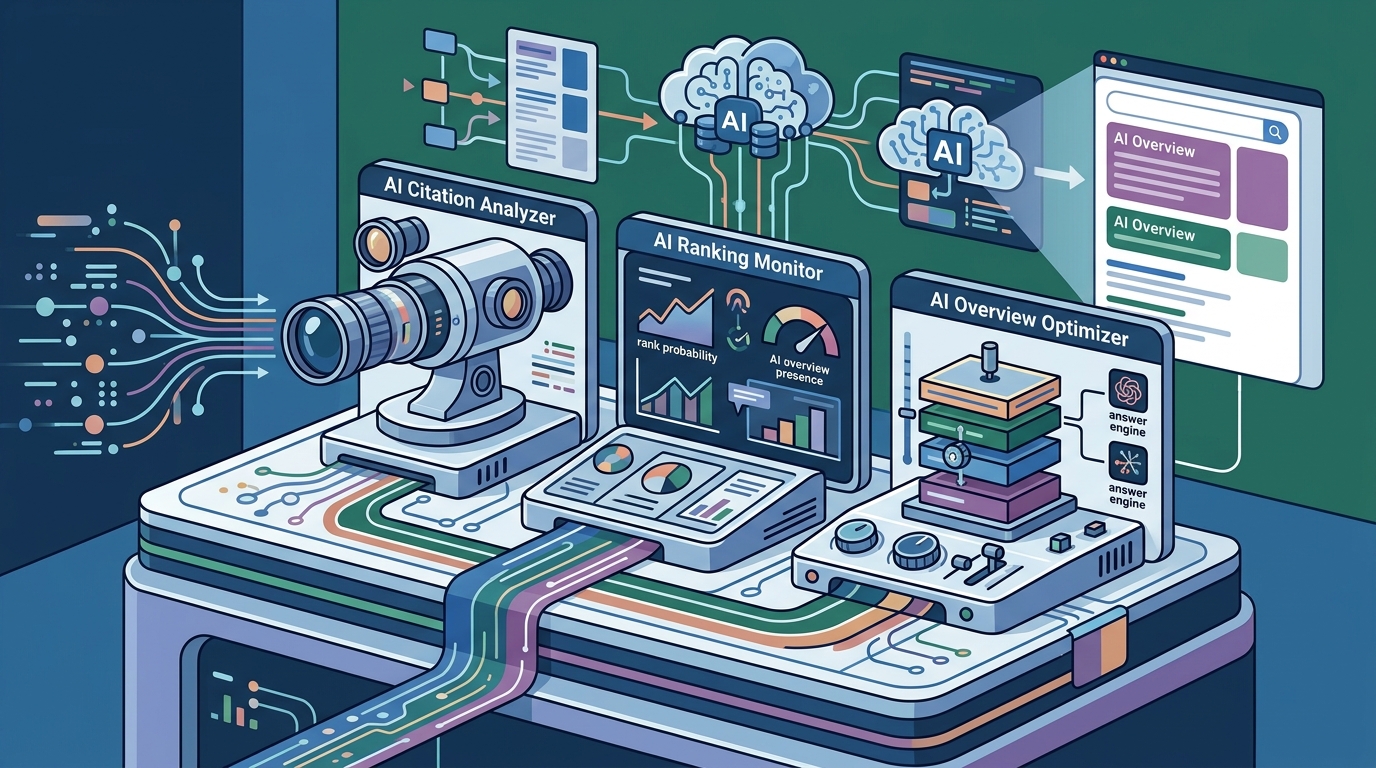
A growing category of purpose-built tools focuses exclusively on AI search visibility. These platforms track whether your brand is mentioned, cited, or recommended inside AI-generated answers.
Cytd
Cytd helps brands measure and improve AI citation visibility and ranking potential across ChatGPT, Google AI, Grok, and other answer engines. It combines monitoring with actionable optimization recommendations, making it a strong fit for teams that want to close the gap between tracking and improvement. Explore their complete guide to AI visibility to see the full methodology.
Profound
Profound is a well-funded enterprise platform that offers prompt-based visibility tracking, citation analysis, and agent analytics. It recently introduced benchmarking features that let customers compare their AI citation performance against peers.
Peec AI
Peec AI is one of the stronger specialist platforms in the category, built specifically for tracking how brands appear across AI answer engines including ChatGPT, Perplexity, and Gemini. It is best suited for marketing teams and agencies wanting a dedicated analytics platform.
Traditional SEO Suites With AI Add-Ons
Major SEO platforms have begun integrating AI visibility tracking into their existing toolkits. This approach works well for teams already invested in a particular ecosystem.
SE Ranking
SE Ranking has expanded from traditional rank tracking into AI search visibility. Its AI Tracker provides monitoring of brand mentions, linked citations, and positioning within AI-generated answers. However, AI tracking may not be included in every plan, so verify coverage before purchasing.
HubSpot AEO
HubSpot offers a free AEO Grader that sends your brand information to ChatGPT, Perplexity, and Gemini to evaluate how each model characterizes your brand. For ongoing monitoring, HubSpot AEO is available at $50/month or included in Marketing Hub Pro and Enterprise.
Content Optimization Tools for GEO
Appearing in AI answers requires more than monitoring. Your content needs to be structured so that answer engines can accurately extract, chunk, and cite it. Understanding LLM citation patterns helps you create content that AI models are more likely to reference.
Key optimization strategies include publishing case studies with measurable outcomes, maintaining consistent messaging across owned and third-party channels, and structuring content with clear definitions and data points. Learn more about content optimization for AI visibility on the Cytd resource hub.
Fresh, experience-driven content consistently outperforms keyword-stuffed alternatives. Research shows that 97.4% of AI citations come from non-Tier-1 media such as Reddit threads, niche YouTube videos, and LinkedIn posts, not major publications. Building a diverse content footprint across these channels is essential for earning AI citations through backlinks.
Why Measurement Comes First
You cannot improve what you cannot measure. AI visibility metrics track how accurately and frequently a brand is cited within generative AI answers, which differs fundamentally from traditional SEO metrics like rank positions and organic clicks.
Answer Engine Optimization (AEO) is the discipline of measuring how often and how prominently AI systems cite a brand in their generated responses. It has become the primary benchmark for digital discoverability in 2026.
Experts recommend re-benchmarking at least quarterly because AI models and answer algorithms update frequently, altering visibility scores. Cytd's State of AI Search report provides updated benchmarks you can use to compare your performance against industry averages.
Tool Comparison Table
| Tool | Type | AI Platforms Tracked | Best For | Starting Price |
|---|---|---|---|---|
| Cytd | AI Visibility Platform | ChatGPT, Google AI, Grok, others | Brands wanting measurement + optimization | See pricing page |
| Profound | Enterprise AI Analytics | ChatGPT, Google AI Overviews, Perplexity | Large enterprises with deep budgets | Custom |
| Peec AI | AI Search Analytics | ChatGPT, Perplexity, Gemini | Agencies and marketing teams | Varies by prompt volume |
| SE Ranking | SEO Suite + AI Add-On | AI Overviews, ChatGPT | Teams already using SE Ranking | Add-on pricing |
| HubSpot AEO | AEO Monitoring | ChatGPT, Perplexity, Gemini | Marketing Hub users | Free grader / $50/mo monitoring |
| Writesonic GEO | Content + AI Tracking | Multiple AI platforms | Content teams using Writesonic | $249/mo (Professional) |
Key Takeaways
- AI search now accounts for 30% of total search volume, making AI ranking tools essential for brand visibility.
- 65% of Google SERPs feature AI Overviews as of March 2026, up from 25% in August 2024.
- Dedicated AI visibility platforms like Cytd provide both measurement and optimization in one workflow.
- Traditional SEO suites are adding AI tracking, but coverage and pricing vary widely across plans.
- 97.4% of AI citations come from non-Tier-1 media, so diversifying your content footprint matters more than chasing major publications.
- Content structured with clear definitions, data points, and entity clarity is more likely to be cited by AI models.
- Re-benchmark your AI visibility at least quarterly to keep pace with model updates.
Frequently Asked Questions
What is an AI rank tracker?
An AI rank tracker is a specialized software tool that monitors how often and how prominently a brand appears in responses generated by AI search engines like ChatGPT, Perplexity, and Google AI Overviews. Unlike traditional trackers that measure position in a list of links, these tools evaluate conversational prompts to see if a brand is mentioned or recommended.
How is AI ranking different from traditional SEO ranking?
Traditional SEO focuses on optimizing content for keyword matching and backlink volume to rank in blue links. AI ranking measures whether your brand is cited, recommended, or referenced within synthesized AI responses. The key difference is that SEO drives website traffic while AI ranking shapes how AI represents your brand when buyers skip search entirely.
What is Generative Engine Optimization (GEO)?
GEO is the practice of optimizing content to appear in AI-generated responses. It extends traditional SEO by addressing how large language models evaluate, select, and cite sources rather than just how search engines crawl and index pages.
How can I check my brand's AI visibility for free?
HubSpot offers a free AEO Grader that evaluates your brand across ChatGPT, Perplexity, and Gemini. You can also start with Cytd's getting started guide to understand the fundamentals of AI visibility measurement.
How often should I track AI rankings?
Experts recommend re-benchmarking at least quarterly. AI models update frequently and URLs inside AI Overviews change often, so continuous monitoring gives a more accurate picture of your visibility trends.
Do backlinks still matter for AI visibility?
Yes. While the mechanism differs from traditional SEO, authoritative backlinks and third-party mentions signal credibility to AI models. Content from diverse sources including Reddit, LinkedIn, and niche publications contributes significantly to AI citations. Read more about how backlinks influence AI citations.
Which AI platforms should I prioritize for tracking?
ChatGPT and Google AI Overviews currently drive the highest downstream conversions, making them the priority channels. However, tracking across Perplexity, Gemini, Grok, and Claude provides a more complete picture of your AI presence.
Can one tool handle both measurement and optimization?
Some platforms focus only on monitoring (read-only), while others offer both tracking and actionable optimization workflows (read/write). Cytd is designed to handle both measurement and improvement, helping brands close the loop between discovery and action.
Start Improving Your AI Visibility Today
AI ranking is no longer optional. Brands that measure and optimize their AI visibility now will compound their advantage as answer engines become the default discovery layer. The first step is understanding where you stand.
Book a free setup call with Cytd to benchmark your brand's AI visibility across ChatGPT, Google AI, Grok, and more. Get a clear picture of where you rank today and a roadmap for improvement.