
AI Ranking Tools: What Works for Better AI Visibility in 2026
Traditional search rankings no longer tell the full story. With AI-powered answer engines like ChatGPT, Google AI Overviews, Perplexity, and Gemini reshaping how buyers discover brands, a new category of tools has emerged to help you measure and improve your visibility inside AI-generated responses. Answer Engine Optimization (AEO) is the practice of structuring and distributing content so that AI platforms extract, cite, and recommend your brand in generated responses. This guide breaks down the most effective tools for improving your AI ranking, what features to prioritize, and how to build a strategy that gets your brand cited where it matters most.
Why AI Ranking Matters More Than Ever
The shift from link-based search to AI-generated answers is accelerating. According to recent industry data, ChatGPT alone accounts for roughly 19.5% of global search traffic, and AI search visitors convert at 14.2%, which is five times higher than traditional organic search. These numbers make AI visibility a revenue concern, not just a marketing curiosity.
The core problem is straightforward: what ranks in traditional search does not reliably predict what gets cited in AI answers. Research from Contently found that only 12% of URLs cited by ChatGPT rank in Google's top 10. That gap is exactly why specialized AI ranking tools exist.
Key Features to Look for in AI Ranking Tools
Not every tool calling itself an AEO platform delivers the same value. When evaluating options, focus on capabilities that connect visibility data to action. A good AEO tool in 2026 should include:
Multi-Engine Coverage
The minimum bar is tracking ChatGPT, Perplexity, Google AI Overviews, and Gemini. These four cover the large majority of AI-influenced buyer journeys. Tools that also monitor Copilot, Grok, and Claude provide a more complete picture, especially for enterprise and technical audiences.
Citation and Sentiment Analysis
Citation frequency is table stakes. What matters more is whether those citations are positive, accurate, and relevant to the buyer's question. Look for tools that surface sentiment trends and source attribution alongside raw mention counts.
Content Optimization Guidance
The best platforms do not stop at dashboards. They recommend specific content changes, whether that means adding answer blocks, restructuring headings, or creating new pages to fill content gaps that AI models have identified.
Top Tools for Improving AI Visibility
Here are the most effective categories of tools brands are using in 2026 to improve their AI ranking and citation rates.
AI Visibility Measurement Platforms
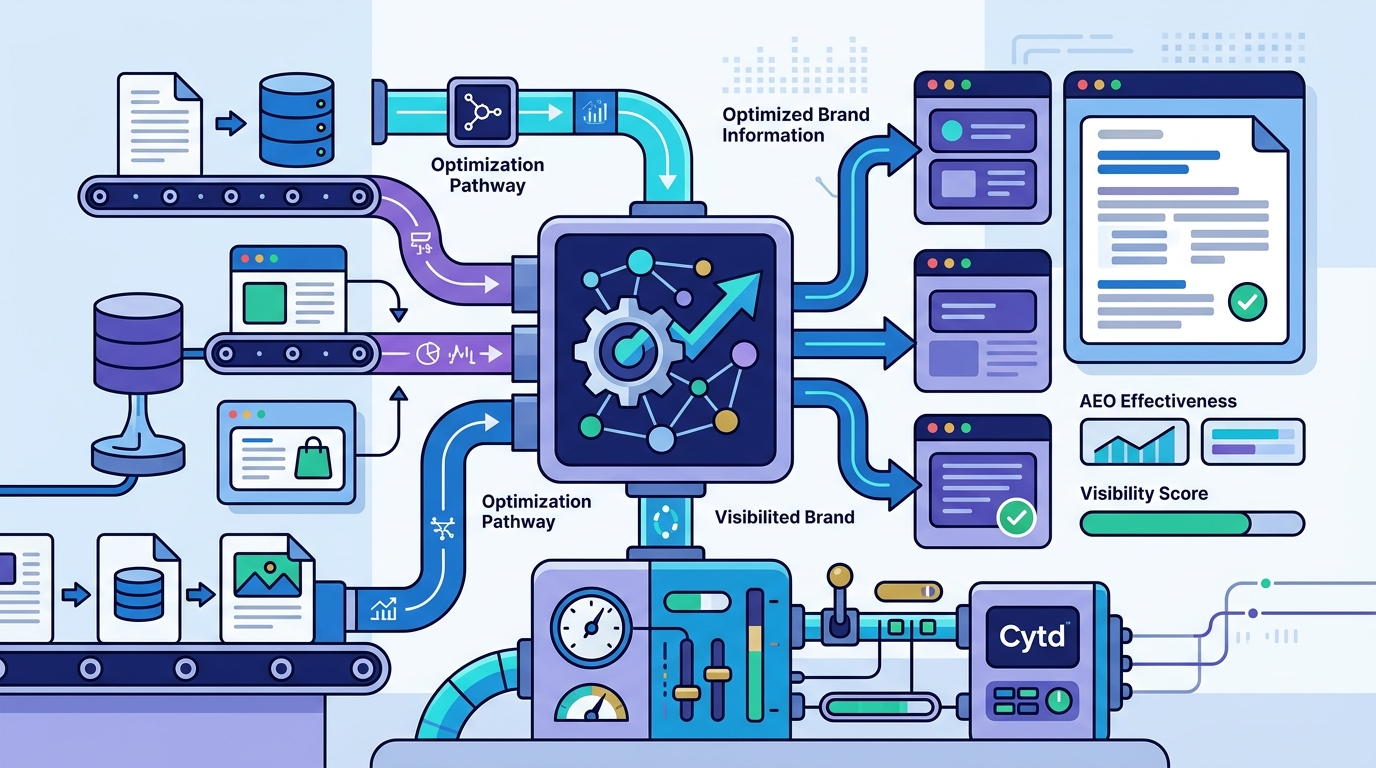
Cytd is a purpose-built AI visibility measurement platform that helps brands track and improve how they appear across ChatGPT, Google AI, Grok, and other answer engines. It connects citation tracking with actionable optimization insights, making it ideal for brands that want both monitoring and a clear path to improvement. You can explore how scoring works in Cytd's guide to understanding your AI visibility score.
AI Search Monitoring Tools
Platforms like Profound track brand mentions across 10+ AI engines including ChatGPT, Claude, Perplexity, and Google AI Overviews. These tools are designed for growth and enterprise teams that need detailed analytics on citation patterns, prompt volumes, and competitive positioning.
Content-Side Optimization Tools
Tools like MarketMuse and Writesonic GEO approach AEO from the content creation side. They help teams identify topical gaps, generate answer-first content, and score content for AI readability before publishing.
Tool Comparison Table
| Tool Category | Primary Strength | AI Engines Covered | Best For |
|---|---|---|---|
| Cytd | AI visibility measurement and improvement | ChatGPT, Google AI, Grok, and more | Brands wanting measurement + optimization |
| Profound | Comprehensive AI search monitoring | 10+ engines including GPT-5.2 | Enterprise teams needing deep analytics |
| HubSpot AEO Grader | Free brand visibility snapshot | ChatGPT, Perplexity, Gemini | Initial audits and quick assessments |
| MarketMuse | Topical authority and content planning | Indirect (content optimization) | Editorial teams building authority |
| Nightwatch | Generative rankings tracking | Multiple AI models | Teams bridging SEO and AEO |
| Writesonic GEO | Content generation with AEO scoring | Indirect (content optimization) | Agencies scaling content production |
Content Optimization for AI Citations
Tools alone will not improve your AI ranking. Content structure is the foundation. AI answer engines care about whether your page directly resolves what someone asked, not about clever intros or keyword density. Structural changes like adding FAQ sections, cleaner heading hierarchies, and direct answer blocks can appear in AI citations within weeks once pages are recrawled.
Understanding how LLMs decide which sources to cite is critical for any optimization effort. The patterns differ significantly from traditional SEO signals, and brands that study these patterns gain a measurable advantage. For a deeper dive into why some content fails to earn AI citations, Cytd's analysis on why content fails in AI search offers practical diagnostics.
Generative Engine Optimization (GEO) is a related discipline that focuses on establishing credibility through authoritative voice and enriched, real-time data. Together, AEO and GEO form the strategic framework for AI-era visibility.
Measuring Your AI Visibility Score
An AI visibility score is a composite metric that quantifies how often and how favorably your brand appears in AI-generated responses. Unlike traditional rank tracking, it accounts for mention frequency, sentiment, citation accuracy, and competitive share of voice.
Cytd provides a complete guide to AI visibility that walks teams through benchmarking, tracking, and improving their scores over time. Measurement should happen at least weekly, since AI answers can shift rapidly as models update their training data and retrieval sources.
The role of backlinks is also evolving. While traditional link authority still carries weight, the relationship between backlinks and AI citations follows different patterns. Cytd's research on backlinks for AI citations explains what matters in the new landscape.
Key Takeaways
- AI ranking tools are now essential because AI search visitors convert at 5x the rate of traditional organic visitors.
- Only 12% of URLs cited by ChatGPT rank in Google's top 10, so traditional SEO alone is insufficient.
- Effective AEO tools must cover at least ChatGPT, Perplexity, Google AI Overviews, and Gemini.
- Citation sentiment and accuracy matter more than raw mention count.
- Content structure, including answer blocks, FAQ sections, and clean heading hierarchies, directly influences AI citation rates.
- Measurement platforms like Cytd connect visibility tracking with actionable optimization guidance.
- Quarterly content refreshes help maintain AI visibility as models update their knowledge sources.
Frequently Asked Questions
What is an AI ranking tool?
An AI ranking tool is software that tracks how your brand appears in AI-generated answers across platforms like ChatGPT, Gemini, and Perplexity. It measures citation frequency, sentiment, and competitive positioning to help you improve your visibility.
How is AEO different from traditional SEO?
SEO targets rankings in a list of links, while AEO targets presence inside synthesized answers that often replace those links entirely. The measurement methods, optimization tactics, and success metrics are fundamentally different.
What AI engines should I track?
At minimum, track ChatGPT, Perplexity, Google AI Overviews, and Gemini. For enterprise and technical audiences, add Copilot, Grok, and Claude to get a more complete picture.
Can I improve AI rankings without specialized tools?
Manual tracking is possible for initial audits but cannot replace systematic monitoring at any meaningful scale. Specialized platforms provide the data consistency and competitive benchmarking needed for ongoing strategy.
How quickly do content changes affect AI citations?
Structural improvements to existing pages, such as adding answer blocks and cleaner heading hierarchies, can appear in AI citations within a few weeks once the page is recrawled by AI systems.
What is an AI visibility score?
An AI visibility score is a composite metric that evaluates how often your brand is mentioned, cited, and recommended across AI answer engines. It typically factors in sentiment, presence quality, share of voice, and competitive positioning.
Do backlinks still matter for AI visibility?
Backlinks remain a trust signal, but their influence on AI citations follows different patterns than traditional SEO. AI models weigh source authority, content clarity, and topical relevance in ways that do not directly mirror PageRank-style link metrics.
Get Started with AI Visibility
The brands investing in AI visibility now will capture disproportionate attention as AI search grows. The first step is understanding where you stand today. Book a setup session with Cytd to benchmark your AI visibility score, identify citation gaps, and build a data-driven plan for improving your brand's presence across every major answer engine.