
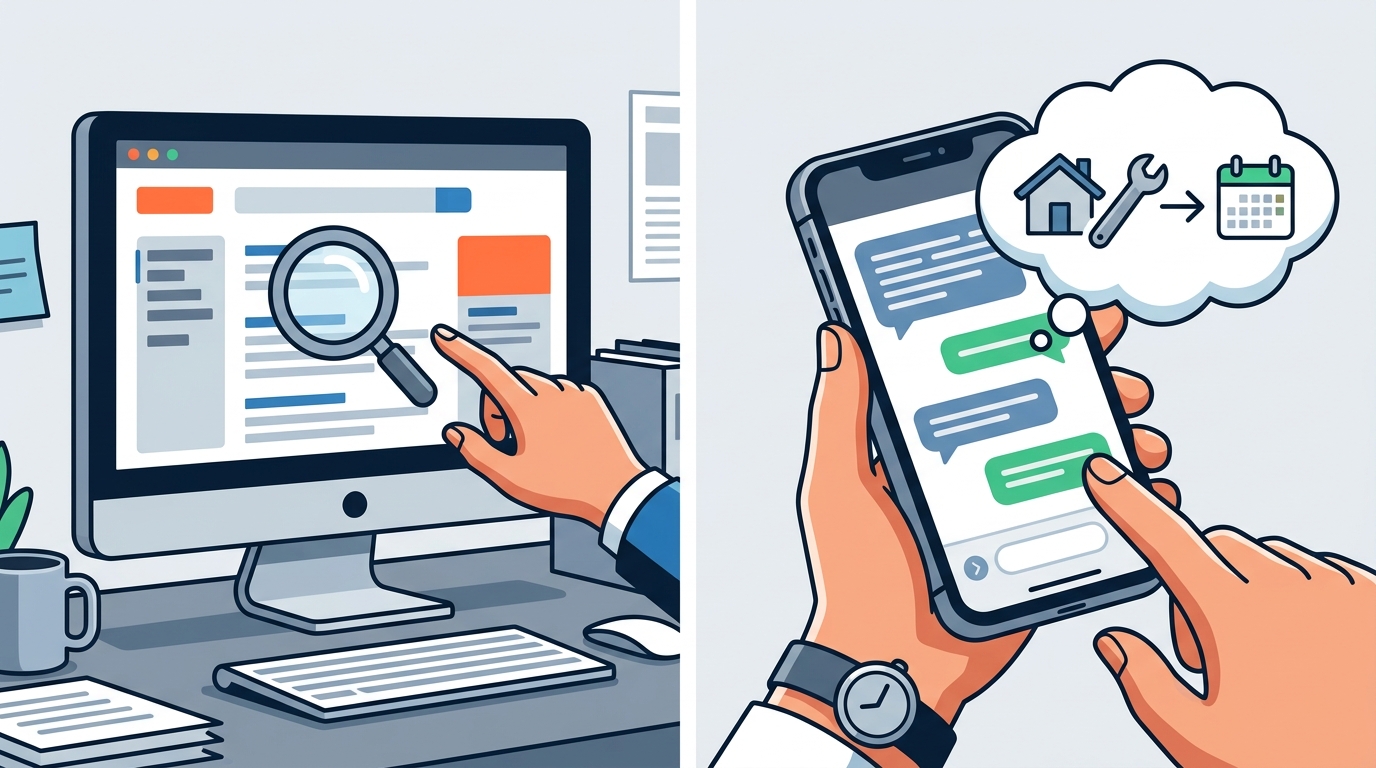
A homeowner needs a plumber. Five years ago, she would have Googled it. Today, she opens ChatGPT, types "best plumber in my area with same-day availability," and gets a single name with a brief explanation of why it was chosen. No ads, no map pack, no ten blue links. If your business wasn’t the one named, you never even knew you lost the lead.
This scenario is no longer hypothetical. AI-powered search is reshaping how customers discover local businesses at a pace that has surprised even seasoned marketers. Here’s what the data says—and what local operators should do about it right now.
The Numbers Behind the Shift
The adoption curve for AI-assisted local discovery has been historic. According to BrightLocal’s 2026 Local Consumer Review Survey, 45% of consumers have used AI tools like ChatGPT, Gemini, or Perplexity to find local business recommendations in the past year—up from just 6% in 2025. That is a seven-fold increase in twelve months, a channel shift without modern precedent.
Meanwhile, Gartner predicts that traditional search volume will drop 25% by 2026 as users migrate to AI assistants. Google’s own share of local discovery has already slipped from 83% to 71% year over year. The traffic is not vanishing; it is relocating.
The age group driving this adoption fastest? Adults aged 30–44 are leading at 64%, which is also the demographic most likely to book home services, schedule medical appointments, and hire professional contractors.
Why Google Rankings Alone No Longer Guarantee Visibility
One of the most important findings in 2026 local search research is the disconnect between traditional Google rankings and AI recommendations. According to the SOCi Local Visibility Index, less than half of businesses that lead in Google local search results also appear in AI local recommendations. More than half of the businesses winning the Google map pack are completely absent from AI answers.
The reason is structural. Google’s Local Pack relies on proximity, Google Business Profile signals, and backlinks. ChatGPT, on the other hand, runs its web search on Bing’s index, synthesizes information from Yelp, TripAdvisor, BBB, and your website, and makes a recommendation based on aggregated third-party trust signals. These are overlapping but fundamentally different systems.
A study found that ChatGPT recommends a specific local business only about 1.2% of the time for relevant queries, compared to Google’s Local Pack appearing roughly 35.9% of the time. That makes every AI mention significantly more valuable—and significantly harder to earn.
How ChatGPT Actually Finds Local Businesses
Understanding the mechanics is essential before jumping into tactics. ChatGPT’s web search capability is now enabled by default for most users. When someone asks it for a local recommendation, it performs a real-time web search rather than relying solely on training data.
The critical difference: ChatGPT’s search runs on Bing’s index, not Google’s. OpenAI’s search partnership is with Microsoft. That means many local businesses that have never optimized for Bing are invisible to the platform their customers are increasingly using.
ChatGPT also relies heavily on what others say about you. Over 65% of citations in AI responses come from third-party sources like Reddit, Quora, industry publications, and review aggregators. Your own website matters, but external validation matters more.
ChatGPT Search shows business websites for 58% of its local search sources, followed by business mentions at 27% and online directories at 15%. The combination of your owned web presence and your earned media footprint determines whether you surface.
The Five Pillars of Local AI Visibility
Based on current research and what platforms actually reward, here are the five areas local businesses should focus on:
1. Claim and Complete Your Bing Places Listing
Since ChatGPT queries Bing, your Bing Places profile is now as important as your Google Business Profile for AI visibility. Verify your listing, match categories exactly, and keep hours and service descriptions current. Many local businesses have never touched their Bing Places listing—that is a missed opportunity in 2026.
2. Build Third-Party Mentions on Expert-Curated Lists
According to local search ranking factor research, the top influences on local AI search visibility are presence on expert-curated “Best Of” lists, dedicated pages for each service, and prominence on key industry-relevant domains. Pitch yourself to local media outlets, niche blogs, and industry directories that regularly publish recommendation content.
3. Diversify Your Review Footprint Beyond Google
ChatGPT does not appear to have direct access to your Google reviews. It pulls from Bing-indexed web results, Yelp, Foursquare, BBB, and industry directories. A business with 4.8 stars on Yelp and 200 reviews will be surfaced more confidently than one with a sparse presence outside of Google. Google review usage itself dropped from 83% to 71%, so diversification is also a consumer trust play.
4. Implement Structured Data and LocalBusiness Schema
Local schema markup, structured FAQs, and review-rich content give AI systems the specific, extractable details they need to cite a business by name. Use Organization, Product, LocalBusiness, and FAQ schema to provide a structured map that LLMs can parse with high confidence.
5. Publish Fresh, Location-Specific Content Weekly
Content freshness is a significant signal for AI retrieval. Businesses that publish new, structured content weekly—via GBP posts, blog updates, or FAQ additions—maintain higher AI search visibility than businesses that update content quarterly. Create content addressing specific problems your industry solves in your service area rather than generic service pages.
The Accuracy Problem—and Why It Creates Opportunity
AI local search is not without its flaws. While Google Maps maintains near 100% accuracy for business hours and locations, ChatGPT’s business profile information has been measured at roughly 68% accuracy. Because it synthesizes data from multiple, sometimes conflicting, web sources, it can generate incorrect hours or even reference closed locations.
For proactive businesses, this is actually an advantage. When your information is consistent across every directory, review site, and your own website, AI tools can reliably identify and recommend you while competitors with inconsistent data get filtered out. NAP (name, address, phone) consistency is no longer just a local SEO best practice—it is the foundation of AI trust.
What About Google AI Overviews?
While ChatGPT gets the headlines, Google’s own AI features are equally transformative for local businesses. AI Overviews grew from roughly 8% to 40% of local searches across 2025, reaching up to 68% of local queries in 2026. Google announced at I/O 2026 that AI Mode passed 1 billion monthly users.
Google’s AI Overviews draw heavily from your Google Business Profile, Merchant Center feeds, and your site’s organic ranking signals. A complete, accurate Google Business Profile remains the backbone of local AI visibility, but it now needs to work for AI retrieval systems, not just the traditional Maps pack.
The 88% Gap: Why Acting Now Is a Competitive Advantage
Here is the most striking statistic of all: 88% of local businesses have no active strategy to appear in AI search results. The gap between how customers are searching and how businesses are optimizing represents the defining local marketing opportunity of 2026.
The businesses winning are not necessarily the biggest or the best-funded. They are the ones that have made themselves understandable and trustworthy across multiple platforms. The local brands that are easiest to understand are easiest for assistants to recommend.
Tools like Cytd help brands measure and improve their AI visibility, tracking how AI models view your business and identifying the specific actions needed to move from invisible to recommended. Rather than guessing whether ChatGPT or Google AI knows about your business, you can see exactly where you stand and what to fix.
Key Takeaways
- 45% of consumers now use AI tools for local business discovery—up from 6% a year ago.
- More than half of Google Map Pack winners are absent from AI recommendations. The two systems require separate optimization.
- ChatGPT searches Bing, not Google. Your Bing Places listing and third-party review profiles now directly impact AI visibility.
- Third-party mentions, “Best Of” lists, and diversified reviews matter more than your own website copy in AI citation decisions.
- 88% of local businesses have no AI search strategy—early movers have a significant window of advantage.
- Consistent NAP data across all platforms reduces AI hallucination risk and increases recommendation confidence.
Frequently Asked Questions
Does AI search actually matter for local businesses in 2026?
Yes. BrightLocal’s 2026 survey shows 45% of consumers have used AI tools to find local business recommendations, up from 6% the prior year. Gartner predicts traditional search volume will drop 25% as users shift to AI assistants. Ignoring AI search means ignoring nearly half your potential customers.
Does ranking well on Google guarantee I will show up in ChatGPT?
No. Research shows less than half of businesses leading in Google local search also appear in AI recommendations. ChatGPT uses Bing’s index and third-party sources, not Google’s, so separate optimization is required.
How does ChatGPT find and recommend local businesses?
ChatGPT performs real-time web searches using Bing’s index. It pulls from your website, Bing Places listing, review platforms like Yelp and Foursquare, and third-party mentions on industry sites and “Best Of” lists to synthesize a recommendation.
What is the most important thing a local business can do to improve AI visibility?
Ensure your business information is consistent and complete across all platforms—Bing Places, Google Business Profile, Yelp, BBB, industry directories, and your own website. AI systems cross-reference multiple sources, and inconsistency causes them to skip your business entirely.
How long does it take to start appearing in AI search results?
New or refreshed content can begin generating AI citations within 3 to 5 days, but building consistent visibility across multiple AI platforms typically takes 2 to 4 months of sustained effort, similar to traditional SEO timelines.
How can I measure whether AI tools are recommending my business?
You can manually test by asking ChatGPT, Gemini, and Perplexity for recommendations in your service category and area. For ongoing, systematic tracking, platforms like Cytd monitor how AI models view your business and benchmark your visibility against competitors.